

Kente Extension Coal Block Clearance in Hasdeo-Arand Forests
Kente Extension Coal Block Clearance in Hasdeo-Arand Forests
Source: The Indian Express (03-07-2026)
Why in News?
The Ministry of Environment, Forest and Climate Change (MoEFCC) has granted Environmental Clearance (EC) for the Kente Extension Integrated Coal Block in the Hasdeo-Arand forests of Chhattisgarh, permitting coal mining with a capacity of 9 million tonnes per annum (MTPA).
About the Kente Extension Coal Block
- Location: Surguja district, Chhattisgarh.
- Area: 1,760 hectares.
- Production Capacity: 9 MTPA.
- Allocated to: Rajasthan Rajya Vidyut Utpadan Nigam Limited (RRVUNL) in 2015.
- Mine Developer and Operator: Adani Group.
- Coal produced will supply thermal power plants at Chhabra and Suratgarh in Rajasthan.
Approval Process
- In-principle Forest Clearance: Granted on 9 June 2026.
- Environmental Clearance: Granted on 24 June 2026.
- The Expert Appraisal Committee (Coal Mining) had recommended environmental clearance in January 2025.
About Hasdeo-Arand Forests
- Located in northern Chhattisgarh.
- One of the largest contiguous (unfragmented) forest landscapes in Central India.
- Covers approximately 1,502 sq. km of coal-bearing forests.
- Dominated by Sal and Teak forests.
- Acts as the catchment of the Hasdeo River, a major tributary of the Mahanadi.
- Considered the "Green Lungs of Central India."
Ecological Significance
- Home to nearly 640 plant species.
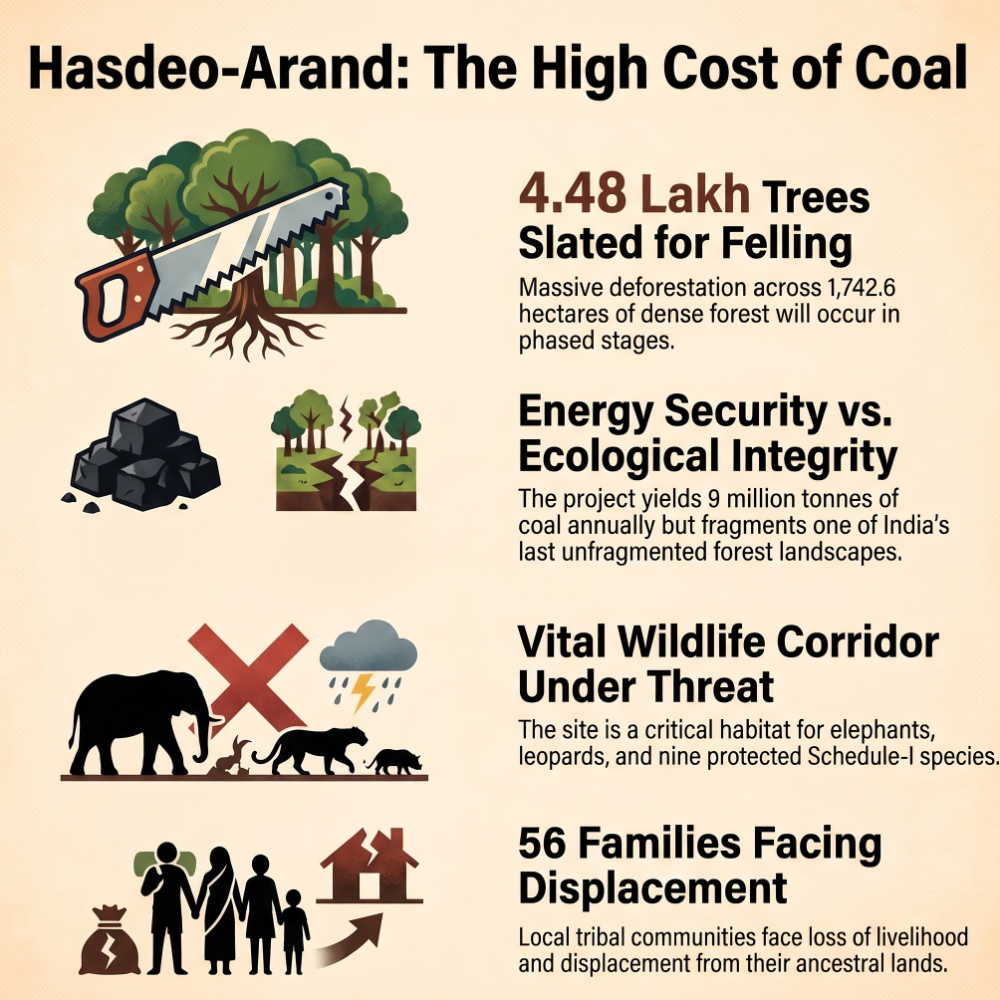
- Habitat of nine Schedule-I wildlife species protected under the Wildlife (Protection) Act, 1972.
- Supports:
- Elephants
- Leopards
- Tigers and other large mammals.
- Serves as an important wildlife corridor for elephant movement.
Biodiversity Concerns
- A 2021 biodiversity assessment by the Wildlife Institute of India (WII) recommended that no new mining should be undertaken in Hasdeo-Arand, except the already operational Parsa East Kente Basan (PEKB) mine.
- The Indian Council of Forestry Research and Education (ICFRE) highlighted:
- Loss of dense forest cover.
- Habitat fragmentation.
- Adverse impacts on biodiversity and wildlife movement.
- Need for stringent environmental safeguards.
Environmental Impact
- Forest land diverted: 1,742.6 hectares.
- Trees proposed for felling: Approximately 4.48 lakh.
- Tree felling to occur in phases:
- Nearly 98,000 trees during the first five years.
- Around 67,414 trees (below prescribed girth) are proposed for transplantation, along with phased felling.
Social Impact
- Around 56 families from Kente, Basan, Chakeri and Parogia villages will be affected.
- Rehabilitation and Resettlement (R&R) to be implemented under the State Government's approved plan.
- Local tribal communities have expressed concerns regarding displacement, livelihood loss and forest rights.
Significance
- Enhances domestic coal production and energy security.
- Supports fuel supply for thermal power generation.
- Contributes to reducing dependence on imported coal.
Challenges
- Diversion of ecologically sensitive forest land.
- Loss of biodiversity and wildlife habitats.
- Human-elephant conflict due to habitat fragmentation.
- Deforestation and carbon emissions.
- Concerns regarding tribal livelihoods and implementation of the Forest Rights Act, 2006.
Way Forward
- Strict compliance with environmental and forest clearance conditions.
- Strengthen biodiversity conservation and wildlife corridor protection.
- Ensure effective implementation of the Forest Rights Act and informed community participation.
- Adopt scientific mine reclamation and compensatory afforestation.
- Accelerate India's transition towards cleaner energy while balancing energy security and ecological conservation.
Conclusion
The Kente Extension project highlights the continuing challenge of balancing energy security with environmental conservation. While domestic coal remains important for India's energy needs, mining in ecologically sensitive landscapes such as Hasdeo-Arand requires rigorous environmental safeguards, protection of biodiversity and respect for the rights of local communities.
