

LAYERED PROCESS TO REMOVE LOK SABHA SPEAKER FROM OFFICE
Morning Standard
Context and Constitutional Setting
The article explains the constitutional and procedural framework governing the removal of the Lok Sabha Speaker. It situates the recent political move within Articles 94 and 96 of the Constitution and the Rules of Procedure of the Lok Sabha. The emphasis is on institutional safeguards designed to protect the dignity and independence of the Speaker’s office.
Key Arguments Presented
Speaker as the custodian of House dignity
The Speaker represents the collective will and dignity of the House, not the executive. Hence, removal is structured as a “resolution” and not an “impeachment.”
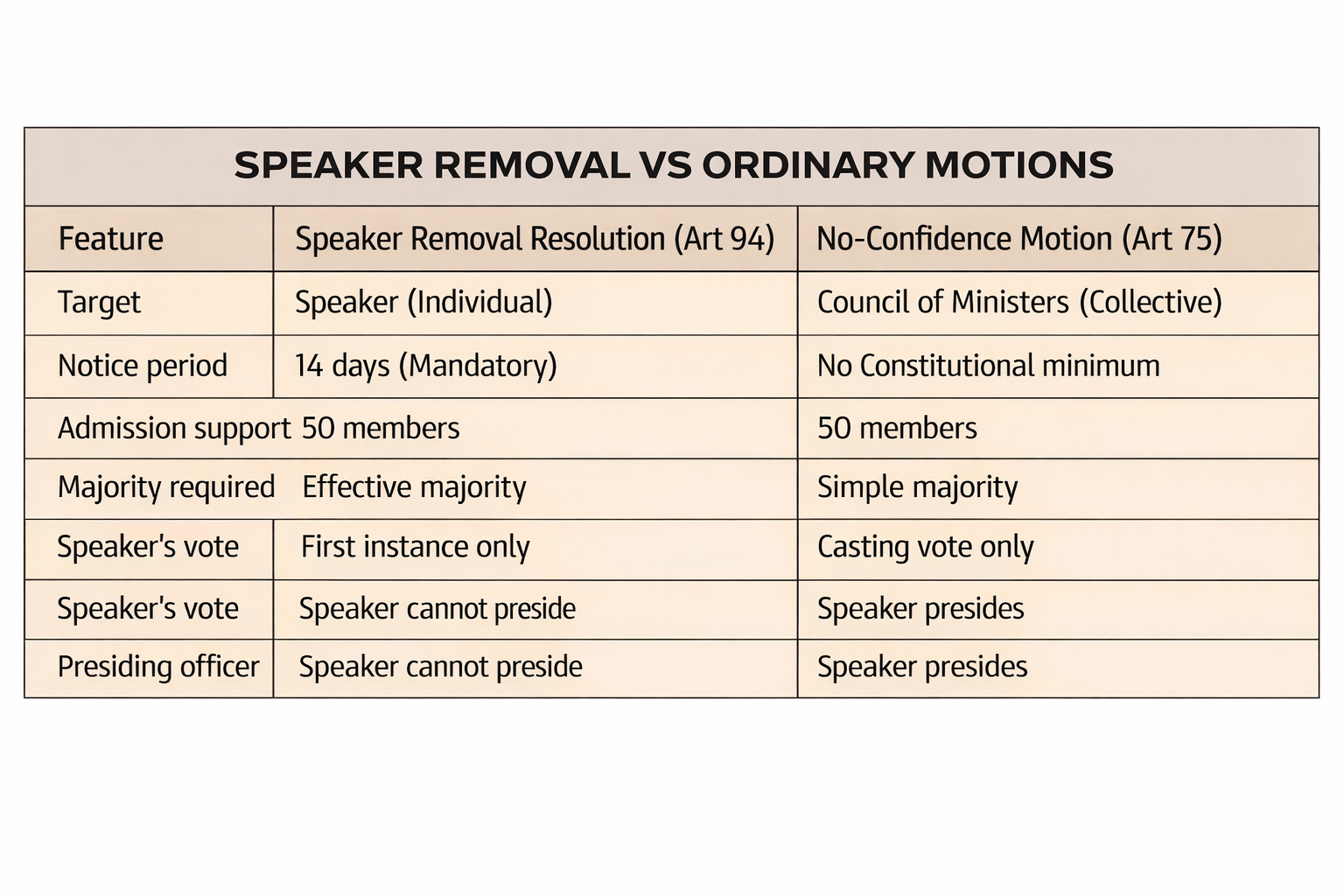
Constitutional safeguards under Article 94
Removal requires:
- A written notice
- A mandatory 14-day notice period
- An Effective Majority of the House
50-member support rule
Before admission, at least 50 members must support the motion. This acts as a preliminary filter against frivolous attempts.
Speaker cannot preside during removal debate
Under Article 96, the Speaker does not preside when a removal motion is under consideration. The Deputy Speaker or another member presides.
Right to participate and vote
The Speaker retains the right to speak and vote in the first instance (unlike normal proceedings where only a casting vote is exercised).
Historical precedents show institutional resilience
Notices were issued against G.V. Mavalankar, Hukam Singh, and Balram Jakhar, but none succeeded. This underlines the high threshold built into the system.
Author’s Stance
The tone is largely explanatory and constitutional. It underscores that the process is deliberately layered to balance two competing principles:
- Accountability of the Speaker
- Independence of the presiding office
The article subtly reinforces the idea that removal should not become a tool of routine political contestation.
Possible Biases
Institutional protection bias
The framing appears sympathetic to preserving institutional sanctity, possibly downplaying the political motivations behind removal attempts.
Procedural emphasis over political context
The focus is more on constitutional design than on the immediate political triggers, limiting discussion on democratic accountability concerns.
Pros and Cons of the Existing Framework
Pros
- Protects Speaker’s independence from partisan pressure
- Prevents frivolous or impulsive removal motions
- Ensures due process through notice and effective majority
- Balances debate rights and neutrality principles
Cons
- High threshold may make accountability difficult
- Effective majority calculation may favour ruling coalitions
- Absence of clearly defined “grounds” allows political interpretation
- Risk of perception of bias if neutrality is questioned
Policy and Constitutional Implications
Institutional Stability vs Political Accountability
The Constitution intentionally avoids specifying grounds for removal, leaving it to the House’s confidence. This reinforces parliamentary supremacy but introduces political subjectivity.
Effective Majority as Democratic Filter
The requirement of an effective majority ensures that only when a clear majority loses faith can removal occur. This prevents instability but may shield incumbents in majoritarian settings.
Comparative Perspective
Unlike impeachment of the President or removal of judges, the Speaker’s removal is less rigid procedurally but politically more dependent on House arithmetic.
Real-World Impact
- Strengthens procedural clarity in times of political confrontation
- Reinforces the dignity of parliamentary offices
- Signals to political actors that removal is constitutionally possible but politically difficult
- Shapes future debates on neutrality of presiding officers
UPSC GS Paper Alignment
GS Paper II – Polity & Governance
- Powers and functions of the Speaker
- Parliamentary procedures and accountability mechanisms
- Balance between independence and responsibility
GS Paper IV – Ethics in Public Life
- Institutional neutrality
- Conflict of interest in constitutional offices
- Ethical conduct in legislative proceedings
Essay Themes
- “Independence of constitutional offices in a majoritarian democracy”
- “Accountability without instability: Designing democratic safeguards”
Balanced Conclusion and Future Perspective
The layered process to remove the Lok Sabha Speaker reflects a carefully crafted constitutional equilibrium. It protects the Chair from transient political pressures while preserving the House’s ultimate authority to withdraw confidence.
In an era of increasing parliamentary polarisation, the durability of this framework will depend less on textual safeguards and more on political culture. The future challenge lies not in redesigning the constitutional process but in strengthening conventions of neutrality and bipartisan respect for institutional offices.
