

Legislative Privileges and Fundamental Rights

Legislative Privileges and Fundamental Rights
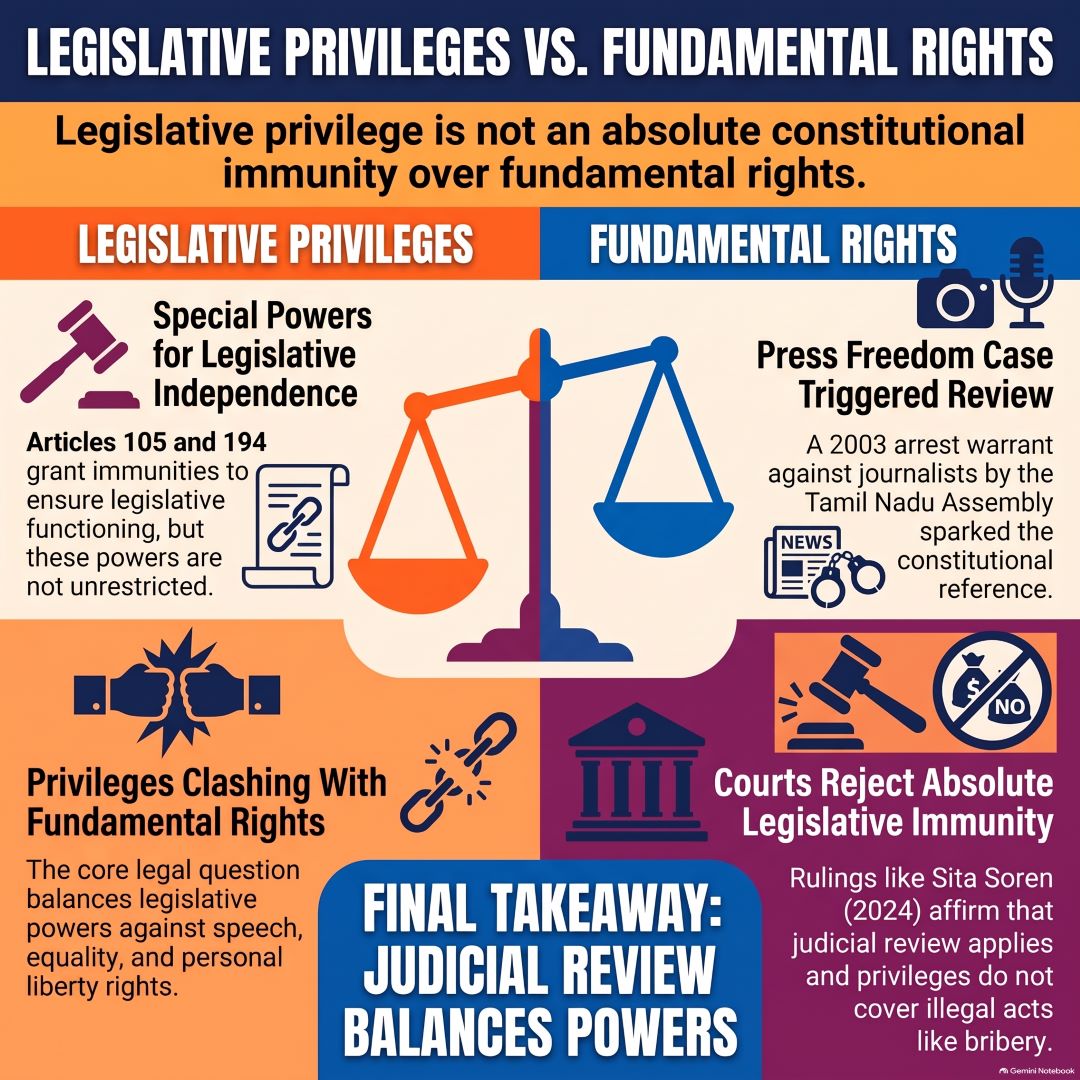
Source: IE
Why in News?
The Supreme Court has begun hearing a long-pending reference before a seven-judge Constitution Bench on the scope of legislative privileges under Articles 105 and 194 of the Constitution.
The central issue is whether the privileges of Parliament and State Legislatures can be exercised against citizens and journalists, particularly when such action affects fundamental rights such as freedom of speech and expression under Article 19(1)(a) and personal liberty under Article 21.
What are Legislative Privileges?
Legislative privileges are special rights, immunities and powers available to Parliament and State Legislatures and their members to enable them to function independently and effectively.
- Article 105 — Privileges of Parliament and its members.
- Article 194 — Privileges of State Legislatures and their members.
- They include freedom of speech within the House and protection from certain legal proceedings relating to legislative functioning.
- Their purpose is to ensure the independence, dignity and effective functioning of the legislature.
However, legislative privilege is not an unrestricted power to override constitutional rights.
The Constitutional Issue
The case involves a balance between:
- Legislative privilege — Articles 105 and 194
- Freedom of speech and expression — Article 19(1)(a)
- Equality before law — Article 14
- Life and personal liberty — Article 21
The key question is whether a legislature can use its breach-of-privilege powers to punish journalists or citizens and whether courts can review such action.
Origin of the Case: Tamil Nadu, 2003
· The matter arose after The Hindu reported exchanges in the Tamil Nadu Legislative Assembly involving the then Chief Minister J. Jayalalithaa and the Opposition.
· The Assembly's Privileges Committee subsequently held journalists guilty of breach of privilege and contempt and imposed imprisonment.
· The journalists approached the Supreme Court, which stayed the arrest warrants and referred the constitutional questions to a larger Bench.
Important Judicial Precedents
|
M.S.M. Sharma v. Sri Krishna Sinha, 1959 — Searchlight Case The Supreme Court held that legislative privilege under Article 194 could restrict publication of legislative proceedings in certain circumstances. The judgment adopted a relatively deferential approach towards legislative privilege, treating Article 194(3) as a special constitutional provision in relation to the general guarantee of freedom of speech. Special Reference No. 1 of 1964 — Keshav Singh Case Keshav Singh was punished by the Uttar Pradesh Assembly for allegedly defaming an MLA. When the Allahabad High Court granted him interim bail, the Assembly initiated action against the judges and lawyer involved. The Supreme Court clarified that:
|
Evolution of the Doctrine
· The judicial approach has progressively moved towards greater constitutional accountability of legislative privilege.
· In Raja Ram Pal v. Speaker, Lok Sabha (2007), the Supreme Court recognised judicial review of parliamentary proceedings in limited circumstances.
· In Sita Soren v. Union of India (2024), the Supreme Court held that legislators cannot claim constitutional immunity from prosecution for bribery connected with their speech or vote.
· These judgments reinforce the principle that legislative privilege is not an absolute constitutional immunity.
Significance
The judgment will have implications for:
- Freedom of the press and investigative journalism.
- Personal liberty under Article 21.
- Separation of powers.
- Judicial review.
- Legislative accountability.
- The constitutional limits of Articles 105 and 194.
Conclusion
Legislative privilege is necessary to ensure the independent functioning of legislatures, but it must operate within the broader framework of constitutional supremacy and fundamental rights.
The key constitutional question is where to draw the boundary between protecting the functioning of the legislature and preventing arbitrary exercise of legislative power.
