

LPG imports rose with urbanisation, schemes, growing middle class
Indian Express
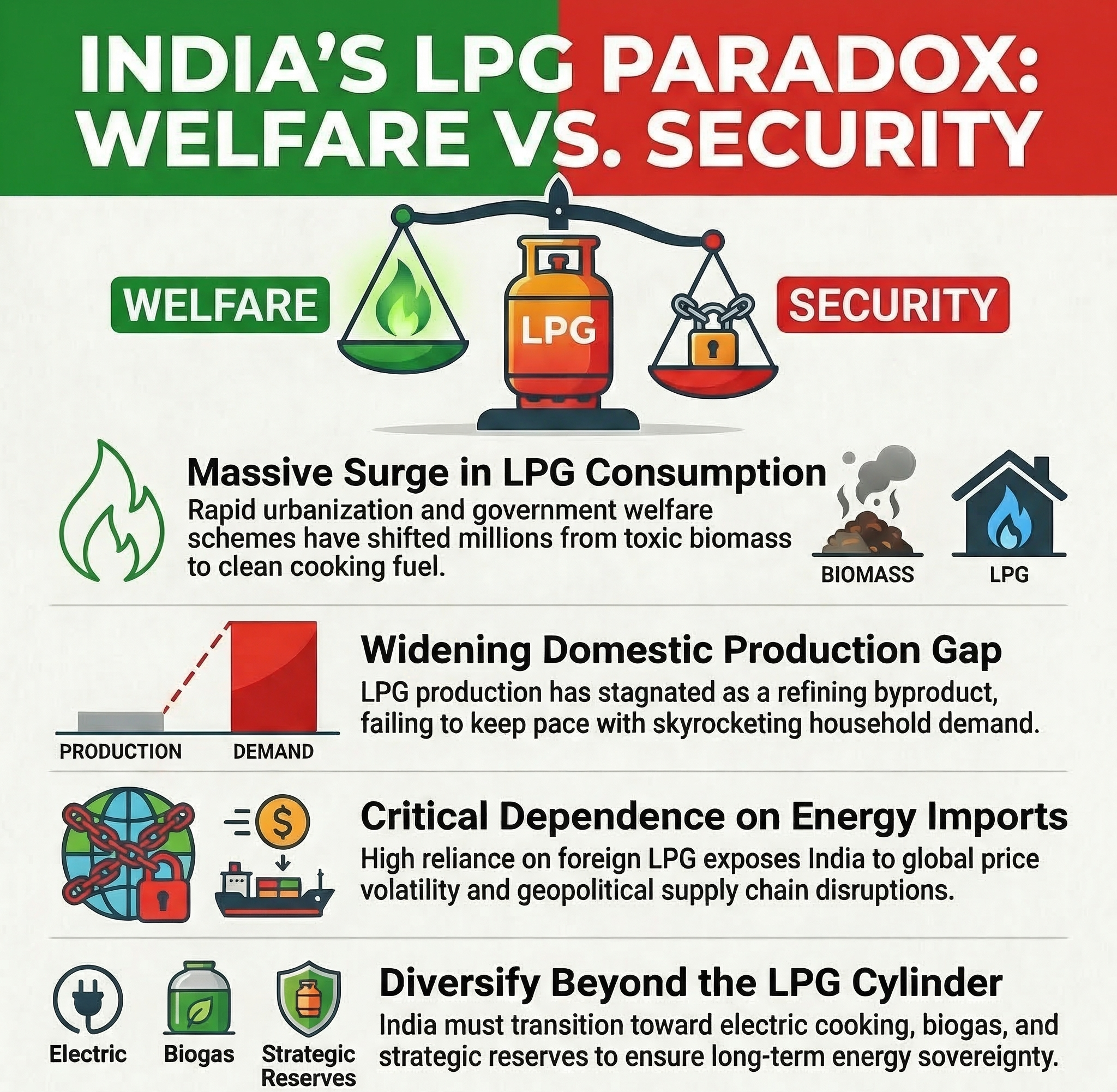
Key Arguments of the Article
Rapid Growth in LPG Consumption
The article highlights that LPG consumption in India has increased significantly over the past two decades. The expansion of clean cooking fuel access has driven demand across both urban and rural households.
The shift from traditional biomass fuels such as firewood and cow dung to LPG reflects improvements in household energy use.
Urbanisation and Middle-Class Expansion
Urban growth and rising incomes have increased the number of households relying on LPG as their primary cooking fuel. The growing middle class has accelerated demand for modern energy services.
This structural transition in household consumption patterns has increased pressure on energy supply systems.
Role of Government Schemes
The article emphasises the role of public policy in expanding LPG access. Government programmes aimed at providing clean cooking fuel to poor households significantly increased LPG adoption.
Such initiatives have improved public health and reduced indoor air pollution.
Rising Import Dependence
Despite improvements in domestic refining capacity, India remains heavily dependent on LPG imports. A significant proportion of the country’s LPG demand is met through imports, making the economy vulnerable to global energy market fluctuations.
The article notes that supply chains are particularly sensitive to geopolitical chokepoints such as major maritime energy routes.
Domestic Production Constraints
LPG production in India has stagnated due to structural limitations in refining capacity and the fact that LPG is primarily a byproduct of crude oil refining and natural gas processing.
As demand grows faster than production, the gap between consumption and domestic supply continues to widen.
Author’s Stance
The author adopts an analytical and balanced stance. While acknowledging the social and developmental benefits of LPG expansion, the article raises concerns about India’s growing import dependence.
The tone suggests the need for strategic planning to ensure long-term energy security.
Possible Biases
Development-Oriented Perspective
The article strongly emphasises the benefits of welfare schemes and energy access programmes.
Energy Security Concern
There is a subtle emphasis on strategic vulnerability due to rising import dependence.
Limited Discussion of Alternatives
The analysis focuses largely on LPG rather than exploring other clean energy alternatives in detail.
Advantages of Expanding LPG Access
Improved Public Health
LPG reduces indoor air pollution caused by biomass fuels, which is a major cause of respiratory diseases.
Women’s Empowerment
Access to clean cooking fuel reduces the time spent collecting firewood and improves household welfare.
Environmental Benefits
The shift from biomass to LPG reduces deforestation and improves local environmental conditions.
Economic Development
Modern energy access supports urbanisation, economic productivity, and improved living standards.
Challenges and Risks
Import Dependence
India’s reliance on imported LPG exposes the country to global price volatility and geopolitical risks.
Supply Chain Vulnerability
Global energy transport routes and supply disruptions can affect domestic availability.
Fiscal Burden
Subsidies for LPG under welfare schemes create fiscal pressures on government finances.
Limited Domestic Production
The structural limitation of LPG production as a byproduct restricts the ability to scale domestic supply.
Policy Implications
Diversification of Energy Sources
India must diversify household energy sources through electricity-based cooking, biogas, and renewable alternatives.
Strengthening Domestic Production
Policies should encourage domestic exploration and production of natural gas and associated LPG.
Strategic Energy Reserves
Creating strategic reserves can reduce vulnerability to global supply disruptions.
Targeted Subsidy Reforms
Better targeting of subsidies can reduce fiscal burdens while protecting vulnerable households.
Real-World Impact
If current trends continue:
• Increased pressure on India’s energy import bill
• Greater vulnerability to global energy market fluctuations
• Expansion of clean cooking access across households
If policies diversify energy sources:
• Reduced import dependence
• Improved energy security
• Greater sustainability in household energy consumption
Alignment with UPSC GS Papers
GS Paper I
Urbanisation, demographic changes, and social development.
GS Paper II
Government welfare schemes and public policy implementation.
GS Paper III
Energy security, resource management, and economic development.
Balanced Assessment
The article highlights a paradox in India’s energy transition. The expansion of LPG access represents a major public health and development achievement, particularly for rural and low-income households.
However, the same expansion has increased India’s reliance on imported LPG, creating long-term energy security challenges.
Future Perspective
India’s household energy transition is likely to continue as incomes rise and urbanisation expands. While LPG will remain an important transitional fuel, future energy strategies may increasingly focus on electrification of cooking, renewable energy integration, and domestic energy resource development.
For policymakers, the challenge lies in balancing social welfare objectives with long-term energy security and sustainability goals.
