

Mohenjo-daro’s urbanisation began earlier than thought
Morning Standard
1. Core Thesis of the Article
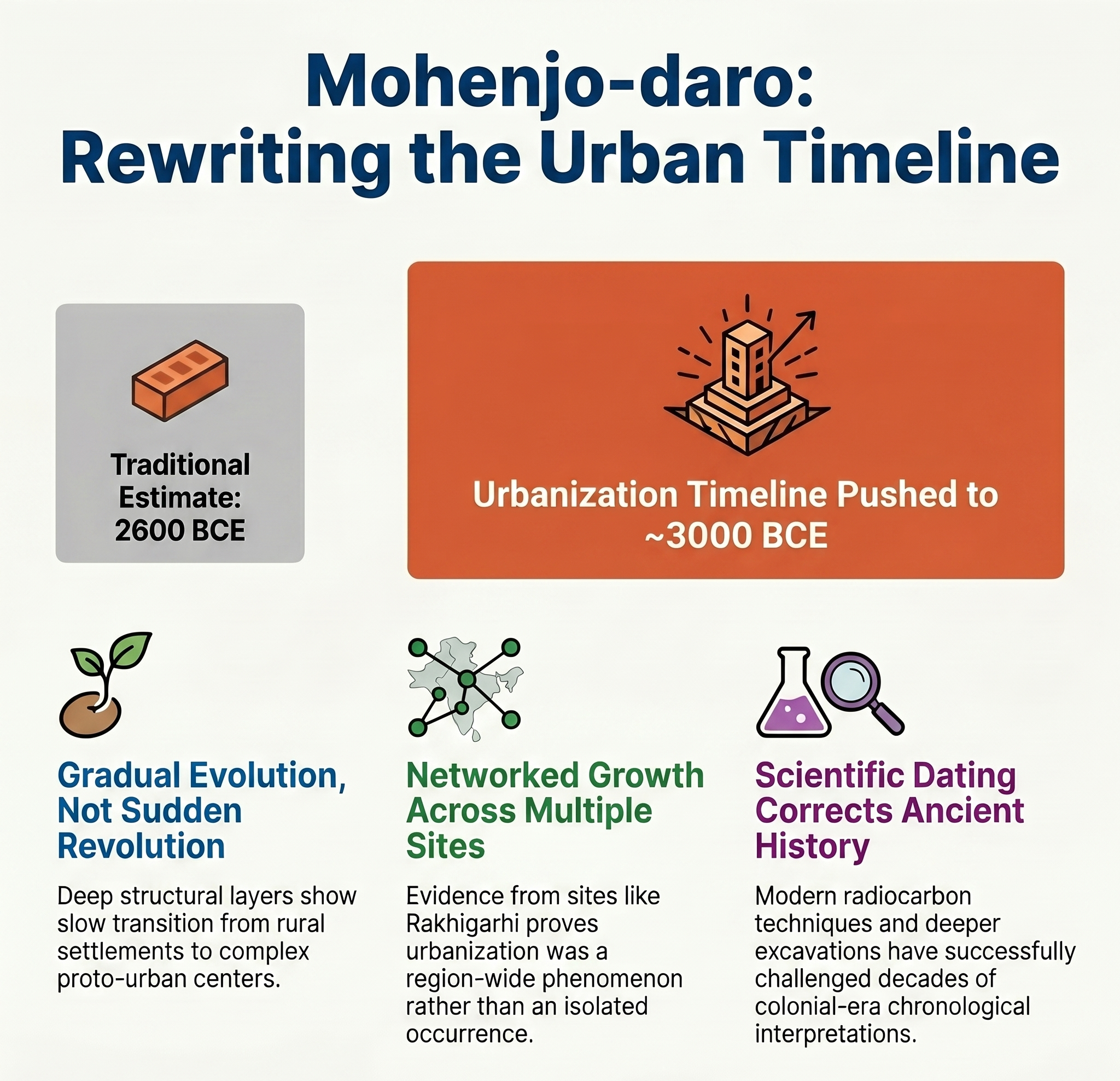
The article argues that new archaeological excavations and radiocarbon dating suggest that urbanisation at Mohenjo-daro began earlier than previously believed (around 3000 BCE), indicating a gradual and regionally interconnected evolution of the Indus Valley Civilisation rather than a sudden urban emergence.
2. Detailed Breakdown of Key Arguments
(1) New Archaeological Evidence
- Recent excavations at Mohenjo-daro (Stupa Mound area)
- Radiocarbon dating:
- Early urban phase traced to ~3000 BCE
- Earlier understanding:
- Mature Harappan phase ~2600–1900 BCE
Key Shift:
Urbanisation timeline pushed back
(2) Discovery of Deep Structural Layers
- Excavations revealed:
- Multiple layers beneath mature Harappan structures
- Evidence includes:
- mud-brick architecture
- pottery linked to Early Harappan phase
Inference:
Urban growth was layered and continuous, not abrupt
(3) Gradual Urban Transition
- Earlier model:
- Sudden urban “revolution”
- New model:
- Gradual evolution from rural to proto-urban
Insight:
Urbanisation was a process, not an event
(4) Regional Linkages Across Indus Sites
- Similar early evidence found in:
- Rakhigarhi
- Kalibangan
- Bhirrana
Conclusion:
Urbanisation occurred across networked settlements, not in isolation
(5) Role of Environmental and Economic Factors
- Development linked to:
- river systems (Indus-Saraswati basin)
- trade networks
- agricultural surplus
(6) Defensive and Planning Features
- Early evidence of:
- fortification walls
- planned layouts
Implication:
Urban characteristics existed earlier than assumed
(7) Methodological Advancement
- Use of:
- modern radiocarbon dating
- deeper excavation techniques
Result:
More accurate chronological reconstruction
(8) Caution Against Overinterpretation
- Archaeologists caution:
- evidence still partial
- cannot fully redefine entire chronology yet
(9) Implications for Harappan Chronology
- Challenges traditional classification:
- Early → Mature → Late Harappan
- Suggests:
- overlapping phases
(10) Broader Civilisational Perspective
- Urbanisation as:
- cumulative, region-wide phenomenon
- Not limited to:
- single “core city”
3. Author’s Stance
- Scientific and cautiously optimistic
- Supports:
- reinterpretation of timelines
- Avoids:
- exaggerated claims
Tone:
- Analytical, evidence-based
4. Biases in the Article
(1) Scientific Optimism Bias
- New findings seen as transformative
(2) Limited Critical Counterview
- Less emphasis on:
- limitations of excavation data
(3) Archaeology-Centric Perspective
- Focus on material evidence, less on:
- socio-cultural interpretation
5. Pros and Cons of the Argument
Pros
Strengthens historical accuracy
- Better dating methods
Challenges outdated theories
- Moves beyond colonial-era interpretations
Highlights regional complexity
- Multiple centres of development
Cons
Evidence still limited
- Excavation scope restricted
Risk of overgeneralisation
- One site may not represent entire civilisation
Chronological uncertainty remains
6. Policy Implications
(1) Heritage Conservation
- Need to:
- protect deeper archaeological layers
(2) Research Funding
- Increase investment in:
- archaeology
- scientific dating
(3) Cultural Policy
- Promote:
- indigenous historical narratives
(4) Academic Curriculum Revision
- Update:
- NCERTs
- university syllabi
7. Real-World Impact
Short-Term
- Academic debate intensifies
Medium-Term
- Revision of:
- Harappan chronology
- urbanisation theories
Long-Term
- Stronger understanding of:
- India’s civilisational roots
- indigenous urban traditions
8. UPSC GS Linkages
GS Paper I
- Indian culture and ancient history
- Indus Valley Civilisation
GS Paper III
- Science and technology in archaeology
Essay Topics
- “Rethinking ancient urbanisation”
- “Science and history: rewriting the past”
9. Critical Analytical Insight
The article underscores a key historiographical shift: from viewing civilisation as a sudden breakthrough to understanding it as a slow, interconnected process shaped by multiple regions and factors.
10. Balanced Conclusion
The article effectively:
- Presents new archaeological evidence
- Challenges conventional timelines
- Emphasises gradual evolution
However:
- It rightly maintains caution due to:
- limited data
- ongoing research
11. Way Forward
- Expand:
- excavation sites
- interdisciplinary research
- Integrate:
- archaeology + environmental science + anthropology
- Ensure:
- preservation of sites
Final Editorial Takeaway
The emerging evidence from Mohenjo-daro does not just push back the timeline of urbanisation—it reshapes our understanding of how civilisations evolve, highlighting continuity, regional diversity, and gradual transformation rather than abrupt emergence.
