

Monetisation Debate Around UPI
Morning Standard
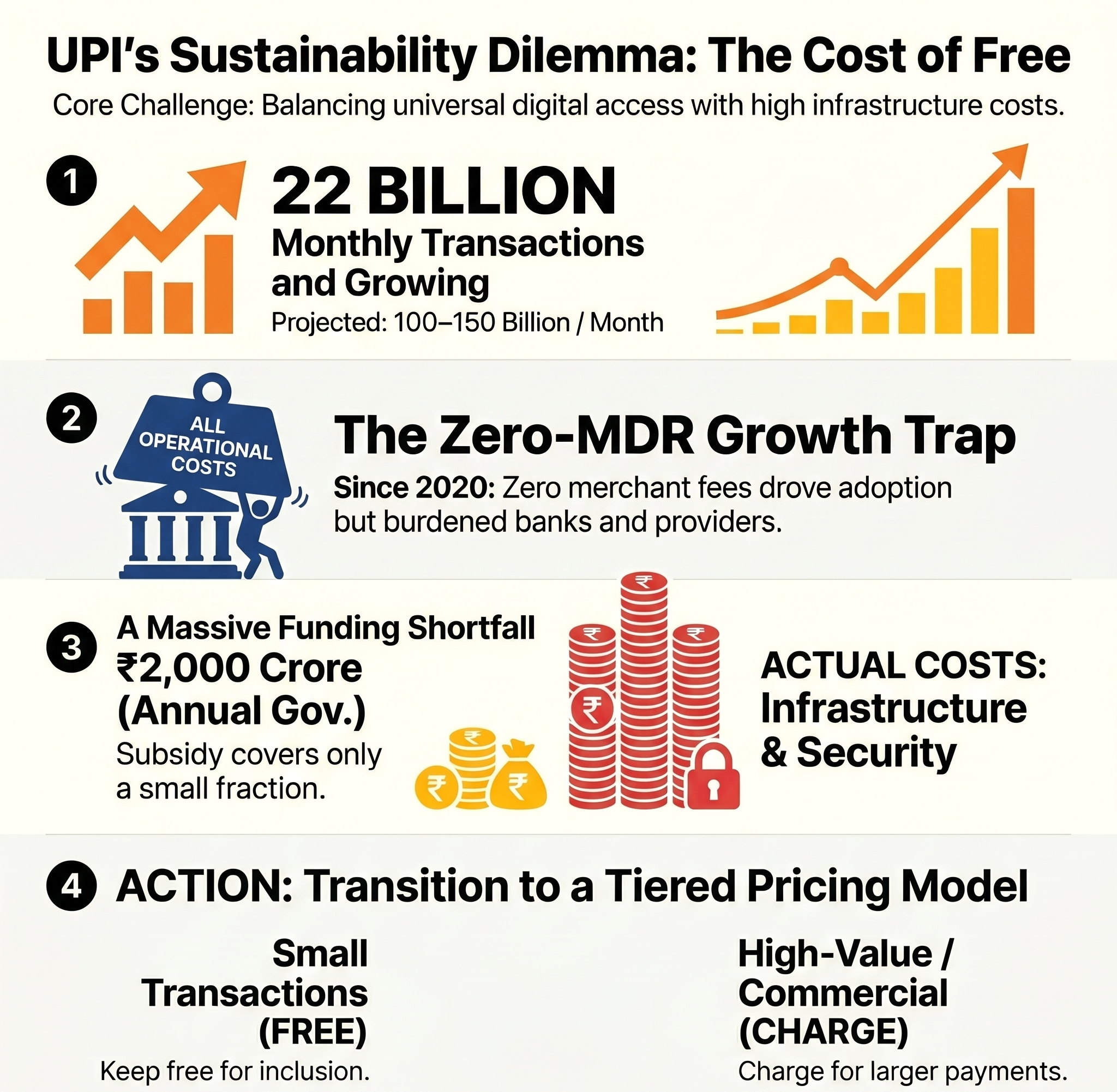
1. Core Thesis of the Article
India’s UPI ecosystem, while globally successful and widely adopted, faces a sustainability challenge due to its zero-cost model, raising the policy dilemma of whether to monetise transactions without undermining financial inclusion and digital growth.
2. Detailed Breakdown of Key Arguments
(1) UPI as a Transformational Public Digital Infrastructure
- UPI:
- World’s largest digital payments system
- Over 22 billion monthly transactions
- Role:
- Backbone of India Stack
- Promotes:
- Financial inclusion
- Digital economy
Insight:
- UPI is not just a payment system, but a public digital good
(2) Zero-MDR Model: Driver of Growth
- Since 2020:
- Zero Merchant Discount Rate (MDR)
- Impact:
- Rapid adoption
- Increased merchant onboarding
Conclusion:
- Free transactions → network expansion
(3) Hidden Cost Burden
- Costs borne by:
- Banks
- Payment Service Providers (PSPs)
- Government subsidy:
- ₹2,000 crore annually
Key Concern:
- Subsidy covers only a fraction of actual costs
(4) Sustainability Challenge
- Scaling issues:
- Infrastructure costs
- Cybersecurity
- Merchant acquisition
- Expected growth:
- 100–150 billion transactions/month
Implication:
- Current model may become financially unsustainable
(5) Parliamentary Committee’s Intervention
- Suggests:
- Tiered pricing model
- Key idea:
- Small transactions → free
- High-value transactions → chargeable
(6) Risks of Monetisation
- Potential consequences:
- Reduced adoption
- Impact on small merchants
- Slower financial inclusion
Insight:
- Monetisation vs accessibility trade-off
(7) Global Comparisons
- Other systems:
- Typically charge transaction fees
- UPI:
- Exception due to:
- State support
(8) Structural Funding Gap
- Zero-MDR:
- Limits ecosystem revenue
- Result:
- Reduced incentive for:
- Innovation
- Infrastructure investment
(9) Regulatory Push for Changes
- RBI proposals:
- Charges on high-value transactions
- Additional safeguards for fraud prevention
- Includes:
- Transaction caps
- Authentication layers
(10) Increasing Operational Costs
- Due to:
- Security upgrades
- Fraud prevention
- Compliance requirements
(11) Equity and Inclusion Concerns
- UPI users:
- Large share of low-income population
- Monetisation risk:
- Digital divide may widen
(12) Need for Balanced Approach
- Suggested solution:
- Hybrid model:
- Free basic services
- Paid premium usage
3. Author’s Stance
- Balanced but leaning towards cautious monetisation
Tone:
- Pragmatic
- Recognises:
- UPI success
- Financial sustainability constraints
4. Biases in the Article
(1) Institutional Bias Toward Sustainability
- Strong focus on:
- Financial viability
- Slightly underplays:
- Social welfare role
(2) Limited Consumer Perspective
- Less emphasis on:
- User sensitivity to pricing
(3) Tech-System Bias
- Focus on:
- Ecosystem players (banks, PSPs)
- Less on:
- Informal sector realities
5. Pros and Cons of the Argument
Pros
Strong policy relevance
- Addresses real governance dilemma
Balanced framing
- Growth vs sustainability
Data-backed insights
- Based on committee reports
Future-oriented
- Anticipates scaling challenges
Cons
Limited behavioural analysis
- How users will respond to charges
Underexplores alternatives
- Like cross-subsidisation models
Less focus on fintech innovation
- Role of private players
6. Policy Implications
(1) Tiered Pricing Model
- Keep:
- Small-value transactions free
- Charge:
- High-value or commercial transactions
(2) Strengthening Digital Infrastructure
- Invest in:
- Cybersecurity
- Scalability
(3) Public-Private Partnership Model
- Encourage:
- Fintech innovation
- Share:
- Cost burden
(4) Protecting Financial Inclusion
- Safeguards:
- No charges for:
- Low-income users
- Essential transactions
(5) Regulatory Evolution
- RBI to:
- Balance innovation + stability
7. Real-World Impact
Short-Term
- Debate on:
- Charging UPI transactions
Medium-Term
- Introduction of:
- Selective fees
Long-Term
Two outcomes:
If balanced:
- Sustainable digital ecosystem
If mismanaged:
- Reduced adoption
- Reversal to cash economy
8. UPSC GS Linkages
GS Paper III
- Digital economy
- Financial inclusion
- Infrastructure
GS Paper II
- Governance
- Role of RBI
- Public policy
GS Paper I
- Social issues (digital divide)
Essay Topics
- “Digital public infrastructure and inclusive growth”
- “State vs market in digital economy”
9. Critical Analytical Insight
UPI represents a unique model where public good meets private infrastructure, and the core challenge lies in balancing accessibility with economic sustainability.
10. Balanced Conclusion
The article effectively highlights:
- The sustainability dilemma of UPI
However:
- It underexplores:
- Alternative funding mechanisms
11. Way Forward
- Adopt:
- Gradual monetisation
- Ensure:
- No impact on small users
- Promote:
- Innovation and competition
Final Editorial Takeaway
UPI’s success story now faces its most critical phase—transitioning from a state-supported public good to a self-sustaining ecosystem. The challenge is not whether to monetise, but how to do so without compromising the inclusivity and trust that made UPI a global benchmark.
