

Mourning the Decline of Election Commission
The Tribune
1. Core Issue and Context
The article presents a deeply critical commentary on the perceived decline in the independence, credibility, and institutional authority of the Election Commission of India (ECI).
Using the context of:
- Bengal politics,
- Communal polarisation,
- Electoral management,
- Appointment mechanisms,
the article argues that the Election Commission — once regarded as one of India’s most respected democratic institutions — is gradually losing public trust.
The core concern raised is:
Whether political influence and institutional weakening are undermining India’s electoral democracy.
The article also links this debate with:
- Judicial responses,
- Electoral fairness,
- Constitutional morality,
- Minority concerns,
- Democratic accountability.
2. Key Arguments in the Article
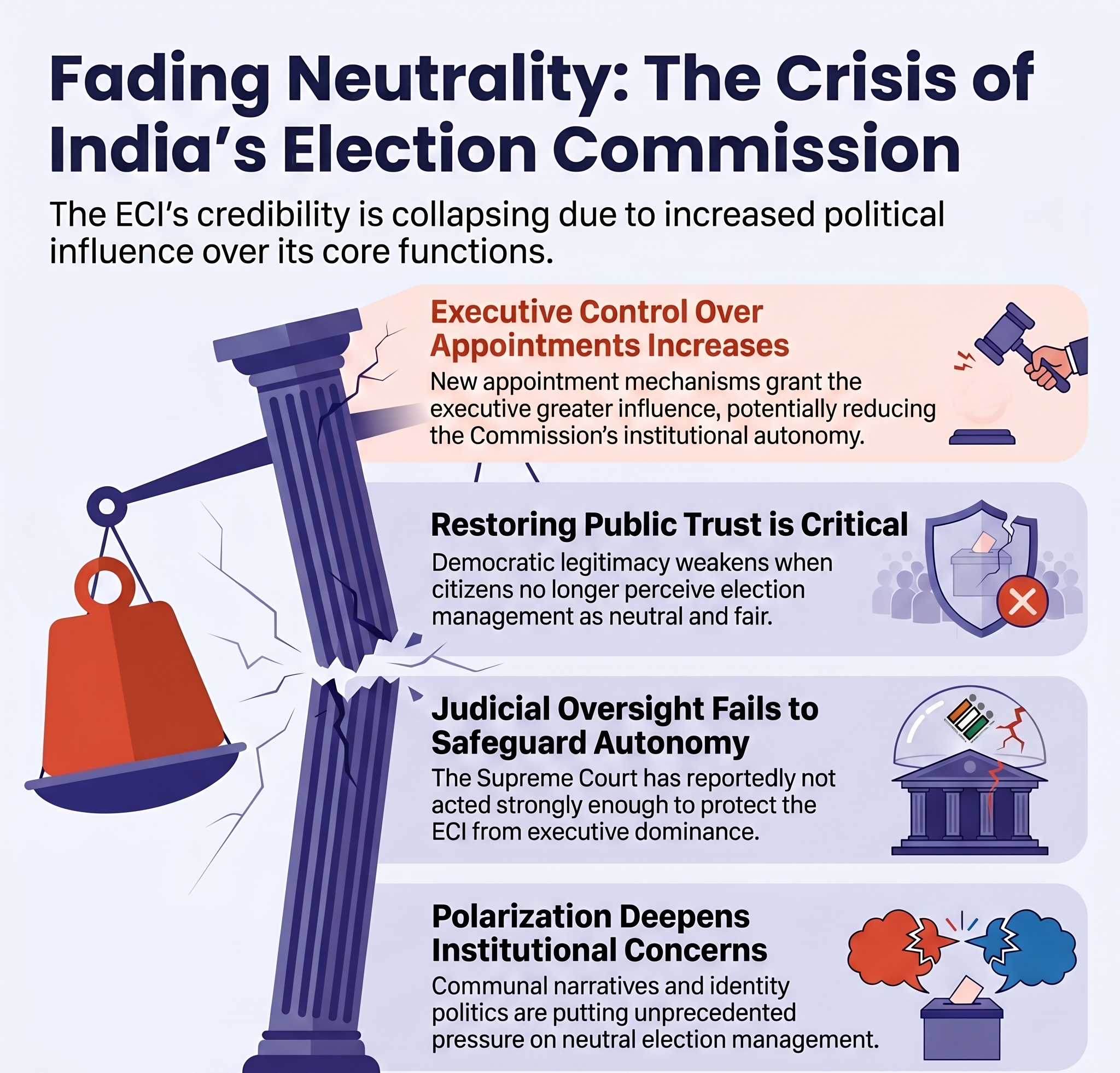
Election Commission’s credibility has weakened
The article argues that:
- The ECI was historically respected for ensuring free and fair elections even under difficult conditions.
However, according to the author:
- Public confidence in the institution has eroded in recent years.
Appointment process has become politically contentious
A major concern highlighted is:
- The new mechanism for appointing Election Commissioners.
The article criticises:
- Greater executive influence in appointments,
suggesting this may reduce institutional autonomy.
Judiciary has not acted strongly enough
The article suggests:
- The Supreme Court failed to sufficiently safeguard the independence of the ECI.
The author implies:
- Constitutional institutions are becoming vulnerable to executive dominance.
Democracy depends on institutional trust
The article repeatedly stresses:
- Electoral democracy functions only when citizens trust neutral institutions.
Without trust in election management:
- Democratic legitimacy weakens.
Communal and political polarisation deepen institutional concerns
The article links electoral politics with:
- Identity mobilisation,
- Communal narratives,
- Minority anxieties,
especially in Bengal and neighbouring regions.
3. Author’s Stance
Strongly critical and emotionally concerned
The author adopts:
- A highly critical stance toward recent institutional developments.
The tone is:
- Alarmed,
- Reflective,
- Institutionally defensive.
The article views the weakening of the ECI as:
- A serious threat to democratic governance.
4. Underlying Biases
Institutionalist bias
The article strongly values:
- Constitutional autonomy,
- Institutional independence,
- Democratic checks and balances.
Anti-majoritarian concern
The discussion reflects anxiety regarding:
- Executive concentration of power
- Majoritarian politics.
Liberal-democratic perspective
The article prioritises:
- Electoral neutrality,
- Constitutional morality,
- Minority protections,
- Institutional accountability.
5. Constitutional and Democratic Dimensions
Role of the Election Commission
The ECI is constitutionally responsible for:
- Conducting free and fair elections.
Its credibility is central to:
- Democratic legitimacy.
Importance of institutional independence
Independent constitutional bodies are necessary to:
- Prevent abuse of power,
- Ensure neutrality,
- Protect electoral fairness.
Appointment mechanism debate
The article critiques the shift in appointment structures that may:
- Increase executive influence over the ECI.
This raises concerns about:
- Separation of powers,
- Institutional autonomy.
Judicial oversight
The article questions whether:
- Courts have adequately defended institutional independence.
6. Pros (Positive Dimensions Highlighted Indirectly)
Democratic debate remains active
The article itself reflects:
- Vibrant democratic criticism
- Public engagement with institutions.
Judicial scrutiny still exists
Despite criticism, constitutional questions continue to:
- Reach courts,
- Generate public discussion.
Institutional memory of credibility survives
The article recalls:
- Earlier periods when the ECI enjoyed widespread public respect.
This suggests:
- Institutional restoration remains possible.
7. Cons and Concerns
Declining public trust
The biggest concern raised is:
- Erosion of confidence in electoral neutrality.
Perception of executive dominance
The article fears:
- Constitutional bodies may increasingly align with ruling political interests.
Communal polarisation
Electoral politics based on identity and fear may:
- Distort democratic competition.
Weakening institutional checks
The article warns that:
- Democratic institutions become fragile when checks and balances weaken.
8. Policy Implications
Need for transparent appointment mechanisms
Reforms may require:
- Independent selection committees,
- Bipartisan consultation,
- Judicial participation.
Strengthening institutional autonomy
Constitutional bodies require:
- Financial independence,
- Administrative security,
- Functional autonomy.
Electoral reforms
Broader reforms may include:
- Campaign finance transparency,
- Stronger Model Code enforcement,
- Hate speech regulation.
Restoring public trust
Institutional credibility depends upon:
- Transparency,
- Fairness,
- Consistency,
- Accountability.
9. Real-World Impact
Impact on democratic legitimacy
If public trust weakens:
- Electoral outcomes may face greater political contestation.
Impact on social cohesion
Perceived institutional bias may deepen:
- Political polarisation,
- Social distrust,
- Identity tensions.
Impact on federal politics
State-level political conflicts increasingly influence:
- National institutional debates.
Impact on international democratic reputation
Institutional credibility affects:
- India’s global democratic image.
10. UPSC GS Paper Linkages
GS Paper II (Polity & Governance)
Relevant themes:
- Election Commission
- Constitutional bodies
- Separation of powers
- Institutional independence
GS Paper II (Democracy & Accountability)
Relevant themes:
- Electoral reforms
- Democratic institutions
- Constitutional morality
GS Paper IV (Ethics)
Relevant themes:
- Integrity in public institutions
- Neutrality
- Accountability
Essay Relevance
Important themes:
- “Democracy and institutions”
- “Constitutional morality”
- “Trust in governance”
11. Critical Examination from UPSC Perspective
Democracy depends on institutions, not only elections
The article correctly highlights:
- Elections alone do not guarantee democracy.
Strong institutions are essential for:
- Fair competition,
- Rule of law,
- Public trust.
Perception matters as much as legality
Even if institutions remain legally functional:
- Public perception of neutrality is critical.
Loss of trust weakens:
- Democratic legitimacy.
Institutional independence must balance accountability
While autonomy is necessary:
- Constitutional bodies must also remain transparent and accountable.
Political polarisation intensifies institutional scrutiny
In highly polarised democracies:
- Neutral institutions face greater pressure and public suspicion.
12. Balanced Conclusion
The article presents a serious and emotionally charged critique of the perceived weakening of the Election Commission of India and broader democratic institutions.
Its central warning is that:
- Electoral democracy cannot survive merely through procedural elections;
it requires: - Trusted institutions,
- Constitutional neutrality,
- Public confidence.
While some arguments in the article reflect ideological concerns and political anxieties, the broader institutional questions raised regarding:
- Appointment processes,
- Executive influence,
- Electoral trust,
remain important for any constitutional democracy.
13. Future Perspective
India’s democratic future will depend upon:
- Strengthening institutional autonomy,
- Transparent constitutional appointments,
- Electoral reforms,
- Judicial independence,
- Citizen trust in governance systems.
The Election Commission’s credibility remains central to the health of Indian democracy. In the long run, restoring institutional trust may prove as important as winning elections themselves.
