

Need for a National Urbanisation Policy (NUP)

Need for a National Urbanisation Policy (NUP)
Source: The Hindu
Why in news?
India's 2027 Census, the first after a 16-year gap, will keep classifying urban areas by statutory notification and the three census-town criteria: population of at least 5,000, density of at least 400 persons per sq km, and at least 75% of male workers in non-agricultural work. This keeps comparability with past Censuses but misses India's changing urban reality, as economic activity, infrastructure and population growth spill beyond municipal limits. This strengthens the case for a National Urbanisation Policy.
India's urban landscape
- 2011: 377 million urban residents in about 8,000 towns and cities. States have since notified about 1,000 more statutory towns.
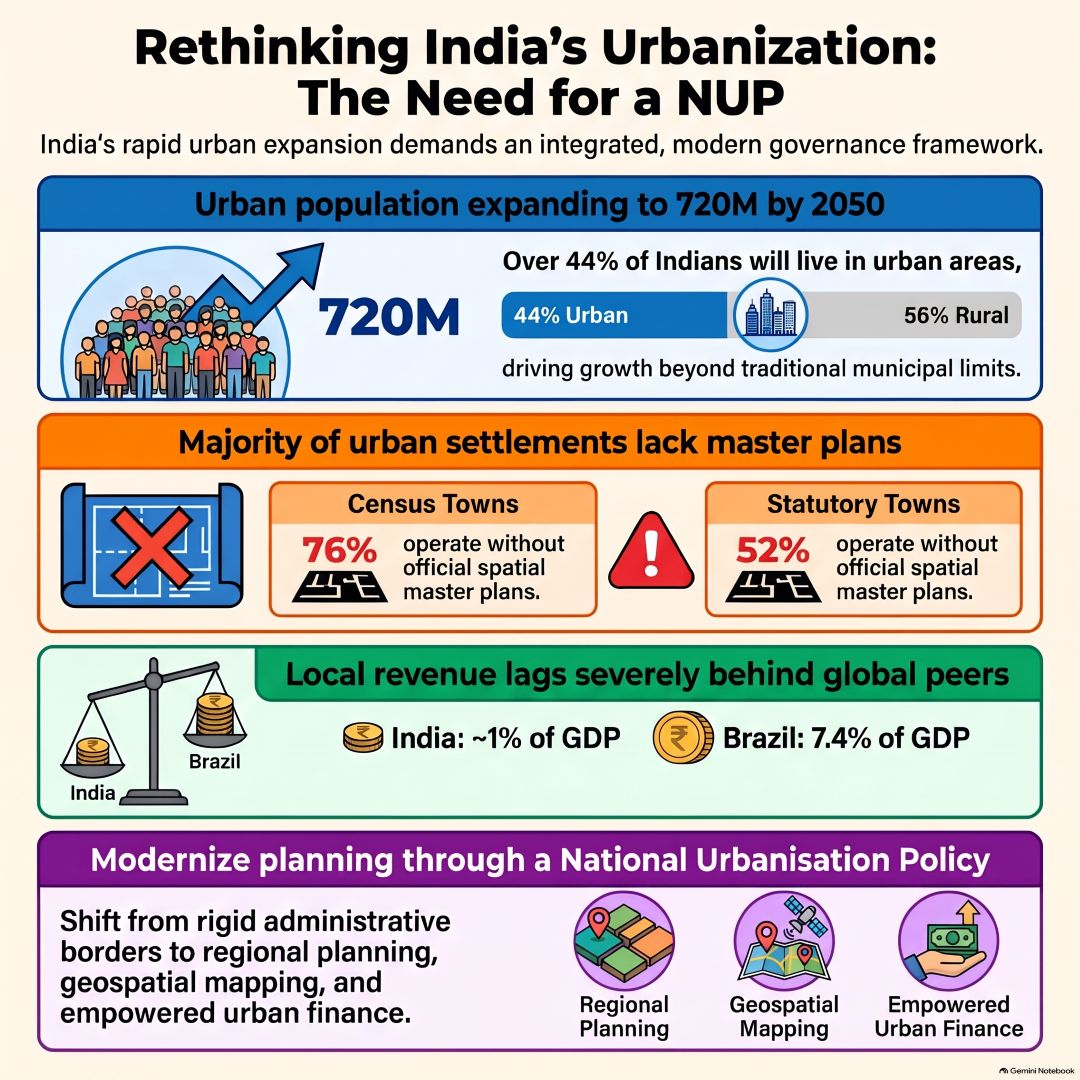
- The UN estimates 44% of Indians are urban, and the urban population is projected to cross 720 million by 2050.
- About 94% of urban settlements are small towns, but nearly 60% of the urban population lives in Class I cities, a group that ranges from megacities (Mumbai, Delhi) to smaller cities (Mangaluru, Amravati).
- Peri-urban areas grow at about 4.15% a year, against 2.9% inside established boundaries.
Emerging policy recognition
- Economic Survey 2026: India is more urban in functional terms than official definitions show, citing satellite-based estimates of 63% urban in 2015.
- Union Budget 2026: ₹5,000 crore each for City Economic Regions (CERs), which treats wider economic geographies rather than isolated cities as the unit.
- 16th Finance Commission: Local-body grants earmarked for ULBs raised to 45%, plus a ₹10,000 crore urbanisation premium for States.
- These steps still lack a coherent framework for recognising transitioning settlements, regional planning and aligning fiscal incentives.
Limits of the rural-urban binary
|
1. Governance gaps
2. Peri-urban governance deficit
3. Weak spatial planning
|
Seven systemic transformations
- Standardise urban classification: Review settlement status at fixed intervals against uniform criteria, not only at the Census. Use satellite and geospatial data to spot urbanising settlements early.
- Modernise spatial and regional planning:
- Spatial planning must come before infrastructure, housing, climate and financial reforms.
- Build on Metropolitan Planning Committees (Art. 243ZE) and District Planning Committees (Art. 243ZD).
- Regional planning should go beyond million-plus cities, and peri-urban zoning should be mandatory in fast-urbanising regions.
- Reform urban finance:
- Municipal revenue is about 1% of GDP, against 7.4% in Brazil and 6% in South Africa. Property tax yields only 0.15% of GDP.
- Strengthen own-source revenue (especially property tax), give predictable formula-based transfers, build project-preparation capacity and widen blended finance.
- Coordination architecture: A National Urbanisation Council could bring together the Inter-State Council, the Central Council of Local Government and NITI Aayog.
- Align reforms with functional geographies: Boundaries rarely match real problems. For example, 65% of Delhi's PM2.5 comes from outside the city. Organise reforms around airsheds, river basins and city regions with institutions empowered at that scale.
- Align urban politics with reform incentives: Untied grants should reach municipalities directly through published formulas, with incentives tied to accountability for services.
- Knowledge exchange and innovation: Technical support, knowledge networks and local innovation help cities adopt context-specific solutions and meet benchmarks.
Conclusion
India's urban future cannot be governed through an outdated rural-urban binary. A NUP can provide a coherent framework for equitable, productive, low-carbon and resilient urbanisation, so that governance, finance and planning keep pace with changing economic geography.