

Need for an Indian Sentencing Council

Need for an Indian Sentencing Council
GS Paper: GS-II (Judiciary, Governance) | GS-IV (Fairness, Accountability) |
Source: The Indian Express
Why in News?
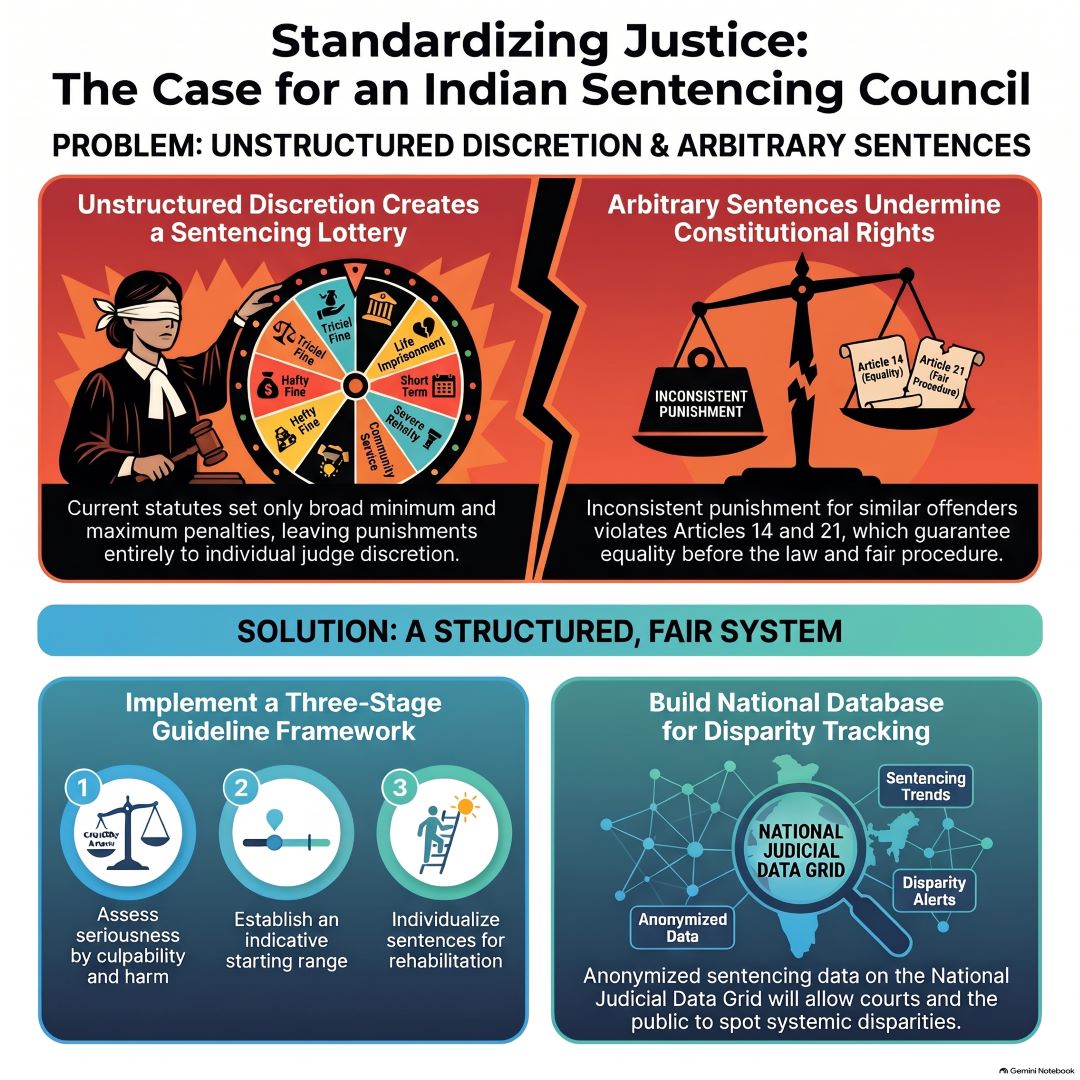
Analysts are calling for a statutory Sentencing Council because two people convicted of the same crime can receive very different sentences depending on the judge. The Supreme Court in Sunita Devi v State of Bihar (2024) said sentencing should not be a "mere lottery" and asked the Centre to examine a national sentencing policy. The Centre has asked the Law Commission of India to examine the issue; its recommendations are awaited.
The Problem: Discretion Without Structure
• Statutes set only maximum (and sometimes minimum) punishments such as "up to ten years". There is no checklist on aggravating and mitigating factors, prior conduct or remorse, so sentencing is left to individual judicial discretion.
• Courts have at times reduced sentences on legally irrelevant or retrograde grounds (for example a complainant's supposed "chastity" or her later marriage) while ignoring psychological harm or breach of trust. The problem is not limited to sexual offences.
• Constitutional stakes: Articles 14 and 21 forbid arbitrary State action and require fair, just and reasonable procedure. Similar offenders receiving very different sentences is hard to reconcile with equality before law.
• The Law Commission's 47th Report (1969) flagged this over 50 years ago, yet Parliament has not built a coherent framework.
• Underused alternatives: Sections 401 and 402 of the BNSS (earlier CrPC Sections 360 and 361: release on probation of good conduct or after admonition, with special reasons to be recorded) and Sections 3, 4 and 6 of the Probation of Offenders Act, 1958. There is no general framework for balancing these against deterrence, reformation and rehabilitation. In Soman v State of Kerala (2012) the Court noted sentencing is among the weakest parts of criminal justice administration. Appellate courts keep correcting sentences case by case, using up judicial time. Section 258(2) BNSS requires a Sessions Judge to hear the convict separately on sentence, but without structured guidance.
The English Model: Structure, Not Elimination of Discretion
• England and Wales set up a Sentencing Council under the Coroners and Justice Act, 2009, with a consolidated Sentencing Code.
• Method: (1) classify the offence by culpability and harm; (2) each combination has a starting point and category range (a sentencing band); (3) adjust for aggravating and mitigating factors, guilty-plea reductions, multiple offences and ancillary orders.
• The aim is uniform principles, not identical punishments.
What an Indian Sentencing Council Could Do
• Develop offence-specific guidelines in three stages: assess seriousness (planning, violence, weapon use, victim vulnerability, demonstrable harm); set an indicative starting point and range within the statutory limits; individualise and justify the sentence on recognised purposes such as rehabilitation.
• Build a national sentencing database on the National Judicial Data Grid (NJDG) infrastructure (anonymised data on offence type, factors, starting points, adjustments and final sentence), so that Parliament, courts and the public can spot disparities.
• Issue guidelines as delegated legislation placed before Parliament: advisory but strongly presumptive. Courts must consider them and give reasons when they depart, which keeps judicial independence while making discretion accountable.
Pitfalls and Way Forward
• Penal populism (especially on sexual offences) could push guidelines towards ever-longer sentences without proof of deterrence.
• Over-centralisation: criminal law is in the Concurrent List but prisons are a State subject, so court capacity and prison conditions vary across states.
• Mechanical compliance: judges may tick checklists without changing their reasoning.
• These risks can be managed only if the Council is independent and evidence-based. India has focused on the "front end" (policing, speedy trial, victims' rights) and neglected the "back end": how punishment is decided after conviction.
|
Sentencing Landmarks and Committees • Bachan Singh v State of Punjab (1980): death penalty only in the "rarest of rare" cases, and the Court said aggravating and mitigating circumstances must be weighed. Machhi Singh (1983) later set out categories (it has been criticised as inconsistent in practice). • Malimath Committee (2003) and Madhava Menon Committee (2007) both urged statutory sentencing guidelines or a sentencing commission. • Theories of punishment: deterrent, retributive, preventive and reformative. India's probation law reflects the reformative approach. • Constitutional entries: criminal law (Concurrent List, Entry 1), prisons (State List, Entry 4). New criminal codes: BNS, BNSS and BSA (2023) replaced the IPC, CrPC and Evidence Act. • Comparison: the US Federal Sentencing Guidelines (1984) were first mandatory and became advisory after United States v Booker (2005). That shows how binding guidelines can be challenged on judicial independence. |