

NEET is flawed to the core

NEET is flawed to the core
The National Eligibility cum Entrance Test (NEET), intended to streamline admissions into medical colleges and ensure a standardized measure of merit, has become one of India's most contentious examinations. While conceived with laudable objectives, its implementation and consequences have led to widespread criticism, suggesting fundamental flaws that undermine its very purpose.
The argument that "NEET is flawed to the core" stems from its profound impacts on equity, access, pedagogical practices, and the mental well-being of aspirants, alongside recurring issues of integrity.
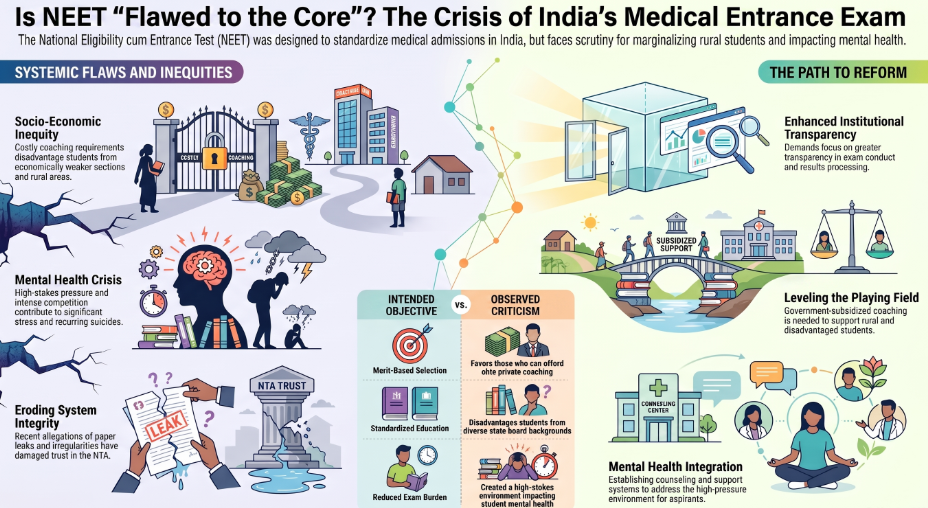
ARGUMENTS:
1. Perpetuation of Inequality and Exclusion
NEET, far from being an equalizer, has been criticized for exacerbating existing socio-economic disparities:
- Coaching Culture Dependence: The exam's highly competitive nature and specific format have created a multi-billion dollar coaching industry. Success in NEET is increasingly correlated with access to expensive, specialized coaching centers, which are largely concentrated in urban hubs. This effectively monetizes access to medical education, creating a significant barrier for economically disadvantaged students, regardless of their intrinsic academic potential.
- Rural-Urban Divide: Students from rural areas often attend schools with limited infrastructure, fewer qualified teachers, and lack exposure to the kind of problem-solving and conceptual understanding emphasized by NEET. They are further disadvantaged by limited access to quality study materials, internet resources, and coaching. This systematically excludes a vast talent pool from semi-urban and rural backgrounds, despite the country's dire need for doctors in these very areas.
- State Board Disadvantage: Despite claims of a unified syllabus, students from diverse state boards often find themselves at a disadvantage compared to those from the CBSE system, which closely aligns with NEET's curriculum. This necessitates additional effort and resources for state board students to adapt, further pushing them towards coaching.
2. Pedagogical Distortion and Rote Learning
The nature of NEET, as a single, high-stakes multiple-choice question (MCQ) exam, significantly influences teaching and learning methodologies:
- Shift from Understanding to Memorization: The emphasis often shifts from conceptual understanding and critical thinking to memorization of facts and pattern recognition for MCQs. This can dilute the quality of foundational learning, which is crucial for a profession like medicine.
- "Teaching to the Test": Schools and junior colleges are increasingly pressured to align their teaching with NEET requirements, potentially neglecting a broader, more holistic education. This narrow focus can stifle intellectual curiosity and a genuine passion for science.
- Neglect of Holistic Assessment: A single exam cannot capture the multifaceted abilities, emotional intelligence, and perseverance required for a medical career. It reduces a student's entire academic journey and aptitude to a few hours of performance under immense pressure.
3. Profound Mental Health Crisis
The "all-or-nothing" nature of NEET places an unbearable psychological burden on millions of aspirants:
- Exorbitant Pressure: The immense competition (millions of aspirants for limited seats) creates an environment of extreme stress, anxiety, and fear of failure.
- Rising Suicides and Mental Health Issues: There is a well-documented increase in mental health challenges, including depression, anxiety disorders, and tragically, suicides, directly linked to NEET pressure, particularly after results are declared or when students are stuck in repeated attempts.
- Lost Years: Many students spend years dropping out of regular education to prepare for NEET, often taking multiple attempts. This leads to a loss of valuable years and can severely impact their overall educational and personal development if they fail to secure a seat.
4. Erosion of Trust and Institutional Integrity
Recent controversies surrounding NEET have severely eroded public trust in the examination's integrity:
- Allegations of Paper Leaks and Irregularities: Recurring reports of alleged paper leaks, disproportionate grace marks, and other anomalies cast serious doubts on the fairness and transparency of the National Testing Agency (NTA), the body responsible for conducting NEET.
- Lack of Accountability: Perceived lack of swift and transparent action against alleged malpractices fuels public skepticism and reinforces the belief that the system is susceptible to manipulation.
- Arbitrary Decision-Making: Instances of sudden changes in examination policies or explanations for discrepancies often come across as arbitrary, further damaging credibility.
5. Impact on Federal Structure and Regional Needs
- Undermining State Autonomy: Many states have historically managed their own medical admissions to cater to regional needs and ensure representation from their local populace. NEET's centralized approach is seen by some as an encroachment on state autonomy and an impediment to addressing local healthcare requirements.
- Language Barrier: While conducted in multiple languages, the quality of translated papers and the availability of resources in regional languages remain concerns, potentially disadvantaging non-English medium students.
Conclusion
While the ideal of a single, merit-based entrance examination for medical admissions is appealing, NEET's current structure and operational issues suggest deep-seated flaws. It has created a system where access to quality medical education is increasingly dictated by financial capacity rather than raw talent or genuine aptitude, fostering an environment of intense pressure and, at times, questionable integrity. Addressing these "core flaws" necessitates a comprehensive review involving all stakeholders – educationalists, medical professionals, policymakers, and civil society – to redesign an admission process that is truly equitable, transparent, pedagogically sound, and sensitive to the mental well-being of India's future doctors.
