

New GDP series: Bigger farm sector, improved measure of informal economy
Indian Express
Key Arguments of the Article
Revision of Sectoral Shares
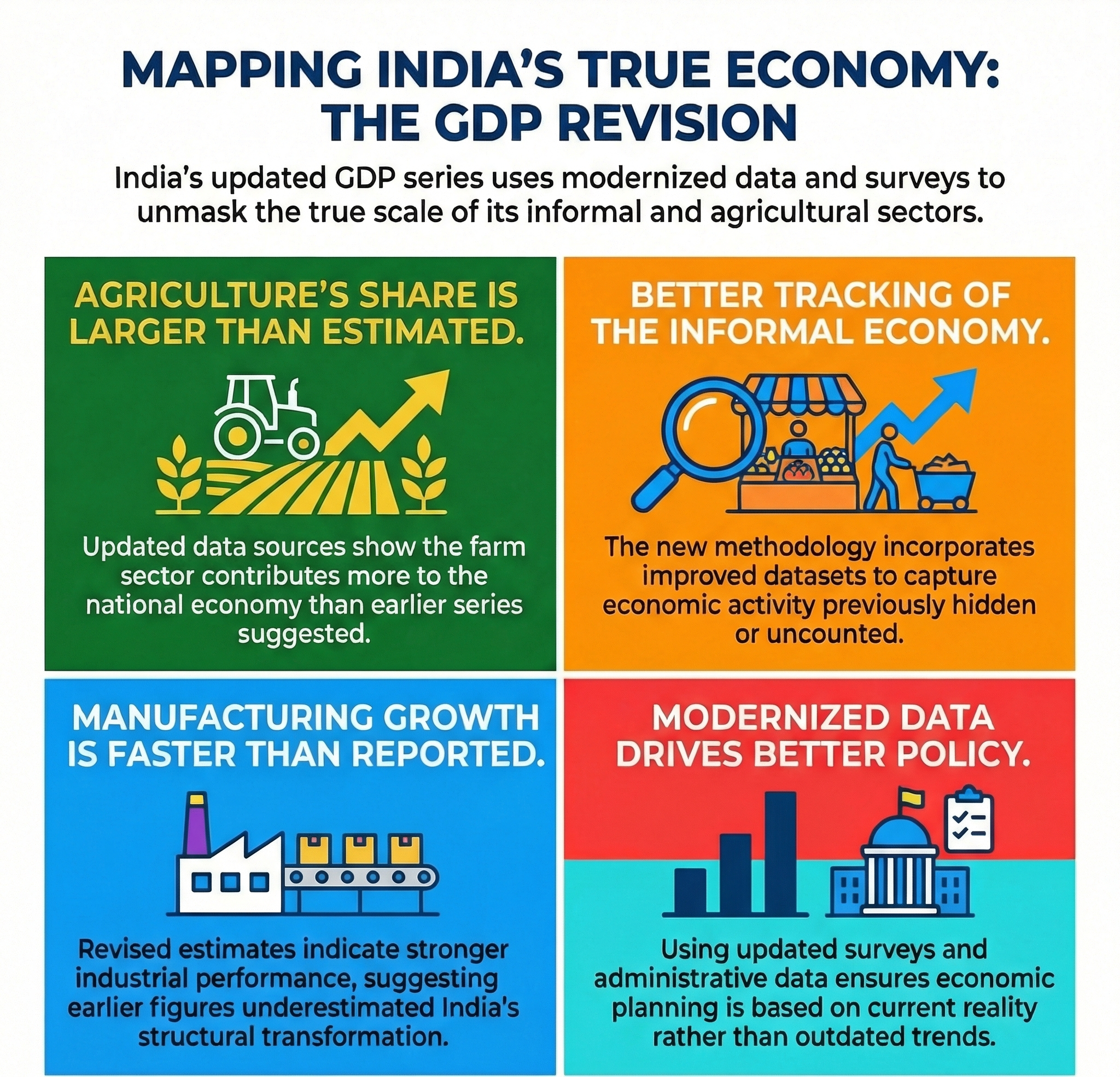
The revised GDP series alters the relative contribution of different sectors. Agriculture’s share appears larger than earlier estimates, while other sectors show modest adjustments.
This change results from updated data sources and improved measurement techniques.
Better Measurement of Informal Economy
A significant claim in the article is that the revised methodology improves the capture of informal economic activity. India’s economy has a large informal component, which historically has been difficult to measure accurately.
The new series incorporates improved datasets and surveys to better estimate this segment.
Faster Manufacturing Growth
The revised GDP estimates indicate stronger manufacturing growth than previously reported. This has implications for interpreting India’s structural transformation and industrial performance.
The revision suggests that earlier estimates may have underestimated industrial activity.
Methodological Changes
The revision involves changes in data sources, statistical methods, and sectoral classification. Improved administrative datasets and enterprise surveys have enhanced measurement accuracy.
Such updates are a routine feature of national income accounting systems.
\
Implications for Economic Analysis
The article notes that GDP revisions can significantly alter perceptions of sectoral performance and policy effectiveness. Policymakers, researchers, and investors rely heavily on these statistics for decision-making.
Thus, methodological transparency and statistical credibility are crucial.
Author’s Stance
The author adopts a cautiously analytical stance. While acknowledging improvements in statistical measurement, the article also recognises that GDP revisions can complicate comparisons with earlier data.
The tone reflects an economist’s perspective that values methodological rigour but emphasises the need for interpretive caution.
Possible Biases
Statistical Optimism
The article appears to assume that improved measurement automatically leads to more accurate representation of economic reality. However, informal economies remain difficult to quantify precisely.
Limited Discussion of Policy Outcomes
While the revision changes sectoral shares, the article does not fully examine how these changes affect policy evaluation.
Data-Centric Focus
The discussion is largely technical and statistical, with limited emphasis on broader socio-economic implications.
Advantages of the Revised GDP Series
Improved Data Accuracy
Updated surveys and administrative data enhance reliability of economic estimates.
Better Representation of Informal Economy
The new methodology attempts to incorporate economic activities previously undercounted.
Clearer Sectoral Understanding
Revised sectoral shares provide policymakers with a more accurate picture of structural changes in the economy.
International Statistical Alignment
Periodic revisions bring India’s national accounts closer to global statistical standards.
Concerns and Limitations
Comparability Issues
Changes in methodology can make it difficult to compare growth trends across time periods.
Measurement Challenges
Despite improvements, the informal economy remains difficult to quantify accurately.
Policy Interpretation Risks
Statistical revisions can alter perceptions of economic performance, potentially influencing policy narratives.
Data Transparency
Clear communication about methodological changes is necessary to maintain public trust in economic statistics.
Policy Implications
Evidence-Based Economic Planning
More accurate GDP data can help policymakers design targeted economic policies.
Agricultural Policy Reassessment
If agriculture’s share is larger than previously estimated, rural development and agricultural investment may need renewed focus.
Industrial Strategy
Revised manufacturing growth estimates may influence industrial policy and production-linked initiatives.
Strengthening Statistical Systems
Continuous improvement in statistical capacity, surveys, and data integration is essential.
Real-World Impact
If the revised series improves measurement accuracy:
• Better-informed policy decisions
• Improved macroeconomic analysis
• Enhanced investor confidence
However, if revisions are misunderstood:
• Confusion in economic interpretation
• Political contestation over growth numbers
• Difficulty in long-term economic comparisons
Alignment with UPSC GS Papers
GS Paper III
Indian economy, national income accounting, structural transformation, informal sector, industrial growth.
GS Paper II
Role of institutions and governance mechanisms in statistical systems and policymaking.
GS Paper I
Economic geography and structural changes in the economy.
GS Paper IV
Transparency and integrity in public data systems.
Balanced Assessment
The revised GDP series represents an important effort to improve the accuracy of India’s economic statistics. By better capturing agricultural output and informal economic activity, the revision may provide a more realistic picture of the economy.
However, statistical revisions also introduce challenges in interpretation and comparability. Policymakers and analysts must therefore exercise caution while drawing conclusions from revised data.
Future Perspective
India’s economy continues to evolve rapidly with digitalisation, urbanisation, and structural transformation. As economic activities become more complex, statistical systems must also adapt.
Strengthening data collection mechanisms, improving transparency, and enhancing statistical capacity will be crucial for maintaining credibility in economic measurement.
For civil services aspirants, the debate around GDP revisions illustrates the importance of understanding both economic methodology and policy implications in interpreting macroeconomic indicators.
