

Optogenetics: Controlling Nerve Cells with Light

Optogenetics: Controlling Nerve Cells with Light
Why in News?
The 2026 Nobel Prize in Physiology or Medicine has been jointly awarded to Karl Deisseroth, Peter Hegemann and Georg Nagel for their discoveries concerning light-gated ion channels and optogenetics.
Their work established a technique that allows scientists to activate or inhibit specific nerve cells using light, transforming neuroscience from merely observing brain activity to experimentally controlling specific neural circuits.
What is Optogenetics?
Optogenetics combines genetics and optics to control selected cells using light.
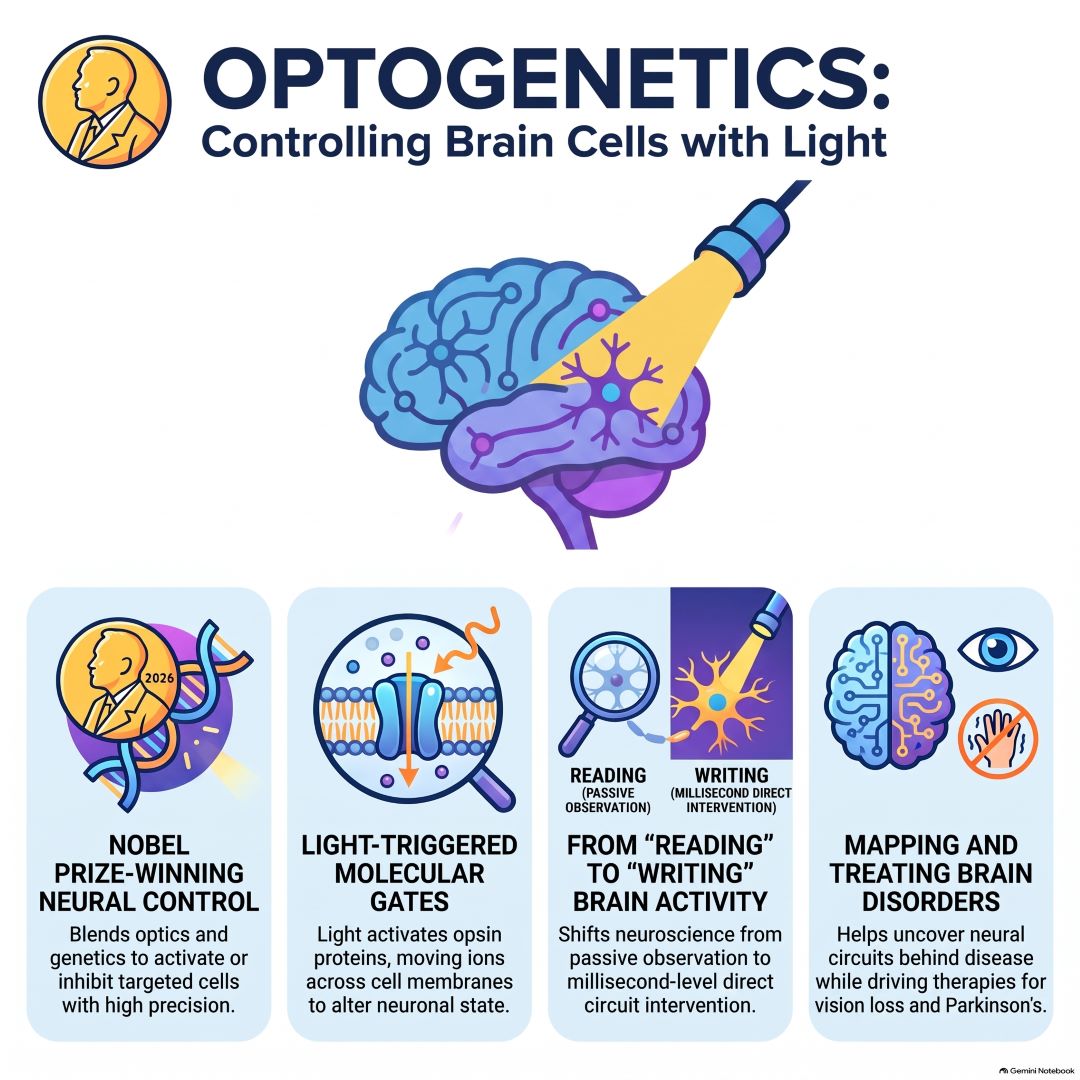
It involves introducing genes for light-sensitive proteins called opsins into specific neurons. When light of an appropriate wavelength falls on these proteins, they open or close and regulate the movement of ions across the cell membrane.
Light → Opsin activation → Ion movement → Change in neuronal activity
This allows researchers to control individual types of neurons with high precision.
Light-Gated Ion Channels
Light-gated ion channels are proteins present in the cell membrane that function like light-controlled molecular gates.
When exposed to a particular wavelength of light:
- The protein changes its structure.
- The channel opens.
- Charged ions move across the membrane.
- The electrical state of the neuron changes.
- The neuron can be activated or inhibited.
Scientific Journey
· The idea can be traced to Francis Crick, who proposed that light could potentially be used to control individual neurons because nerve signals operate extremely rapidly.
· In the 1990s, Peter Hegemann studied the single-celled alga Chlamydomonas, which rapidly responds to light. He proposed that a single protein might both detect light and generate an electrical signal.
· Georg Nagel subsequently helped demonstrate that two proteins from the alga, channelrhodopsin-1 and channelrhodopsin-2 (ChR2), function as light-sensitive ion channels.
· ChR2 was particularly important because it opens extremely rapidly following exposure to blue light, allowing positively charged ions to enter cells.
|
Karl Deisseroth and Optogenetics Karl Deisseroth introduced the channelrhodopsin gene into mammalian neurons. In 2005, his team demonstrated that light could activate genetically modified rat neurons. The method was subsequently termed optogenetics in 2006. Later experiments demonstrated that stimulating specific neurons in living animals could influence behaviour, establishing optogenetics as a powerful tool for studying neural circuits. What Has Optogenetics Revealed? Optogenetics allows researchers to identify specific neural circuits involved in:
It has therefore helped scientists understand how different groups of neurons contribute to behaviour and neurological functions |
Medical Applications
Optogenetics has improved understanding of disorders such as:
- Depression
- Anxiety
- Schizophrenia
- Alzheimer's disease
- Parkinson's disease
It is also being investigated for therapeutic applications. In retinitis pigmentosa, for example, optogenetic approaches have been explored to restore partial visual function by making surviving retinal cells responsive to light.
The technology could potentially make devices such as cochlear implants more precise by allowing targeted stimulation of auditory pathways.
Why is it Revolutionary?
Traditional neuroscience often focuses on recording and observing neuronal activity.
Optogenetics allows scientists to intervene in specific neural circuits with:
- High cell-type specificity
- Very rapid, millisecond-level control
- Precise spatial targeting
Thus, it has been described as moving neuroscience from “reading” brain activity towards “writing” into neural circuits.
Safety and Limitations
Optogenetics does not provide a practical means of remotely controlling human thoughts or behaviour.
Its limitations include:
- Target neurons generally need to be genetically modified to express opsins.
- Light delivery into the brain is difficult because the skull and tissues scatter and absorb light.
- Activating or inhibiting a particular neural population does not provide general control over a person's thoughts or actions.
Conclusion
Optogenetics represents a major breakthrough in neuroscience by combining genetic modification with light-based control of neurons. From Hegemann's work on a light-responsive alga to Deisseroth's experiments in mammalian neurons, the field has provided unprecedented insight into the relationship between neural circuits, behaviour and disease.
Source: The Nobel Prize; Indian Express.
