

PM Poshan Scheme: Delhi's Midday Meal Programme Under Scrutiny

PM Poshan Scheme: Delhi's Midday Meal Programme Under Scrutiny
Relevance: GS Paper II — Government Policies and Interventions for Development in Social Sectors (Health, Nutrition, Education); Welfare Schemes for Vulnerable Sections (children)
Why in the News?
A dead lizard found in a midday meal at a Delhi government school has renewed scrutiny of the PM Poshan scheme, raising questions on portion equity, menu adequacy, and monitoring gaps — issues that go beyond isolated hygiene lapses to the scheme's structural design.
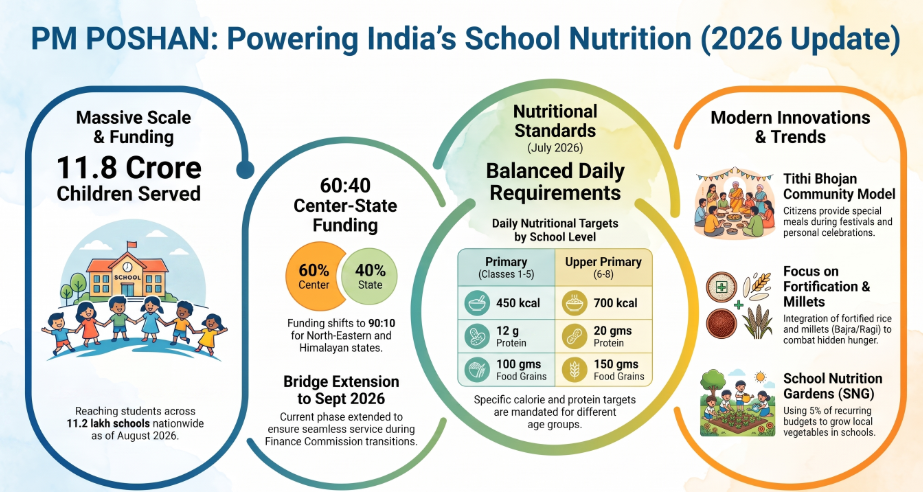
The Entitlement
PM Poshan guarantees primary school children 20g pulses, 50g vegetables, and 5g oil/fat (~12g protein, 450 calories), and upper primary children 30g pulses, 75g vegetables, and 7.5g oil/fat (~20g protein, 700 calories), delivered through a rotating weekly menu (rajma-rice, puri-chhole, kadhi-rice, sambhar-rice, snacks and fruits).
Three Structural Gaps Identified
- Portion equity is not guaranteed. Meals are served from bulk containers using a standard ladle, but actual quantity received varies by server discipline and lunchbox size. Since every child is officially recorded as having received the full meal regardless, nutrition delivered functions more as an administrative estimate than an enforceable entitlement — monitoring covers ingredient quality, hygiene, and quantity dispatched from the kitchen, but not what actually reaches the plate.
- The protein debate remains unresolved. The West Bengal government's move to hand PM Poshan preparation in Kolkata Municipal Corporation schools to the ISKCON-linked, vegetarian-only Annamitra Foundation led to eggs being dropped in favour of soy chunks, paneer, and rajma — triggering a national debate on whether egg inclusion should be a uniform nutritional standard or remain subject to state/religious sensitivities. Nutritionists note eggs remain among the most efficient protein sources for growing children, but menu composition today varies by state discretion rather than a binding national protein floor.
- Financing is donation-dependent. Implementing NGOs like Akshaya Patra report that government contribution covers only part of the actual per-meal cost, with the balance raised through donations — meaning the quality and consistency of meals (e.g., addition of paneer, third menu items beyond the government's two-item norm) can depend on an implementing partner's fundraising capacity rather than uniform public provisioning.
Significance for Mains
- Connects to the Right to Food and Article 21 (right to life with dignity), and to India's obligations on child nutrition under the National Food Security Act, 2013 and POSHAN Abhiyaan.
- Illustrates a recurring governance pattern: a well-designed entitlement on paper (specific gram/calorie norms) weakened by implementation gaps — parallel to issues seen in PDS leakages and NIPUN Bharat's learning-outcome shortfalls.
- Highlights the growing reliance on NGO/private partnership (Akshaya Patra, Ekta Shakti, ISKCON-linked bodies) to deliver a state welfare obligation, raising questions about accountability, uniformity, and the risk of ideological influence (as in the egg-removal controversy) over a nutrition entitlement meant to be need-based, not belief-based.
- Underlines the gap between input-based monitoring (ingredients, hygiene, dispatched quantity) and outcome-based monitoring (nutrition actually consumed) — a broader theme relevant to evaluating any welfare scheme's real effectiveness.
