

Preventive Detention

Preventive Detention
Source: The Hindu, Page 8
Why in News?
- Delhi Police detained over 5,000 protesters attempting to reach Jantar Mantar. On October 11, the Supreme Court directed the Centre and Delhi Police to ensure the free movement of people, subject to law and order.
- The Court emphasised that there should be no unlawful detention and that all detentions must follow established legal procedures.
Key Provisions and Safeguards
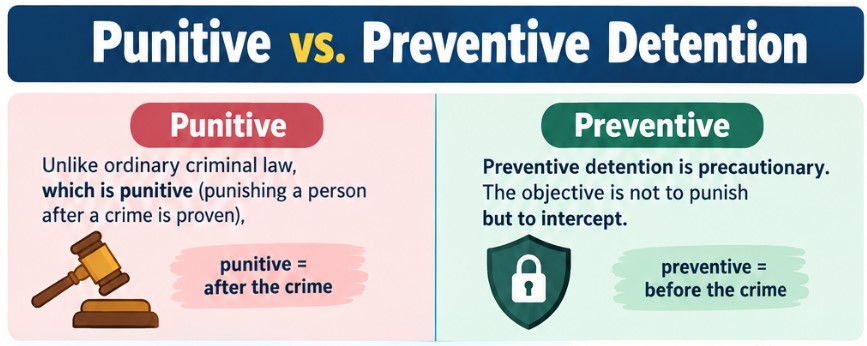
- Preventive detention involves detaining a person without trial or conviction to prevent anticipated activities that may threaten public order, state security or other specified interests.
- The National Security Act (NSA), 1980, permits preventive detention for activities prejudicial to India’s defence, foreign relations or security of the State.
- Section 163 of the Bharatiya Nagarik Suraksha Sanhita (BNSS) replaces Section 144 of the Code of Criminal Procedure, 1973, and empowers magistrates to issue prohibitory orders to prevent immediate harm or public disturbance.
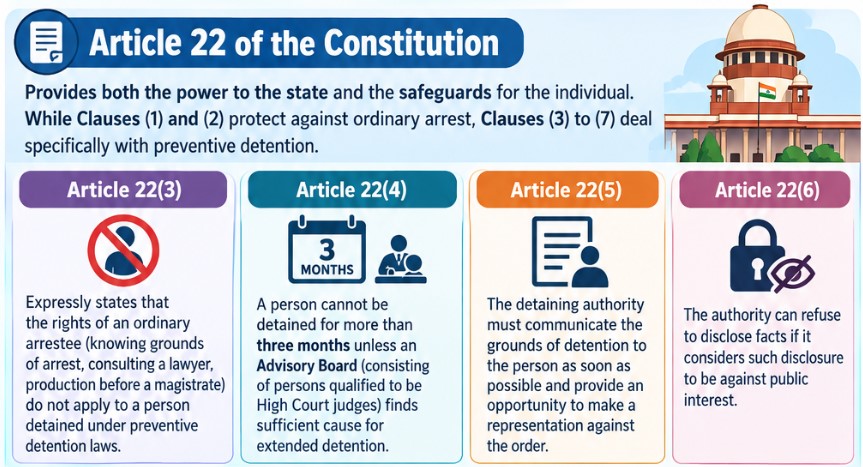
- Article 22 provides constitutional safeguards, including communication of detention grounds and review by an Advisory Board for detention exceeding three months, subject to constitutional exceptions and conditions.
- Articles 14, 19 and 21 protect equality, fundamental freedoms, and life and personal liberty, forming important safeguards against arbitrary state action.
|
Constitutional Framework: Article 22 While Article 22(1) and (2) provide safeguards against arrest (right to be informed of grounds, right to a lawyer, and production before a magistrate within 24 hours), Article 22(3) specifically excludes those held under preventive detention laws from these protections. Key Provisions under Article 22(4)–(7):
Major Preventive Detention Laws Several statutes empower the executive to exercise this power:
Latest Judicial Stance (2024-2026) The Supreme Court has recently tightened the scrutiny on preventive detention, labeling it a "draconian measure" that must be the exception, not the rule.
|
Historical Background and Judicial Pronouncements
- Preventive detention has colonial roots in laws such as the Rowlatt Act, 1919, and the Defence of India Act, 1939.
- Post-independence laws include the Preventive Detention Act, 1950, the Maintenance of Internal Security Act (MISA), 1971, repealed in 1978, and the Conservation of Foreign Exchange and Prevention of Smuggling Activities Act (COFEPOSA), 1974.
- In Maneka Gandhi v. Union of India (1978), the Supreme Court held that procedures restricting personal liberty must be just, fair and reasonable.
- In Babulal Parate v. State of Maharashtra (1961) and Khudiram Das v. State of West Bengal (1975), the Court addressed the limits and safeguards associated with preventive powers.
- In Mazdoor Kisan Shakti Sangathan v. Union of India (2018), the Court opposed a complete ban on protests and favoured reasonable regulation.
- In Shaik Naznen v. State of Telangana (2022), the Court reiterated that preventive detention is an exceptional power and should not be used routinely.