

Private Citizens for Census Duty: Census Rules Amendment

Private Citizens for Census Duty: Census Rules Amendment
GS Paper: GS-II (Governance, Statutory Bodies, Fundamental Rights, Judiciary) | GS-I (Population Data) |
Source: The Indian Express
Why in News?
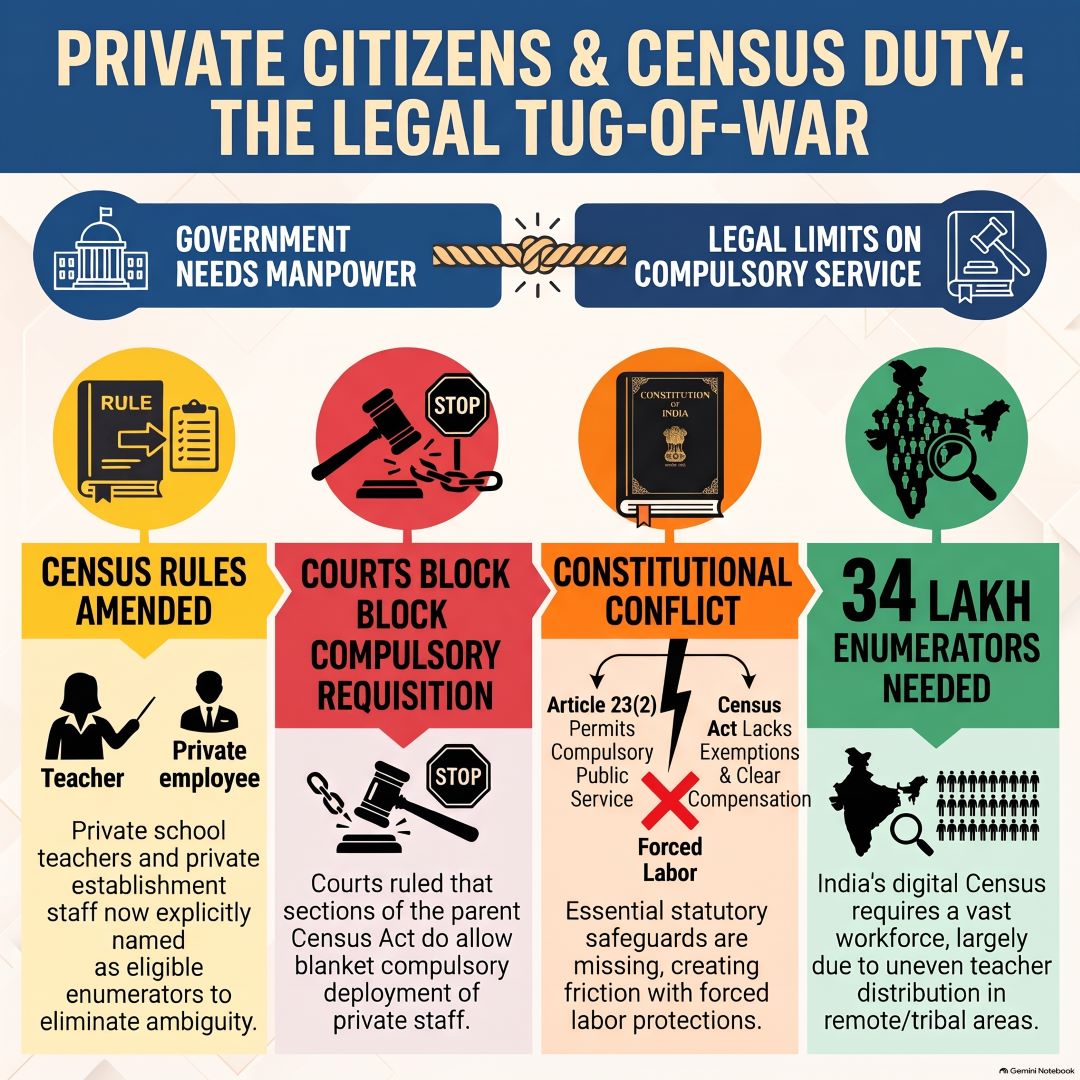
The Centre amended the Census Rules, 1990 to expressly include teachers of private educational institutions and employees of private establishments (banks, companies, societies, trusts) as eligible enumerators. This has reignited the legal question of whether the government can compel private individuals to do Census work, and why an amendment was needed if the old rules already allowed "any person".
What the Amendment Changes
• The rules now name teachers of government, local authority, aided and unaided private institutions as eligible, while keeping the broader category of any person the state or UT government considers suitable.
• This is not very different from old Rule 3, which allowed enumerators to be chosen from "teachers, clerks or any official or any person". The MHA says the aim is to remove ambiguity for a Census needing lakhs of enumerators.
• Trigger: In May 2026 the Bombay High Court gave interim protection to 500+ private unaided and minority schools in Maharashtra. It held that Sections 6 and 7 of the Census Act do not allow compulsory requisition of private unaided school staff (unlike Section 4A, which binds local authorities). It rejected the idea that "any person" covers private teachers (that reading could extend to doctors, advocates and CAs) and held, prima facie, that rules cannot exceed the parent Act. In October 2026 the Punjab and Haryana HC stayed Haryana's request for private-school teacher details. The amendment is seen as a response.
What the Census Act, 1948 Says and Judicial Precedents
• Section 4(2): states can appoint persons as census officers, who "shall be bound to serve". This is the government's strongest basis.
• Section 4A: local authorities must provide staff when the Centre directs. Sections 6 and 7: assistance from private establishments only in limited cases, mainly counting people within their premises.
• 2010, LIC Jalandhar (P&H HC): an order requiring LIC to provide 150 employees was quashed because Section 7(c) covers only counting persons within the establishment; states remain free to use Section 4(2).
• 2019, Gujarat HC (LIC case): a similar ruling, now challenged in the Supreme Court.
• Census 2011: the Bombay HC first protected private teachers (January 2011) and later allowed deployment before and after school hours, exempting Class X and XII teachers.
Constitutional Position and Why the Workforce Matters
• Article 23(1) bans forced labour (begar), but Article 23(2) permits compulsory service for public purposes, provided it is non-discriminatory. Examples: special police officers under the Police Act, 1861 (Dulal Samanta v District Magistrate, Howrah, 1958), and the National Service Act, 1972, which had registration, hardship postponement, remuneration and employer reinstatement provisions.
• Gap: the Census Act lacks such statutory machinery, so its compulsory-service basis is weaker.
• Scale: Census enumeration is still manpower-intensive; about 34 lakh enumerators and supervisors were estimated (June 2025), with around 31 lakh being trained. India has over 50 lakh government teachers. A former RGI official says the issue is uneven distribution (remote and tribal areas lack teachers) rather than shortage, and that good honoraria can encourage voluntary participation.
Analysis and Way Forward
• The case shows the clash between administrative necessity and limits on compulsory service. Section 4(2) may offer a sound route, but Sections 6 and 7 cannot justify blanket deployment of private staff.
• Clarity depends on the pending Supreme Court case before Census 2027. A statutory framework (compensation, exemptions, release from work, protection of livelihood and school timetables) and voluntary, well-paid participation would reduce litigation.
|
Census Basics for Prelims and Mains • Census Act, 1948 (Union List, Entry 69, Seventh Schedule) and Census Rules, 1990; conducted by the Registrar General and Census Commissioner of India under the MHA. Census 2027 is India's first digital census (mobile apps, self-enumeration) and is expected to include caste enumeration. It has two phases: house-listing and population enumeration. Verify the final dates and details. • Census data is the basis for delimitation, reservation and welfare allocation, and it was delayed since 2021 (the 2011 Census was the last). • Article 23: prohibition of traffic in human beings and forced labour (the right against exploitation). People's Union for Democratic Rights v Union of India (1982): payment below minimum wage is forced labour. • Subordinate legislation rule: delegated legislation (rules) must stay within the parent Act (ultra vires doctrine).
|
Quick Revision: Mains Linkages
• Rights vs state power: SEMs and the Census compulsion both concern limits on executive power over individuals (Articles 19, 21, 22, 23).
• Federalism and development: climate justice shows equity between countries; compare with CBDR-RC and India's NDCs.
• Ethics and governance: reasoned orders, proportionality, and accountability of executive officers.