

Production-Linked Incentive (PLI) Schemes

Production-Linked Incentive (PLI) Schemes
Context
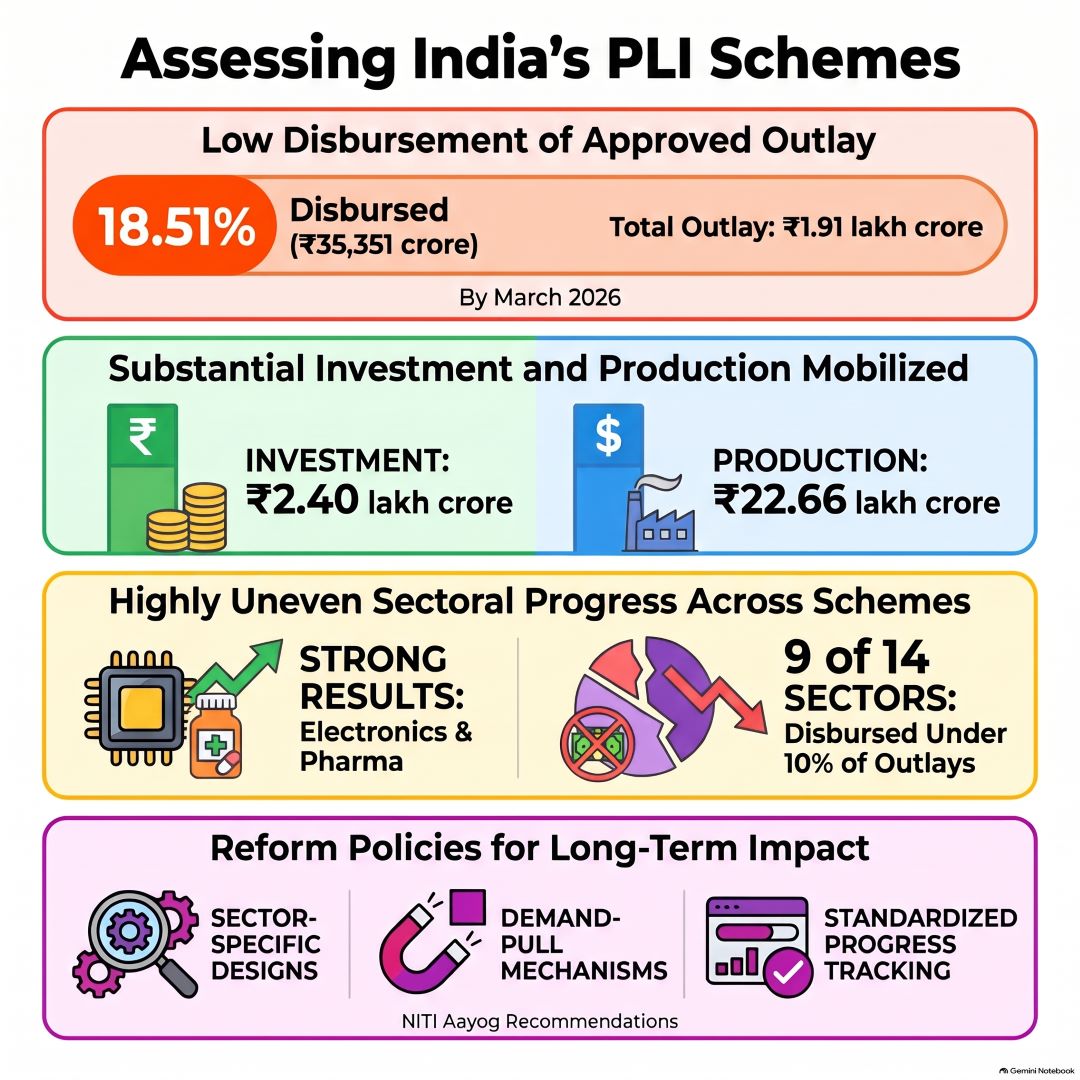
A joint impact assessment conducted by NITI Aayog and IIM Ahmedabad has highlighted that cumulative disbursements under India's 14 Production-Linked Incentive (PLI) schemes stood at just 18.51% of the total approved financial outlay by March 2026. The assessment also suggested several reforms to enhance the long-term effectiveness of these schemes.
Performance of PLI Schemes
- Launched in 2020 across 14 key sectors, including pharmaceuticals, textiles, automobiles and steel.
- The schemes have a combined financial outlay of ₹1.91 lakh crore.
According to the assessment, the performance up to March 2026 was as follows:
|
Key Indicators |
Performance |
|
Incentives disbursed |
₹35,351 crore (18.51% of total outlay) |
|
Investment attracted |
₹2.40 lakh crore |
|
Production generated |
₹22.66 lakh crore |
|
Employment generated |
More than 8.49 lakh people |
|
Targeted segments |
Nearly 70% broadly on track |
- Electronics, telecommunications and pharmaceutical drugs recorded particularly strong outcomes.
Sector-wise Differences in Performance
The disbursement of incentives has varied significantly across sectors.
- Nine schemes, including bulk drugs, automobiles and textiles, recorded disbursements of less than 10% of their respective financial outlays.
- Schemes covering drones and drone components, large-scale electronics and food products recorded comparatively higher disbursements, ranging between 25% and 77% of their respective outlays.
- The assessment highlighted that all schemes did not become operational simultaneously. Some sectors also required longer gestation periods before achieving the desired outcomes.
Why Are PLI Disbursements Relatively Low?
The relatively low level of incentive disbursement is partly explained by the performance-linked structure of the schemes.
- Incentives are released only when participating companies fulfil specified investment, production and other eligibility conditions.
- Therefore, payments are not made upfront but are linked to the actual performance of companies.
- As companies expand their manufacturing capacity, increase production and achieve progressively higher performance targets, incentive disbursements are expected to increase during the respective scheme periods.
However, the assessment also raised concerns regarding the quality and sustainability of industrial growth.
- Certain electronics manufacturing programmes have witnessed increased imports.
- Mobile phone manufacturing has generated limited employment, as the sector has largely expanded through assembly-based operations.
Key Recommendations of NITI Aayog
1. Sector-specific policy design
- A uniform policy approach may not adequately address the distinct requirements and challenges of different industries.
- Factors such as technology adoption, gestation periods, global competition and capital requirements differ considerably across sectors.
- Future incentive programmes should therefore be designed according to sector-specific needs.
2. Demand-side incentives
- Existing PLI schemes primarily follow a supply-driven approach by encouraging companies to expand production and manufacturing capacity through output-linked financial incentives.
- The assessment recommends introducing demand-pull mechanisms alongside supply-side incentives to ensure sustained demand for domestically manufactured products.
3. Standardised data collection
- Reporting mechanisms across different ministries need to be standardised.
- Information relating to additional revenue, employment, production and exports is currently inconsistent across sectors.
- Clear guidelines should establish the information companies are required to report, reporting timelines and procedures for monitoring annual progress.
4. Focus on long-term effectiveness
- The emphasis should move beyond assessing the initial success of PLI schemes.
- Greater attention must be given to strengthening their long-term contribution to industrial transformation.
Significance for India's Industrial Development
PLI schemes aim to achieve the following objectives:
- Strengthen domestic manufacturing capabilities.
- Attract domestic and foreign investment.
- Generate employment opportunities.
- Enhance India's competitiveness in global supply chains.
The assessment indicates that these schemes have attracted substantial investments and generated significant production. However, their long-term success will depend on whether the expansion of manufacturing translates into:
- Higher domestic value addition.
- Sustainable employment generation.
- Stronger and more competitive industrial capabilities.
A combination of targeted financial incentives, stronger domestic demand and reliable performance data can further improve policy outcomes.
Conclusion
The PLI framework has contributed to investment mobilisation and manufacturing expansion in India. However, uneven sectoral performance and concerns relating to employment generation and import dependence highlight the need for policy recalibration.
Moving towards sector-specific policies, demand-side support and standardised monitoring mechanisms will be essential to improve the effectiveness of future incentive programmes and achieve sustainable industrial transformation.