
Religious Conversion and Reservation

Religious Conversion and Reservation
Context
- The Supreme Court upheld the Madras High Court’s decision invalidating a Tamil Nadu Government Order dated 9 March 2024, which allowed certain persons converting to Islam to obtain Backward Class Muslim certificates without establishing their eligibility.
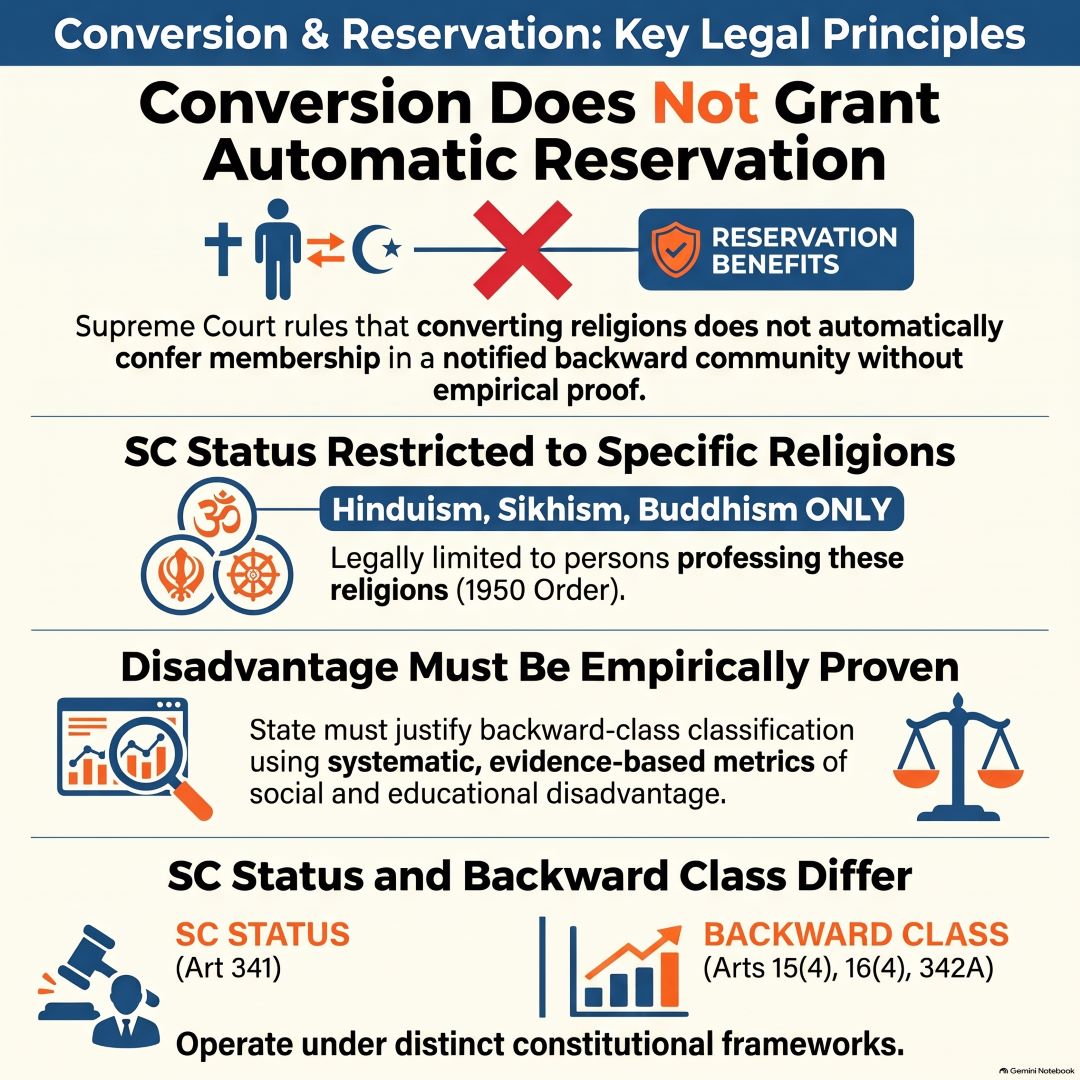
- In The Secretary to Government v. Sameer Ahamed N., the Court clarified that religious conversion does not automatically confer membership of a specific notified backward community.
Key Aspects of the Ruling
- No automatic eligibility: Conversion to Islam alone does not establish eligibility for Tamil Nadu’s 3.5% reservation for Backward Class Muslims. Applicants must satisfy the applicable community-identification criteria.
- Evidence-based classification: The State must justify backward-class identification through relevant evidence of social and educational disadvantage.
- Muslim backward classes: The ruling does not exclude Muslims from reservation. Non-Hindu communities can qualify as backward classes if they meet the relevant constitutional criteria.
- Community certificates: A certificate cannot independently create eligibility where the underlying legal requirements are not satisfied.
Constitutional Framework
- Article 341: The President specifies Scheduled Castes for each State or Union Territory. Parliament may include or exclude communities by law under Article 341(2).
- Constitution (Scheduled Castes) Order, 1950: Paragraph 3 currently restricts Scheduled Caste status to persons professing Hinduism, Sikhism or Buddhism. Conversion to Islam or Christianity does not preserve SC status under the existing Order.
- Article 15(4): Enables special provisions for the advancement of socially and educationally backward classes, Scheduled Castes and Scheduled Tribes.
- Article 16(4): Permits reservation in public employment for backward classes that are inadequately represented in State services.
- Article 342A: Provides the constitutional framework for identifying socially and educationally backward classes. Following the 105th Constitutional Amendment, States can maintain their own lists for State purposes.
|
Constitutional Framework for SC Status The core of this debate lies in the Constitution (Scheduled Castes) Order, 1950, issued under Article 341.
|
Evidence-Based Identification of Backward Classes
- Mandal Commission: The Second Backward Classes Commission used 11 indicators covering social, educational and economic disadvantage, with a maximum score of 22. Its framework emphasised systematic assessment rather than classification based only on identity.
- Tamil Nadu Backward Classes Commission: The State Government Order relied on a letter suggesting that data could be collected on converts who had previously benefited from reservation. However, the required empirical assessment of their eligibility was not established.
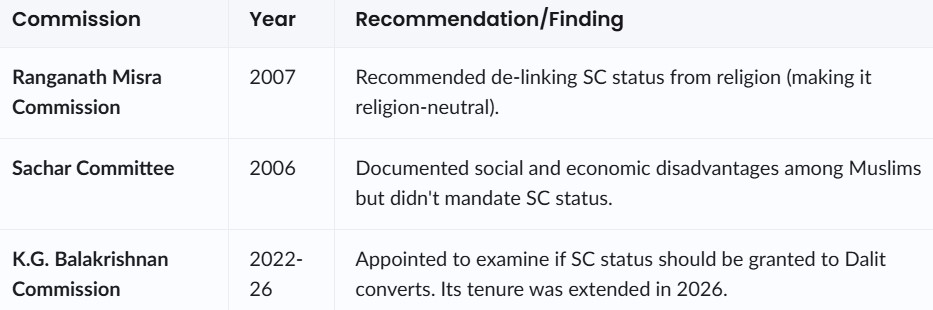
- Sachar Committee: Its 2006 report documented socio-economic and educational disadvantages among Muslims, including in education, employment and access to credit. However, general evidence of Muslim disadvantage does not automatically establish that converts belong to a particular notified backward Muslim community.
Religious Conversion and SC Status
- The Ranganath Misra Commission (2007) recommended removing the religion-based restriction on Scheduled Caste status. The recommendation did not itself change the existing law.
- In October 2022, a commission headed by former Chief Justice of India K.G. Balakrishnan was constituted to examine whether Scheduled Caste status could be extended to people who converted to religions outside those specified in the Presidential Order.
- SC status and backward-class eligibility are separate legal questions: the former is governed by Article 341 and the 1950 Order, while the latter depends on the applicable constitutional and State-level framework.
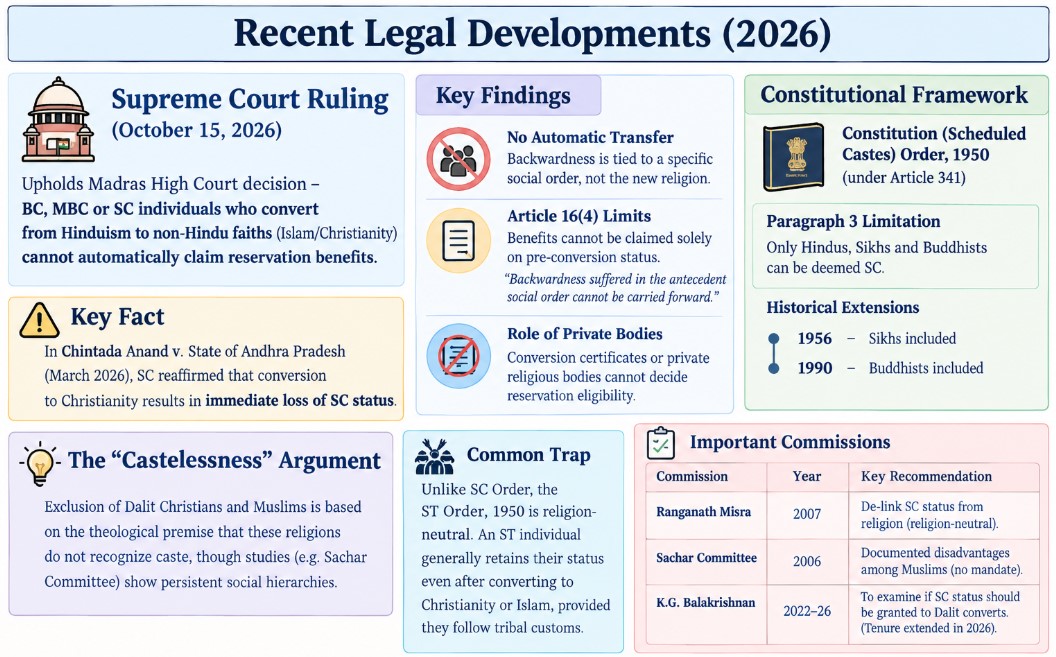

Important Commissions to Remember