

Repurposing Thermal Power Plants into Synchronous Condensers
Repurposing Thermal Power Plants into Synchronous Condensers
Why in News?
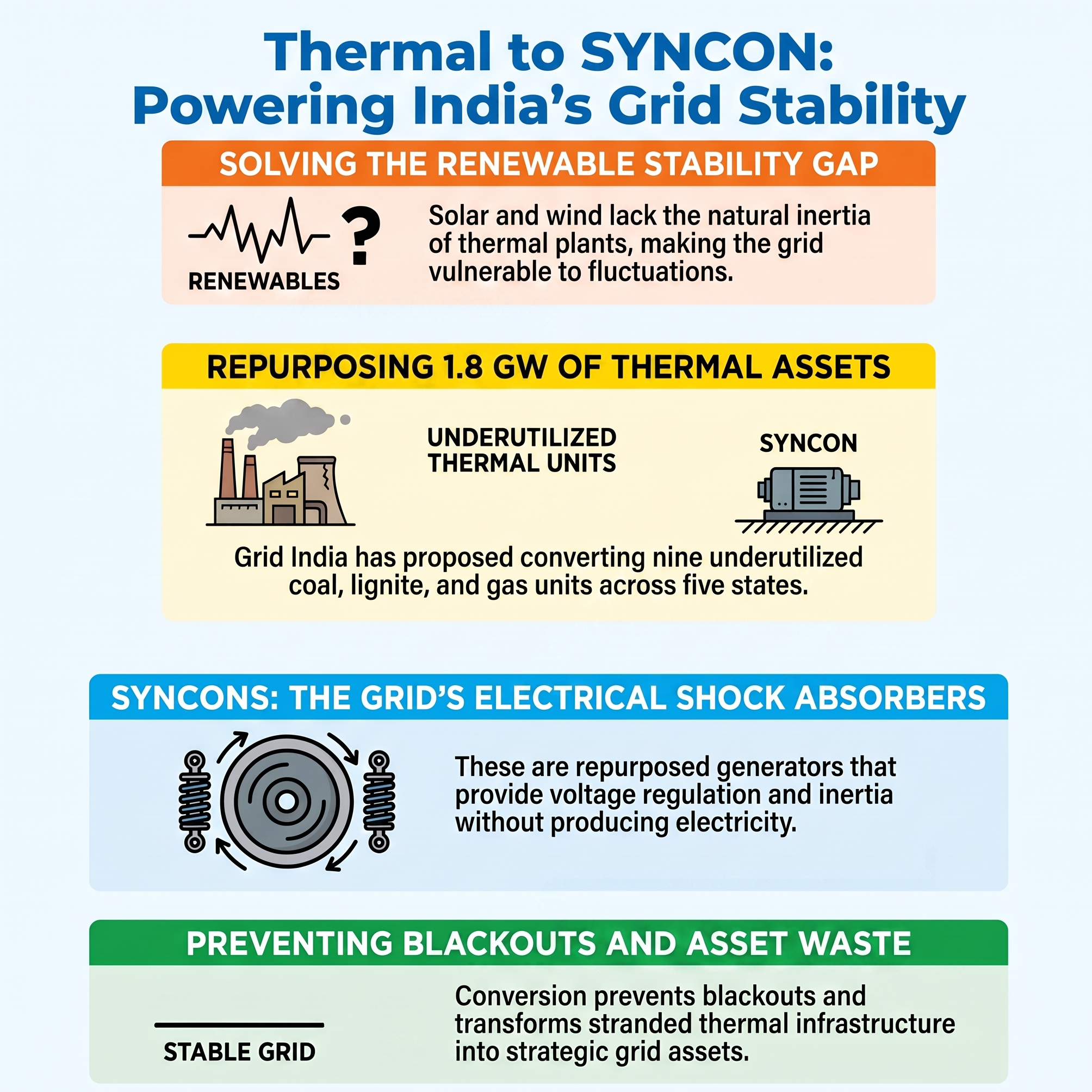
Grid India has proposed converting nine underutilised thermal power units (1.8 GW) into Synchronous Condensers (SYNCONs) to improve grid stability and support the integration of India's rapidly expanding renewable energy capacity.
Background
• The proposal emerged during a review meeting on summer power preparedness chaired by Union Power Secretary Pankaj Agarwal.
• The identified units include eight coal/lignite-based plants and one gas-based plant, located across Rajasthan, Gujarat, Maharashtra, Karnataka and Tamil Nadu.
• Most of these units are operating at low utilisation levels or remain under prolonged outages.
What are Synchronous Condensers?
• Synchronous condensers are generators that do not produce electricity but provide critical grid-support services.
• They supply reactive power, voltage regulation, inertial response and short-circuit strength, helping maintain grid stability during fluctuations.
• They function as electrical shock absorbers, particularly important when power generation increasingly comes from solar and wind sources.
Why is India Considering SYNCONs?
• Conventional thermal plants naturally provide inertia, voltage control and fault-current support to the grid.
• Renewable sources such as solar and wind are largely inverter-based and do not provide these services adequately.
• Growing renewable penetration has increased concerns regarding grid reliability and system stability.
• Recent disturbances, including the June 2024 tripping of the Champa–Kurukshetra HVDC link, highlighted the need for additional grid-support mechanisms.
Key Benefits
• Strengthens grid reliability and resilience.
• Facilitates large-scale integration of renewable energy.
• Provides voltage support and frequency stability.
• Enhances operation of protection systems through short-circuit current contribution.
• Utilises underperforming thermal assets instead of retiring them completely.
Global Experience
• Countries such as the United States, United Kingdom and Mexico have successfully converted retired thermal units into synchronous condensers.
• The Northern Regional Power Committee has also recommended deploying SYNCONs in the Rajasthan Renewable Energy Complex.
Significance
• Supports India's clean energy transition.
• Helps balance decarbonisation with grid security.
• Reduces the risk of blackouts and voltage instability.
• Converts stranded thermal infrastructure into strategic grid assets.
Conclusion
As India's renewable energy capacity expands rapidly, maintaining grid stability is becoming as important as adding new generation capacity. Converting underutilised thermal plants into synchronous condensers offers a cost-effective solution to strengthen the grid while supporting the country's long-term energy transition goals.
PYQ Linkage
• Renewable Energy Integration
• National Grid & Power System Stability
• Energy Transition and Decarbonisation
• Power Sector Infrastructure
Micro Flowchart
Rapid Renewable Energy Expansion
↓
Reduced Grid Inertia & Voltage Support
↓
Need for Grid-Stability Solutions
↓
Grid India Proposal (9 Thermal Units; 1.8 GW)
↓
Conversion into Synchronous Condensers (SYNCONs)
↓
Reactive Power + Voltage Control + Inertial Response
↓
Reliable Renewable Energy Integration
↓
Resilient National Power Grid

