

Reservation Limit and the 50% Cap

Reservation Limit and the 50% Cap
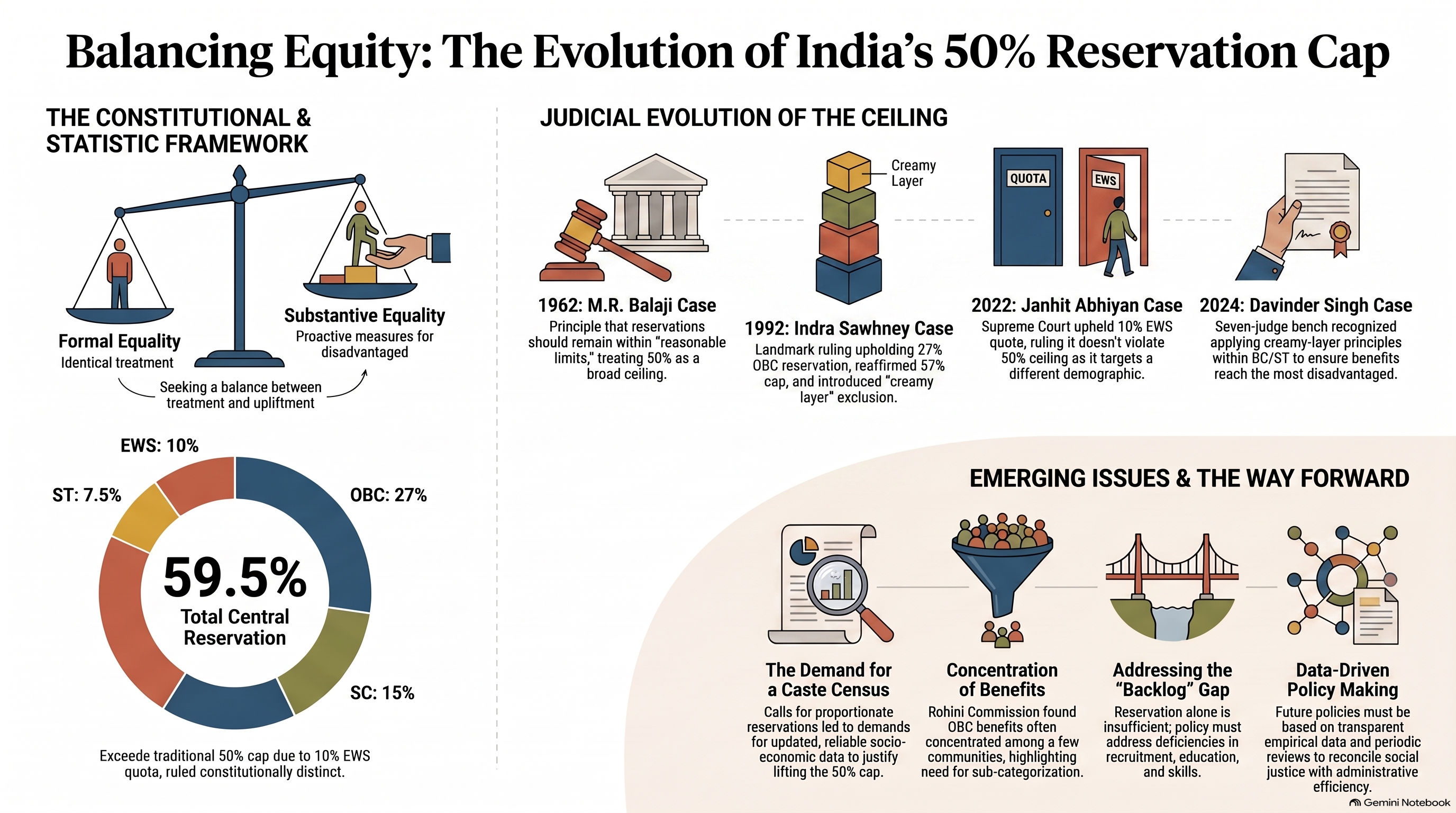
Context
- The debate over the judicially evolved 50% reservation ceiling has resurfaced amid demands for higher quotas, caste census and sub-categorisation.
- The issue reflects the constitutional balance between formal equality and substantive equality.
Constitutional Framework
- Articles 14, 15 and 16 establish equality and permit affirmative action for disadvantaged groups.
- Central reservation: OBC – 27%, SC – 15%, ST – 7.5%, EWS – 10%.
- EWS reservation is constitutionally distinct from reservations for socially and educationally backward classes.
Evolution of the 50% Cap
|
Case |
Significance |
|
M.R. Balaji (1962) |
Introduced the principle that reservations should remain within reasonable limits; 50% treated as a broad ceiling. |
|
N.M. Thomas (1975) |
Strengthened the idea of substantive equality; affirmative action is part of equality, not merely an exception. |
|
Indra Sawhney (1992) |
Upheld 27% OBC reservation, reaffirmed 50% ceiling and introduced the creamy-layer principle for OBCs. |
|
Janhit Abhiyan (2022) |
Upheld 10% EWS reservation; held that the 50% ceiling does not invalidate EWS quota. |
|
Davinder Singh (2024) |
Seven-judge Bench recognised the need to apply creamy-layer principles within SC/ST reservation to identify better-off sections. |
Emerging Issues
- Higher quotas: Demands for reservations proportionate to population have strengthened calls for a caste census and reliable socio-economic data.
- Unequal distribution: The Rohini Commission highlighted concentration of OBC benefits among a relatively small number of communities, supporting sub-categorisation.
- SC/ST creamy layer: Raises the question of whether benefits should reach the most disadvantaged sections within reserved categories.
- Backlog vacancies: Significant reserved vacancies remain unfilled, indicating that reservation alone cannot overcome deficiencies in recruitment, education and skills.
Way Forward
- Base reservation policy on updated and transparent empirical data.
- Implement carefully designed sub-categorisation to ensure equitable distribution.
- Address educational, skill and employment inequalities alongside reservations.
- Improve recruitment processes and fill backlog vacancies.
- Maintain a balance between social justice, equality of opportunity and administrative efficiency.
Conclusion
The 50% ceiling should not be viewed merely as a numerical dispute. The larger constitutional question is how affirmative action can achieve substantive equality without becoming either ineffective or excessively exclusionary. A data-driven and periodically reviewed reservation policy can better reconcile social justice with equality.
