

River Sand Mining: CEC’s Roadmap for Sustainable Alternatives

River Sand Mining: CEC’s Roadmap for Sustainable Alternatives
Source: IE
GS3: Environment, Infrastructure | GS2: Federalism, Governance
Context
The Central Empowered Committee (CEC), appointed by the Supreme Court, submitted Report No. 36 of 2026 on 2 November in the suo motu case on illegal sand mining in the National Chambal Sanctuary. The Court has widened the case to cover river sand mining across India. The CEC recommends phasing out unsustainable extraction from active river channels within three years and building alternative sources of sand.
Background: Legal and Ecological Framework
- Legal status: Sand is a minor mineral under the MMDR Act 1957. States frame the rules, grant leases and collect royalty. Mines and minerals fall under Entry 23 and water under Entry 17 of the State List, which makes Centre-State coordination central to any national framework.
- Regulation: Leases need environmental clearance from SEIAA/DEIAA under the EIA Notification 2006, guided by a District Survey Report. Deepak Kumar v. State of Haryana (2012) extended this to leases below 5 hectares. MoEFCC issued the Sustainable Sand Mining Management Guidelines 2016 and the Enforcement and Monitoring Guidelines 2020.
- Constitutional basis: Article 21 (right to a healthy environment), Article 48A (State to protect the environment), Article 51A(g) (duty of citizens) and the public trust doctrine (M.C. Mehta v. Kamal Nath, 1997), under which the State holds rivers in trust for the public.
- Ecological concept: Mining beyond a river’s natural sediment replenishment lowers the riverbed, erodes banks, drops the groundwater table, damages bridges and embankments, and destroys habitat. The Chambal Sanctuary (MP, Rajasthan, UP) protects the gharial, Gangetic dolphin and red-crowned roof turtle.
- The policy trap: The CEC’s 2020 Rajasthan report found legal collection fell from about 57 million tonnes a year to 5 million tonnes after Supreme Court restrictions. The supply gap became a major driver of illegal mining. Restriction without alternatives feeds the sand mafia.
Key Recommendations of the CEC
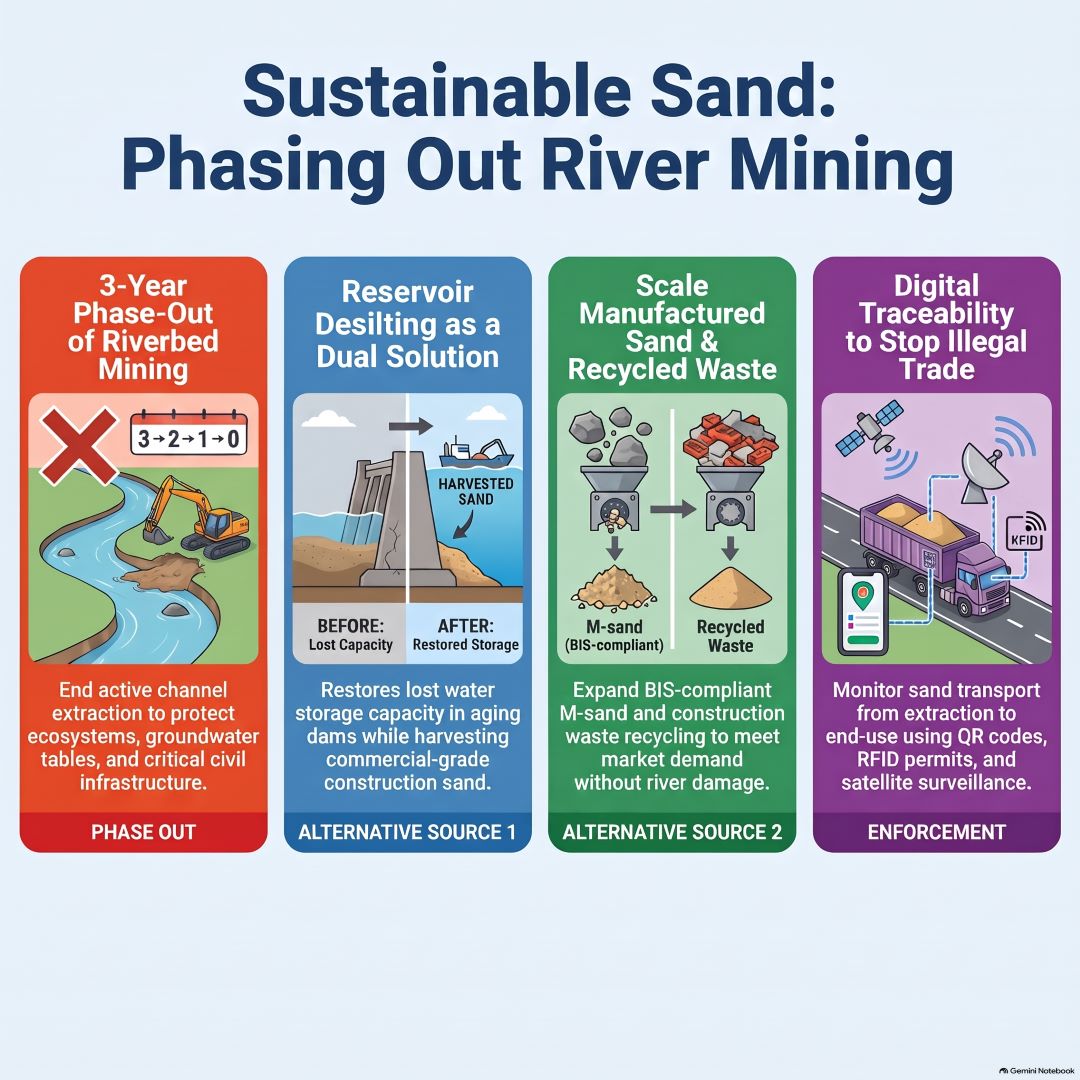
- Phase-out: Time-bound roadmap to end unsustainable extraction from active river channels in three years.
- Alternative sources: Reservoir sediment, manufactured sand (M-sand, if it meets BIS specifications) and recycled construction and demolition (C&D) waste.
- Desilting programme: Assess all dams older than 15 years that have not been systematically desilted. Award contracts within three years, then run a 10-year cycle desilting about one-tenth of suitable reservoirs a year. Desilting must rest on technical and environmental suitability, not be mandatory for every dam. Recovered sand is to be sold transparently.
- Institutions: Ministry of Jal Shakti to lead a national framework with the Central Water Commission, National Dam Safety Authority (Dam Safety Act 2021), MoEFCC and States.
- Traceability: Digital monitoring of permissions, quantities, actual extraction, e-transit permits and end-use, with QR codes, barcodes or RFID on permits.
Significance
- Dual benefit: Of 439 assessed reservoirs, average storage loss from sedimentation is 19.24% and 23 have lost over half their capacity. Gobind Sagar (Bhakra) fell from 9,868 MCM to about 7,300 MCM, a 26% decline. Desilting restores storage for irrigation, hydropower and flood control while supplying construction sand.
- Policy shift: Moves from banning illegal mining to creating legal supply, which addresses the cause of the Rajasthan failure.
- Circular economy: C&D recycling under the C&D Waste Management Rules 2016 reduces waste and demand for river sand.
- Governance: Traceability from mine to end-use can curb the illegal economy and the revenue leakage to States.
Challenges
- Data gap: No reliable national database of illegally extracted sand, and usable sand in reservoirs is not assessed nationally. The CEC itself cautions that not all accumulated sediment is recoverable or commercially usable.
- Federal coordination: Sand and water are State subjects, so a national framework depends on State buy-in.
- Demand during transition: Alternatives must scale without disrupting construction.
- Quality and capacity: M-sand acceptance (BIS standard IS 383) and weak C&D recycling capacity.
- Enforcement: Local nexus between miners and officials weakens even good rules.
Way Forward
- Complete scientific assessment of reservoir sand and river sediment budgets before scaling desilting.
- Build a national sand database and a transparent pricing and sale system.
- Scale up M-sand and C&D recycling with quality checks, and use public procurement to create demand.
- Use satellite imagery, drones and GPS-tracked transport for enforcement.
- Use a cooperative federalism model, with the Centre setting the framework and States implementing.