

Role of Civil Society and Public Pressure Groups in Strengthening Democracy

Role of Civil Society and Public Pressure Groups in Strengthening Democracy
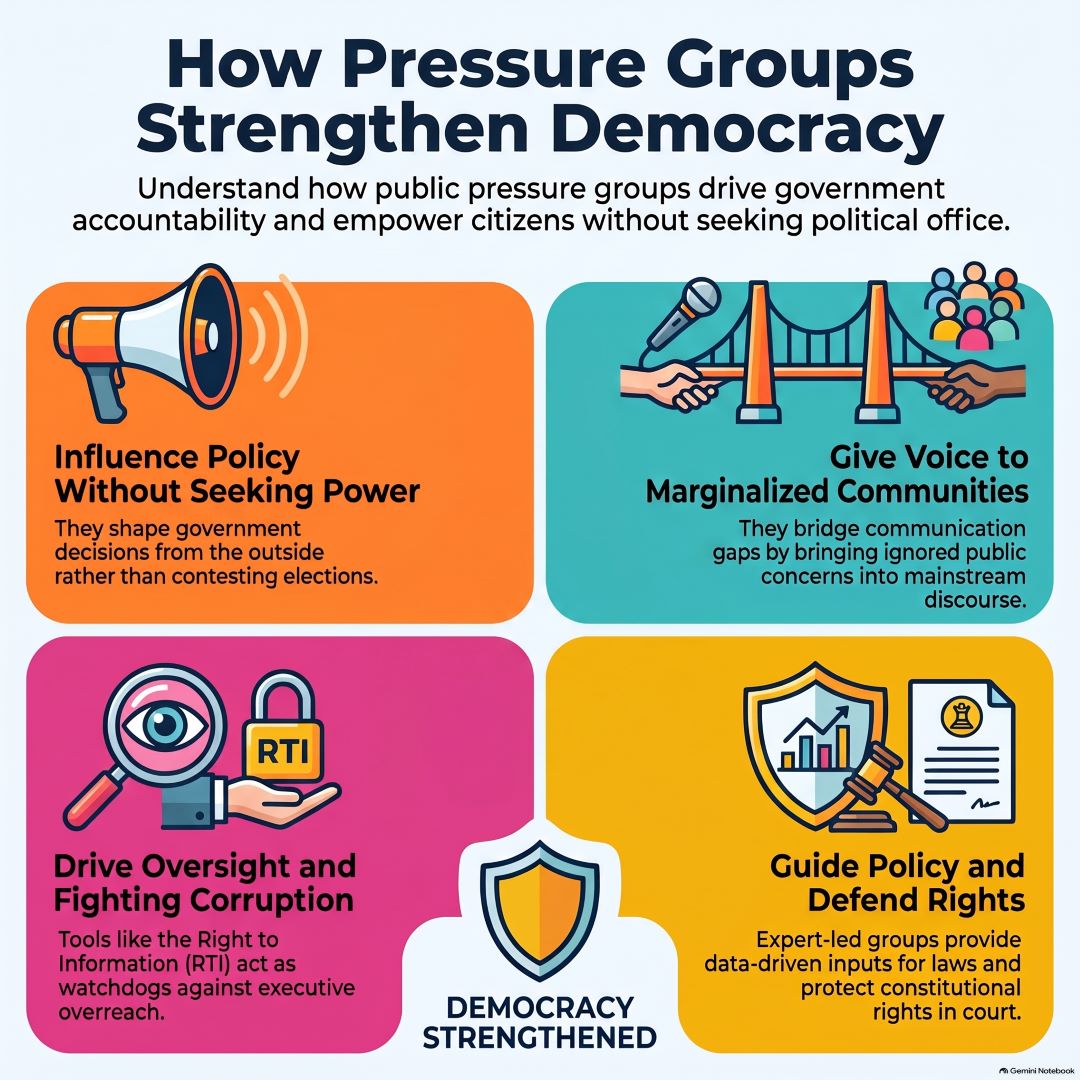
Source: The Statesman, 22 October 2026
Why in News?
- An opinion article discusses the emergence of the Cockroach Janata Party (CJP) as a public pressure group amid concerns over the weakening of opposition parties and democratic institutions.
- It highlights the need for political accountability, independent media, ethical leadership and citizen participation in a healthy democracy.
Role of Public Pressure Groups
- Public pressure groups influence government policies and political parties without necessarily contesting elections.
- They can raise public concerns regarding unemployment, poverty, inequality, gender-based violence and institutional accountability.
- Their effectiveness depends on independence from political parties, transparent functioning and a clear public-interest mandate.

|
Mechanisms of Strengthening Democracy Unlike political parties, these groups do not seek to capture state power; instead, they aim to influence it from the outside.
Typology of Influence Groups The effectiveness of these groups depends on their organization and the methods they employ.
|
Challenges to Democracy
- Weakening of opposition parties may reduce scrutiny of the government and undermine democratic accountability.
- Political and corporate funding can create conflicts of interest and encourage transactional politics.
- Media capture by political interests may weaken its role as the watchdog of democracy.
- Changes in government do not automatically guarantee better governance, highlighting the importance of institutional integrity and continuous public scrutiny.
Way Forward
- Maintain the political neutrality and financial independence of public pressure groups.
- Ensure transparency in funding, leadership and decision-making.
- Protect media freedom and strengthen democratic institutions.
- Encourage informed citizen participation and hold all political parties accountable, irrespective of ideology.
- Promote ethical political conduct and ensure that public welfare remains central to policymaking.
Conclusion
A healthy democracy requires more than elections, economic growth and changes in government. Independent institutions, a responsible media, effective opposition and vigilant citizens are essential to ensure accountability and protect public interests.