

Rot in Education
The Statesman
Key Arguments of the Article
Examination-Centric Education System
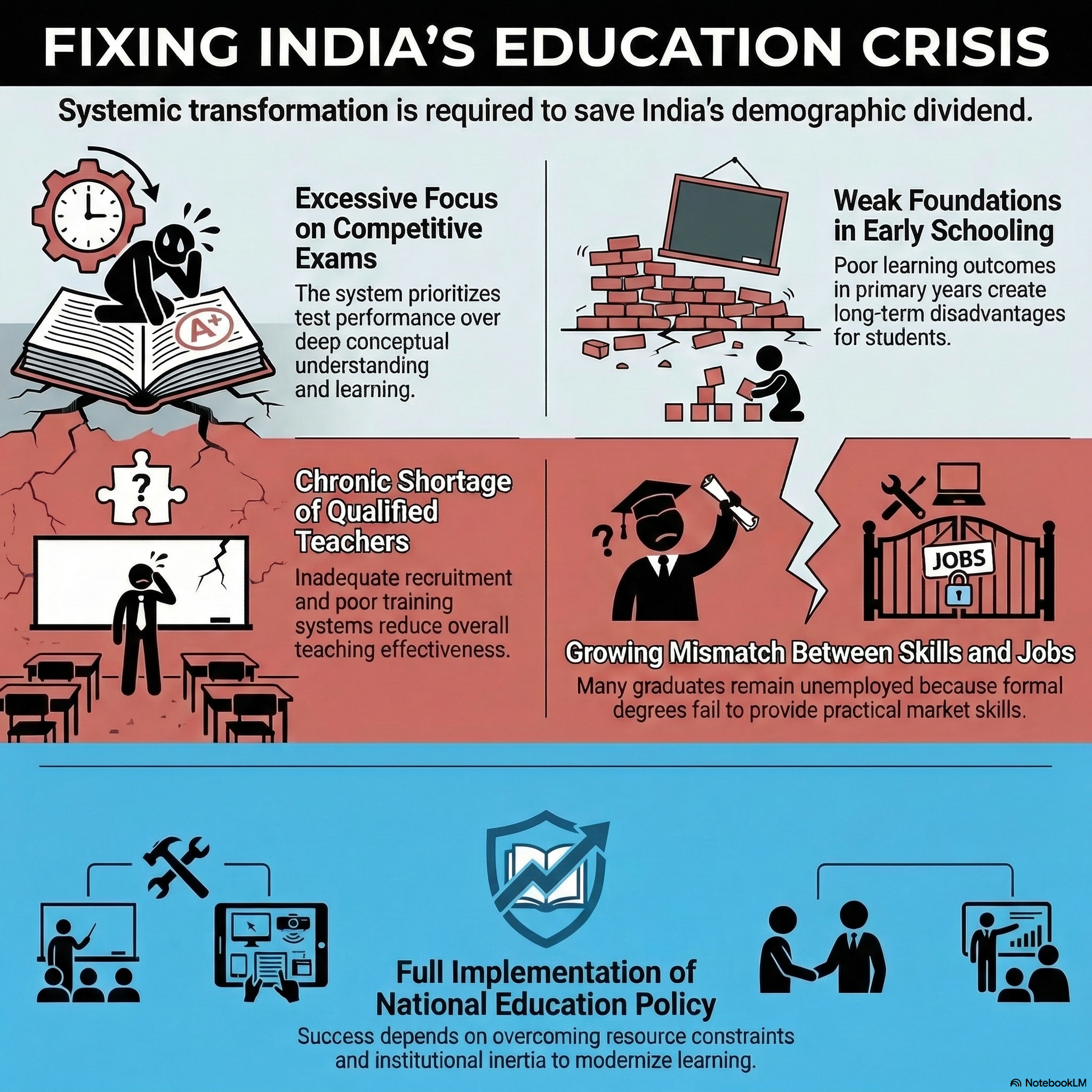
The article argues that India’s education system has become excessively exam-oriented. Competitive examinations such as NEET-PG determine career prospects, creating intense pressure on students.
This exam-driven model prioritises test performance rather than deep learning or conceptual understanding.
Weak Foundations in School Education
A central argument is that problems in higher education are rooted in weak foundational schooling. Poor learning outcomes in early education create long-term disadvantages for students.
Deficiencies in infrastructure, teacher availability, and teaching quality weaken the overall education ecosystem.
Coaching Industry and Commercialisation
The article highlights the rise of the coaching industry as a symptom of institutional failure. Students increasingly rely on private coaching to succeed in competitive exams.
This creates an unequal system where success depends heavily on financial resources rather than academic ability alone.
Shortage of Qualified Teachers
Another issue identified is the shortage of trained and motivated teachers, particularly in public schools. Inadequate teacher recruitment, poor training systems, and administrative burdens reduce teaching effectiveness.
Teacher quality directly affects student learning outcomes.
Implementation Challenges of the National Education Policy
The article notes that while the National Education Policy proposes important reforms—such as multidisciplinary learning and vocational education—its success depends on effective implementation.
Resource constraints, institutional inertia, and uneven state capacity may limit its impact.
Skills–Employment Mismatch
The article also argues that India’s education system often fails to equip graduates with practical skills required by the labour market.
As a result, many graduates remain unemployed or underemployed despite holding formal degrees.
Author’s Stance
The author adopts a critical and reform-oriented stance. The tone reflects deep concern about structural inefficiencies in the education system and calls for comprehensive reforms rather than incremental policy adjustments.
The argument emphasises systemic transformation rather than isolated policy fixes.
Possible Biases
Critical Institutional Perspective
The article strongly critiques institutional structures and may underrepresent improvements made in recent years in education access and enrolment.
Emphasis on Structural Failures
The focus on systemic weaknesses could overshadow positive developments such as digital learning initiatives and expansion of higher education institutions.
Reformist Bias
The narrative assumes that large-scale reforms are necessary, which may overlook gradual improvements occurring within the system.
Advantages of the Article’s Argument
Highlights Structural Issues
The article draws attention to deep-rooted problems in education that often remain overlooked in policy discussions.
Focus on Foundational Learning
Emphasising early education aligns with evidence that foundational literacy and numeracy are critical for long-term educational success.
Attention to Equity
The discussion of coaching culture and access inequality highlights socio-economic disparities in educational opportunities.
Limitations and Counterpoints
Progress in Enrolment and Access
India has achieved significant improvements in school enrolment and expansion of higher education institutions over the past decades.
Role of Technology
Digital learning platforms and online education initiatives are transforming access to education, which the article does not fully explore.
Complexity of Reform Implementation
Education reforms require coordination across multiple levels of government and institutions, making rapid transformation difficult.
Policy Implications
Strengthening Foundational Education
Greater investment in early education, teacher training, and learning assessment is necessary to improve foundational skills.
Teacher Recruitment and Training
Improving teacher quality through professional training and better recruitment policies is essential.
Regulation of Coaching Sector
Policies may be needed to regulate coaching institutions and reduce excessive exam pressure.
Aligning Education with Skill Development
Education systems must integrate vocational training and industry-linked learning opportunities.
Effective Implementation of NEP
Successful implementation of the National Education Policy requires sustained funding, institutional capacity, and monitoring mechanisms.
Real-World Impact
If reforms succeed:
• Improved learning outcomes in schools
• Better employability of graduates
• Reduced dependence on coaching institutions
• Greater equity in educational opportunities
If problems persist:
• Rising education inequality
• Skill shortages in the labour market
• Increased youth unemployment
• Continued pressure from competitive examination systems
Alignment with UPSC GS Papers
GS Paper II
Education policy, governance challenges, and implementation of public sector reforms.
GS Paper III
Human capital development, employment generation, and skill development.
GS Paper I
Social development issues and the role of education in societal transformation.
GS Paper IV
Ethical issues related to equality of opportunity and fairness in public institutions.
Balanced Assessment
The article presents a compelling critique of systemic weaknesses in India’s education system. By highlighting issues such as exam-oriented learning, coaching culture, and weak foundational education, it underscores the need for comprehensive reforms.
At the same time, policy efforts such as the National Education Policy represent attempts to address many of these challenges, though their success depends on effective implementation.
Future Perspective
India’s demographic dividend depends heavily on the quality of its education system. Strengthening foundational learning, improving teacher quality, and aligning education with labour market needs will be essential for sustaining economic growth.
For policymakers and civil services aspirants, the article illustrates the critical link between education reform, human capital development, and long-term national progress.
