

Safeguards on Arrest: Supreme Court’s Evolving Jurisprudence

Safeguards on Arrest: Supreme Court’s Evolving Jurisprudence
Constitutional and Legal Framework
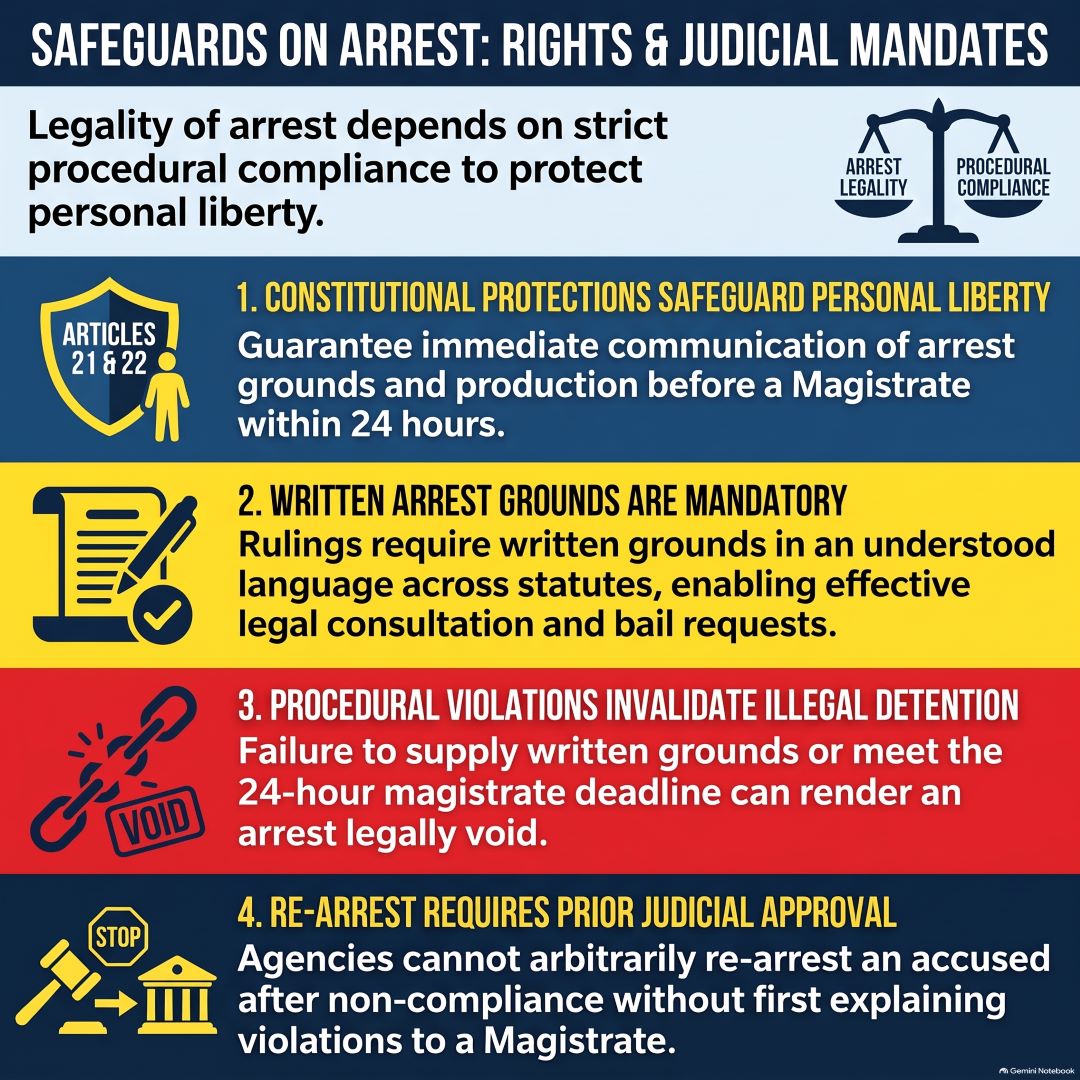
- Article 21 guarantees the right to life and personal liberty, requiring deprivation of liberty to follow a fair, just and reasonable procedure.
- Article 22(1) provides that an arrested person must be informed, as soon as possible, of the grounds of arrest and cannot be denied the right to consult and be defended by a lawyer of choice.
- Article 22(2) requires production before the nearest Magistrate within 24 hours of arrest, excluding necessary travel time. Further detention requires judicial authorisation.
- Section 47 of the Bharatiya Nagarik Suraksha Sanhita (BNSS), 2023, corresponding to Section 50 of the CrPC, requires an officer arresting a person without a warrant to communicate the grounds of arrest.
Evolution of Supreme Court Jurisprudence
- Pankaj Bansal v. Union of India (2023): In the context of the Prevention of Money Laundering Act (PMLA), the Court held that written grounds of arrest must be furnished as a matter of course. This enables the accused to understand the allegations, consult a lawyer and seek bail effectively.
- Prabir Purkayastha v. State (NCT of Delhi) (2024): The Court extended the requirement of written grounds beyond the PMLA to arrests under the Unlawful Activities (Prevention) Act (UAPA), reinforcing the constitutional significance of this safeguard.
- Rajesh Mihir Shah (2024): As described in the supplied material, the Court emphasised written communication in a language understood by the arrested person. Where immediate written communication is impracticable, the stated framework permits initial oral communication, provided written grounds are supplied at least two hours before production for remand.
- Vihaan Kumar (2025): The Court stressed that communication must be effective and meaningful, enabling the accused to understand the basic facts constituting the grounds of arrest. The arresting agency bears the burden of establishing compliance once non-communication is alleged.
Latest Development: Jaskaran Jeet Singh Deol Case
- In September 2026, the Supreme Court considered the failure to supply written grounds of arrest alongside a violation of the 24-hour production requirement under Article 22(2).
- The Court reaffirmed that failure to communicate grounds of arrest in accordance with constitutional and statutory requirements can invalidate the arrest and subsequent remand.
- Violation of the 24-hour production requirement can render the arrest and continued detention illegal where the constitutional conditions are not met.
- The Court also addressed re-arrest following an invalid arrest, emphasising that the same investigating authority cannot simply re-arrest the accused at its discretion. The agency must approach the Magistrate, explain the earlier non-compliance and obtain judicial approval.
- Departmental proceedings against the concerned investigating officers highlighted the importance of accountability for violations of arrest safeguards.
Significance for Constitutional Governance
- Personal liberty: Prevents arbitrary deprivation of liberty and strengthens Article 21 protections.
- Access to justice: Written grounds allow the accused and legal counsel to challenge the legality of arrest and seek appropriate relief.
- Judicial oversight: Timely production before a Magistrate prevents unauthorised detention and enables independent scrutiny of custody.
- Rule of law: Treats compliance with constitutional safeguards as a substantive obligation rather than a procedural formality.
- Police accountability: Reinforces responsibility for unlawful arrests and procedural violations.
Way Forward
- Standardise written arrest notices in languages understood by the arrested person and maintain verifiable records of communication.
- Train police and investigating agencies on constitutional safeguards, statutory requirements and judicial precedents.
- Ensure prompt production before Magistrates and meaningful scrutiny of the grounds for continued detention.
- Strengthen legal aid and access to counsel from the earliest stages of custody.
- Enforce accountability for violations while ensuring that legitimate investigations remain effective.
The Supreme Court’s evolving jurisprudence emphasises that the legality of an arrest depends not merely on the authority to arrest but also on compliance with safeguards protecting personal liberty. Effective communication of grounds, timely judicial oversight and accountability are essential to preventing arbitrary detention.