

Saving Ganga from Reckless Development
The Tribune
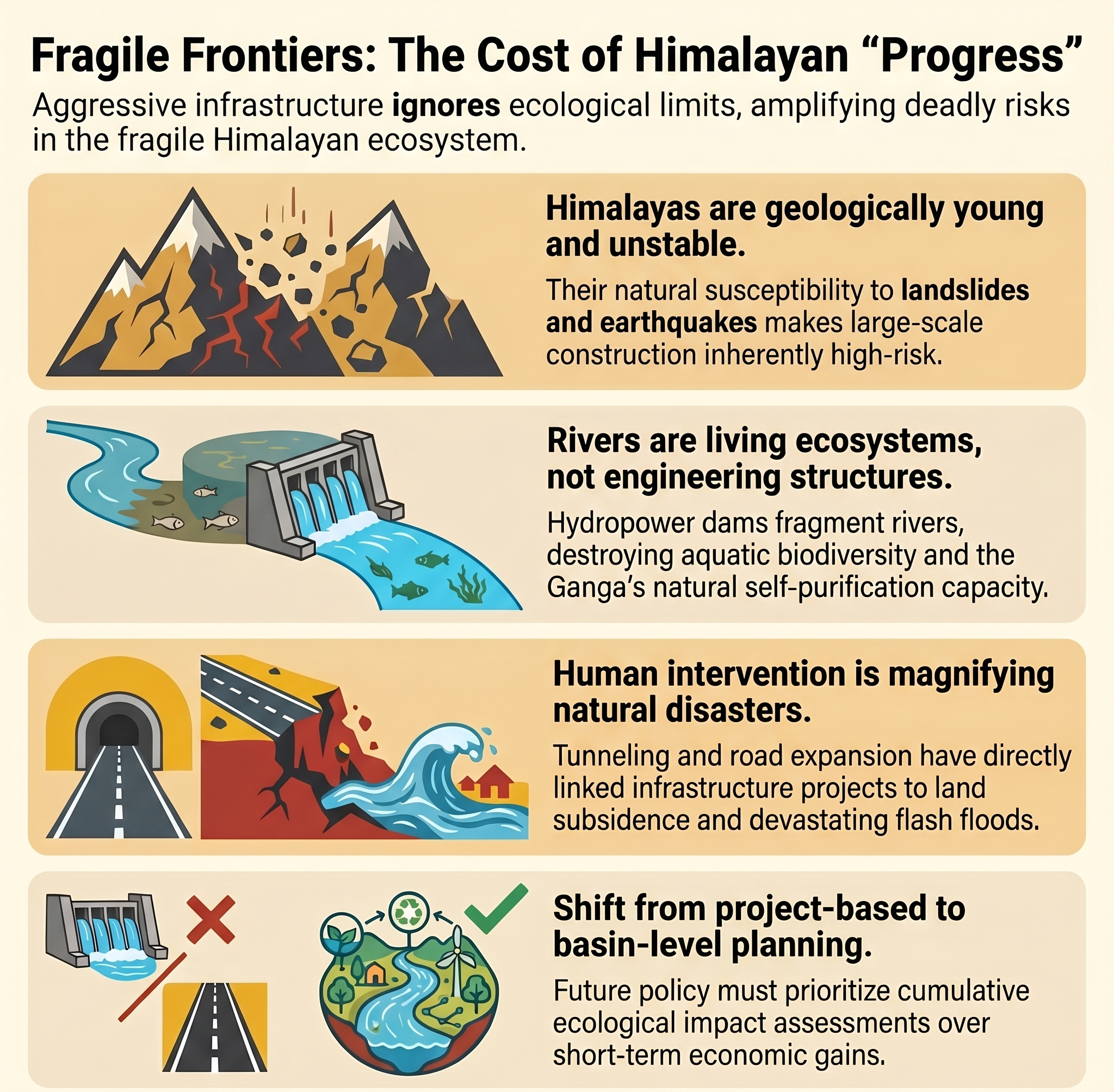
Core Theme
The central argument is:
The Ganga and the fragile Himalayan ecosystem are increasingly threatened by reckless infrastructure expansion, especially hydropower projects, road construction, tunneling, and river modification activities.
The article contends that ecological warnings have repeatedly been ignored despite judicial interventions, expert committee reports, and scientific evidence.
Background Context
The article refers to:
- Uttarakhand floods (2013)
- Joshimath land subsidence crisis
- Glacial lake outburst flood (GLOF) concerns
- Expansion of hydropower projects
- Char Dham infrastructure projects
- Tunnel and road construction activities
These events are used to demonstrate growing ecological vulnerability in the Himalayan region.
Key Arguments Presented
1. Himalayas are ecologically fragile
The article emphasizes that:
- Himalayas are geologically young mountains.
- The terrain is naturally unstable.
- The region is highly susceptible to landslides, earthquakes, floods, and erosion.
Large-scale infrastructure projects increase these vulnerabilities.
Significance
This challenges the conventional assumption that infrastructure expansion can proceed in the Himalayas using the same developmental model applied elsewhere.
2. Hydropower projects have altered river ecosystems
A major criticism concerns:
- River fragmentation
- Tunnel-based diversions
- Reduced ecological flows
- Destruction of aquatic biodiversity
According to the article, hydropower development has transformed rivers from living ecosystems into engineering structures.
Environmental Consequences
- Habitat destruction
- Loss of fish migration routes
- Sediment disruption
- Reduced river self-purification capacity
3. Scientific warnings have been ignored
The article argues that:
Several expert committees and environmental assessments have repeatedly warned against excessive construction activities.
Yet:
- Approvals continued.
- Environmental safeguards were diluted.
- Economic interests often prevailed over ecological concerns.
4. Development is increasing disaster vulnerability
The article links:
- Landslides
- Flash floods
- Riverbank erosion
- Land subsidence
with human interventions.
The argument is not that disasters are entirely man-made, but that development projects amplify natural risks.
5. The Ganga is more than a river
The article adopts a broader perspective:
Ganga represents:
- Ecological heritage
- Cultural identity
- Religious significance
- Livelihood support system
Therefore, river management cannot be reduced solely to engineering calculations.
Author's Stance
The author adopts a clearly environmentalist position.
Key Features of the Stance
- Strongly critical of hydropower-led development.
- Supportive of ecological conservation.
- Skeptical of current development policies in the Himalayas.
- Advocates precautionary principles in environmental governance.
The article places ecological sustainability above rapid infrastructure expansion.
Potential Biases in the Article
1. Ecological conservation bias
The article prioritizes environmental concerns.
While valid, it may underemphasize:
- Energy needs
- Regional development demands
- Employment generation
- Strategic infrastructure requirements
2. Anti-hydropower tendency
The article focuses largely on negative impacts of hydropower.
It provides limited discussion on:
- Renewable energy benefits
- Reduced fossil-fuel dependence
- Energy security gains
3. Precautionary bias
The article assumes:
Environmental risks should take precedence whenever uncertainty exists.
While environmentally prudent, policymakers often must balance competing priorities.
Strengths of the Argument
Recognizes Himalayan Fragility
The article correctly highlights:
- Seismic vulnerability
- Climate sensitivity
- Geological instability
These are scientifically established concerns.
Connects Ecology and Disaster Risk
It effectively demonstrates that:
Environmental degradation increases disaster intensity.
This aligns with modern disaster risk reduction frameworks.
Promotes Sustainable Development
The article reinforces:
Development should not compromise ecological resilience.
This is consistent with SDGs and climate adaptation principles.
Encourages Evidence-Based Policy
The article relies on:
- Scientific studies
- Committee reports
- Environmental assessments
rather than emotional arguments alone.
Limitations of the Argument
Underestimates Energy Requirements
India faces rising:
- Electricity demand
- Industrial growth needs
- Urbanization pressures
Hydropower remains an important renewable energy source.
Strategic Considerations Receive Less Attention
Himalayan infrastructure also serves:
- Border security
- Disaster response
- Connectivity needs
These dimensions receive relatively limited treatment.
Lack of Practical Alternatives
The article criticizes existing projects but offers fewer concrete alternatives regarding:
- Energy replacement
- Regional economic development
- Infrastructure planning
Environmental Governance Issues Raised
Weak Environmental Impact Assessment (EIA)
The article indirectly questions:
- Quality of EIAs
- Independence of assessments
- Monitoring mechanisms
Fragmented Decision-Making
Different agencies often pursue:
- Roads
- Dams
- Tourism projects
without cumulative ecological assessment.
Compliance Deficit
Environmental conditions are often:
- Weakly enforced
- Poorly monitored
- Rarely audited after approval
Policy Implications
Need for Cumulative Impact Assessments
Rather than project-wise approvals:
Authorities should assess:
- Entire river basins
- Regional ecological carrying capacity
Strengthening Ecological Flow Norms
Hydropower projects should ensure:
- Minimum environmental flows
- River continuity
- Biodiversity protection
Climate-Resilient Infrastructure
Future infrastructure must account for:
- Glacial retreat
- Extreme rainfall
- Landslide risks
- Flash floods
Integrated Himalayan Policy
A dedicated Himalayan ecological framework may be required to balance:
- Conservation
- Development
- Disaster resilience
Community Participation
Local communities should play a greater role in:
- Environmental assessments
- Monitoring
- Decision-making
Real-World Impact
Ecological Impact
Unchecked development can result in:
- Biodiversity loss
- River degradation
- Forest fragmentation
Economic Impact
Short-term gains may lead to:
- Long-term disaster losses
- Infrastructure damage
- Increased rehabilitation costs
Social Impact
Communities face:
- Displacement
- Livelihood disruptions
- Increased disaster vulnerability
Cultural Impact
The degradation of Ganga affects:
- Religious traditions
- Pilgrimage routes
- Cultural heritage
Constitutional and Legal Dimensions
The article indirectly touches upon:
Article 21
Right to life includes:
- Right to a healthy environment.
Article 48A
State shall protect and improve the environment.
Article 51A(g)
Citizens have a duty to protect natural resources.
Sustainable Development Principle
Development must meet present needs without compromising future generations.
UPSC GS Paper Linkages
GS Paper I
- Physical Geography of Himalayas
- Environmental geography
- Disaster-prone regions
GS Paper II
- Environmental governance
- Federalism in natural resource management
- Role of judiciary in environmental protection
GS Paper III
- Environment and Ecology
- Disaster Management
- Climate Change
- Conservation
- Sustainable Development
GS Paper IV
- Intergenerational equity
- Environmental ethics
- Public responsibility
Arguments Supporting the Article
Ecological warnings are increasingly validated
Recent disasters indicate that ecological concerns cannot be ignored.
Prevention is cheaper than recovery
Disaster rehabilitation costs often exceed preventive conservation costs.
Rivers are ecosystems, not merely resources
The article correctly broadens the understanding of river systems.
Climate change magnifies risks
Fragile mountain ecosystems require greater caution than before.
Arguments Against the Article
Development cannot stop entirely
Infrastructure remains necessary for:
- Connectivity
- Economic growth
- National security
Hydropower remains a clean energy source
Compared to coal, hydropower reduces carbon emissions.
Technological solutions are evolving
Improved engineering and environmental safeguards may reduce risks.
Economic aspirations of local populations matter
Development projects also create jobs and infrastructure benefits.
Model UPSC Value Addition
Key Concept
Ecological Carrying Capacity
The maximum level of development an ecosystem can sustain without irreversible degradation.
Key Principle
Precautionary Principle
Where serious environmental harm is possible, lack of full scientific certainty should not delay preventive action.
Key Framework
Disaster Risk Reduction (DRR)
Integrating environmental conservation into development planning to reduce future disaster losses.
Balanced Conclusion
The article presents a compelling warning against treating the Himalayas and the Ganga basin merely as spaces for infrastructure expansion. It persuasively argues that recurring disasters are exposing the ecological costs of an overly aggressive development model that often overlooks scientific warnings and environmental limits.
However, the debate should not be framed as development versus conservation. India's challenge is to pursue development that is ecologically informed, scientifically assessed, and socially responsible. Energy security, connectivity, and economic growth remain legitimate objectives, but they must operate within the carrying capacity of fragile mountain ecosystems.
The article's greatest contribution is its reminder that environmental sustainability is not an obstacle to development but a prerequisite for long-term prosperity.
Future Perspective
The future of the Ganga and the Himalayan ecosystem lies in:
- Basin-level planning rather than project-level approvals.
- Stronger environmental impact assessments.
- Climate-resilient infrastructure.
- Greater reliance on cumulative ecological studies.
- Community-centric conservation.
- Integration of disaster risk reduction into development policy.
India's developmental success in the Himalayas will ultimately be measured not by the number of dams, tunnels, or highways built, but by whether economic progress can coexist with ecological security and the preservation of one of the world's most fragile and sacred river systems.
