

Special Executive Magistrates (SEMs) and Preventive Powers

Special Executive Magistrates (SEMs) and Preventive Powers
GS Paper: GS-II (Polity: Executive-Judiciary Relations, Fundamental Rights, Police Reforms) | Source: The Hindu | The Indian Express
Why in News?
The detention and subsequent bail of Cockroach Janta Party (CJP) activists Saurav Das and Ashutosh Ranka, along with a notice to AISA president Neha Bora, has put the powers of Special Executive Magistrates (SEMs) under scrutiny. They were arrested on 14 October 2026 for allegedly breaching security at Jantar Mantar during protests against the Special Intensive Revision (SIR) of electoral rolls. The case has reopened a debate on how much power non-judicial officials should have over personal liberty.
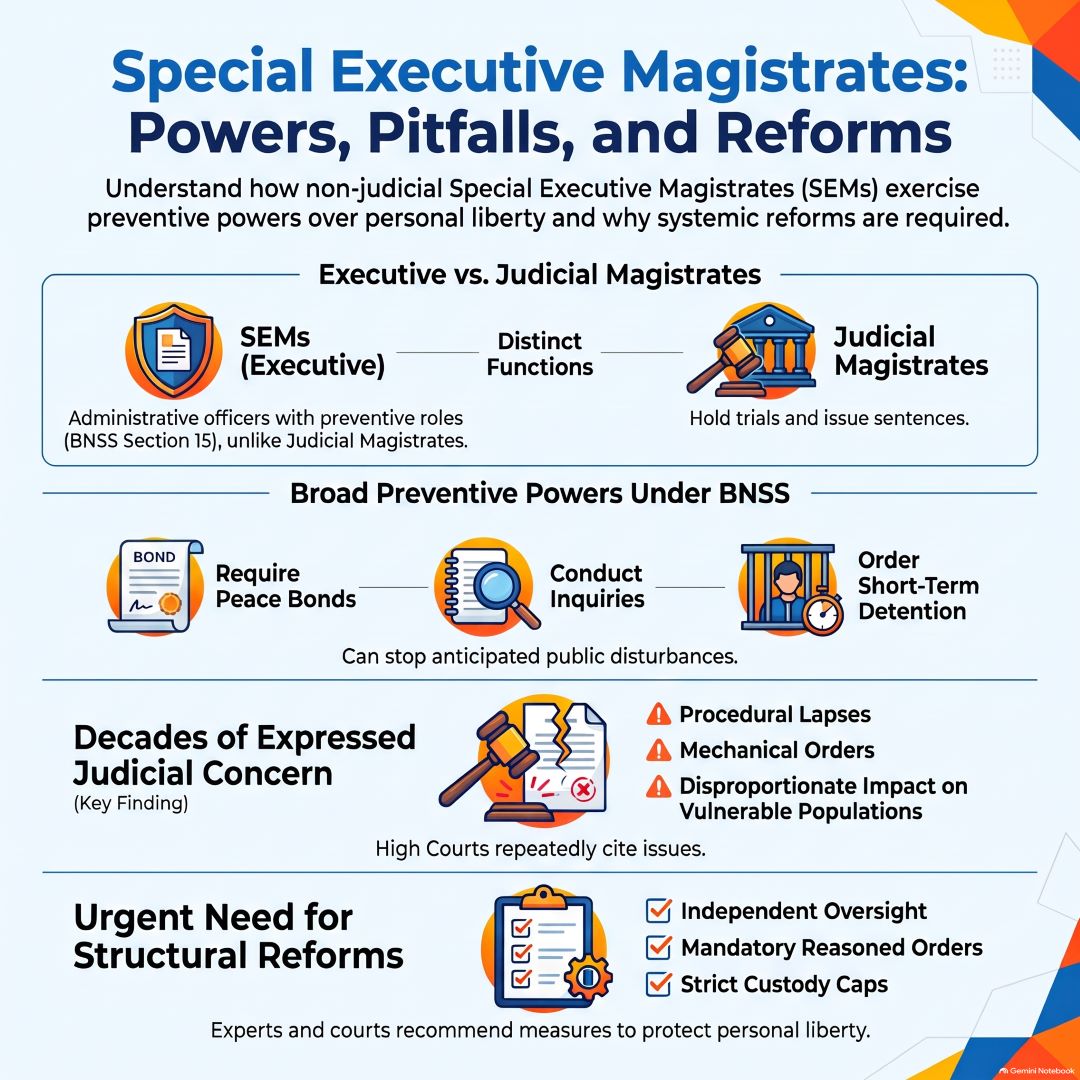
Who Are SEMs? Executive vs Judicial Magistrates
• State governments appoint SEMs for specific areas, periods or purposes, giving them Executive Magistrate powers under Section 15 of the Bharatiya Nagarik Suraksha Sanhita (BNSS), 2023. In Delhi, the Delhi Police Act lets the Centre authorise the Police Commissioner and officers of ACP rank and above to exercise such powers.
• Executive Magistrates work under the government, with administrative and preventive roles, and their careers depend on executive superiors.
• Judicial Magistrates (BNSS Section 9) are appointed by High Courts, belong to the judiciary, and can hold trials, grant bail and sentence.
• SEMs cannot try or convict. Their role is preventive: to intervene before a disturbance, not punish afterwards.
What Powers Do SEMs Have?
• Peace bond (Section 126, BNSS): a person likely to breach the peace can be asked to show cause why they should not execute a bond for up to one year.
• Inquiry (Section 135): the magistrate inquires and may order security during the inquiry, recording reasons in writing.
• Breach (Section 141(1)(b)): if the bond is breached, arrest or detention for the remaining period can be ordered.
• Urgent preventive orders against nuisance or apprehended danger (obstruction, injury, threat to life, riot).
• Preventive arrest (Section 170) is a police power too, to stop a cognisable offence.
• Colonial roots: these powers trace to England's Justices of the Peace Act, 1361, came into Indian law in 1861, continued in the CrPC and now sit in the BNSS (in force from 1 July 2024, replacing the CrPC).
A Recurring Pattern of Judicial Concern
• 1984, Sunil Batra case: an application from Tihar Jail exposed unjustified arrests under old Section 107 CrPC, using copy-pasted (cyclostyled) proformas. The Delhi High Court asked that reasons for the bond be communicated and warrants accompany detention orders.
• 2018, Delhi HC: found little had changed. It called for an oversight mechanism (possibly with retired district judges), suggested renaming SEMs "Special Executive Officers" (not implemented), recommended separate spaces for preventive detainees, noted "palpable bias" (disproportionate share of minority and poor detainees who cannot furnish sureties), and capped preventive custody at seven days at a time with weekly review.
• 2007, Delhi HC: SEMs must record statements before starting proceedings and pass reasoned, non-mechanical orders.
• 2008, Narmada Bachao Andolan case (MP HC): arrest of Medha Patkar and 120 protesters without due process violated their right to peaceful protest; Rs 10,000 compensation each.
• SEM orders are subject to judicial review and can be challenged before courts or authorities.
Analysis and Way Forward
• The issue reflects the old tension of blending executive and judicial functions where personal liberty is at stake. Courts have found the same lapses decades apart.
• Reforms: independent oversight, rename SEMs, mandatory reasoned orders and communication of grounds, time-limited custody, regular audit of data (who is detained, and for how long), and training to separate protest management from criminalisation of dissent.
|
Constitutional and Legal Linkages • Article 19(1)(a), (b): freedom of speech and peaceful assembly without arms, subject to reasonable restrictions in Article 19(2) and 19(3). Article 21: life and personal liberty (procedure must be fair, just and reasonable). Article 22: safeguards on arrest, including grounds and production before a magistrate within 24 hours. • Article 50 (DPSP): separation of the judiciary from the executive in public services. Many states have separated the two (the old District Magistrate model still keeps some executive-magistrate functions). • Preventive detention vs preventive arrest: preventive detention laws (NSA, UAPA provisions, COFEPOSA) allow detention without trial under Article 22(3)-(7); the peace bond and preventive arrest under BNSS are lighter, short-term measures linked to apprehended offences. Related: BNS, BNSS and BSA (2023) replaced the IPC, CrPC and Evidence Act; Ritesh Sinha and D.K. Basu (1997) guidelines on arrest; right to protest (Ramlila Maidan, 2012). SIR: a periodic Election Commission exercise to verify and update electoral rolls |