

Strategic Autonomy Must Guide India’s Starlink Policy

Strategic Autonomy Must Guide India’s Starlink Policy
Source: The Hindu
Context
A recent public dispute erupted when Elon Musk accused Indian “oligarchs” of blocking Starlink’s entry into India. The government denied the allegations, clarifying that all satellite operators must follow the same regulatory process. However, the larger concern is India's strategic autonomy, national security and control over satellite internet infrastructure.
Starlink: Role and Strategic Importance
- Fibre and mobile networks: Optimised for high population density but require expensive infrastructure such as towers and cables.
- Starlink: Optimised for wider geographical reach, providing connectivity without terrestrial infrastructure. However, its capacity per region is limited.
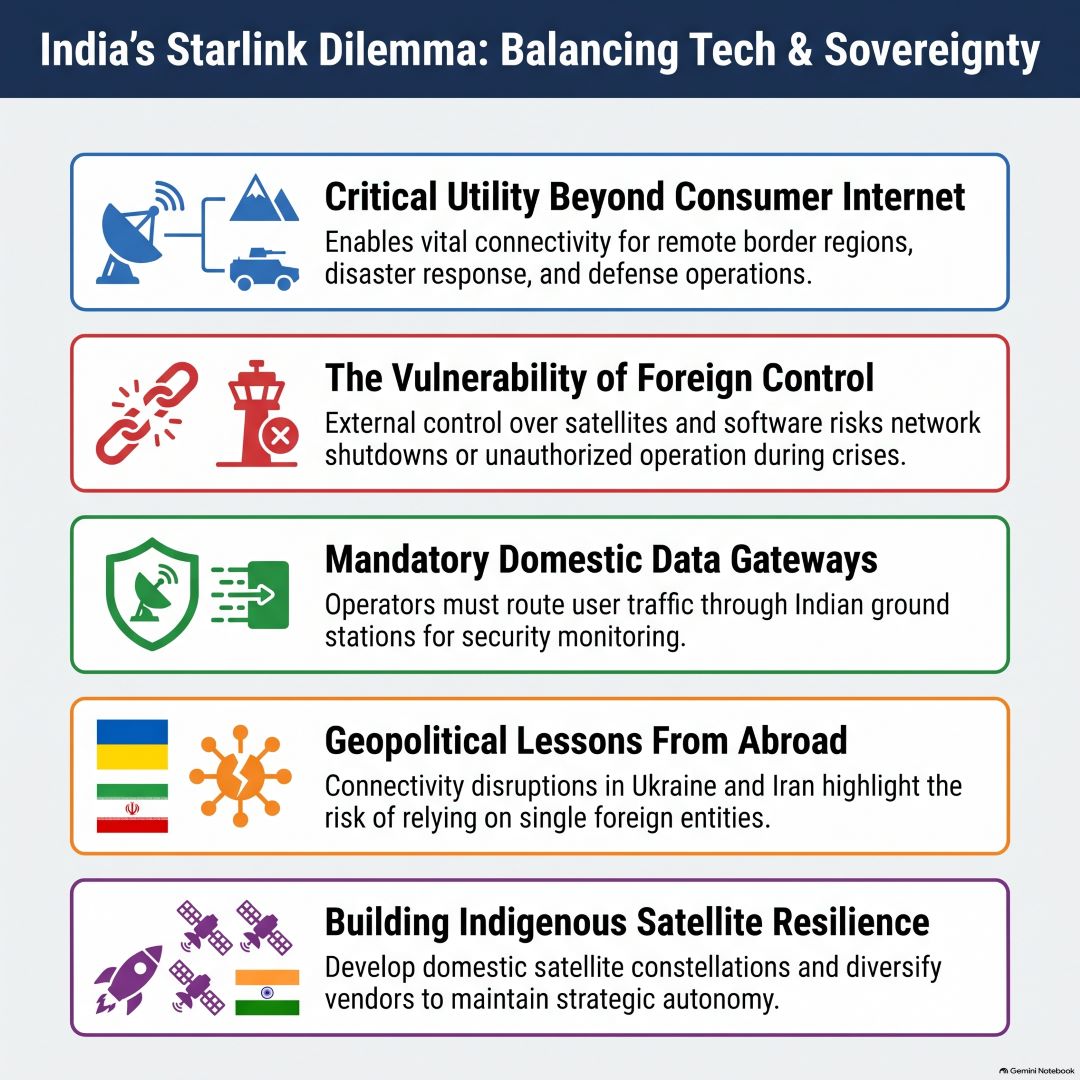
- Key applications: Remote settlements, border regions, ships and disaster-hit areas.
- Security relevance: Provides connectivity for soldiers, drones, sensors and military command centres.
Thus, Starlink is not merely a consumer internet service but also a strategic national security asset.
Core Concern: Limited Indian Control
- Although India can license and penalise Starlink, SpaceX retains direct control over its satellites, software and terminal access.
- This creates two major risks: the network may remain active despite Indian shutdown orders or become unavailable when India needs it most.
- Dependence on a foreign-controlled network could affect military communications during a crisis.
India's Regulatory Safeguards
- Domestic gateways: Satellite operators must route Indian user traffic through domestic gateways (ground stations).
- Restrictions on routing: Operators cannot bypass Indian gateways through inter-satellite links or foreign gateways.
- Security compliance: Operators must provide monitoring access to security agencies and comply with security-related shutdown orders.
- Starlink's compliance: SpaceX has announced Indian gateway sites and India-specific data controls.
Enforcement challenge: While domestic gateways can be inspected, verifying whether Indian traffic is secretly routed abroad largely depends on SpaceX's disclosures.
Trade-off: Restrictions on inter-satellite rerouting may reduce network redundancy during gateway failures.
Global Experiences and Lessons
- Iran: Since 2023, Iran has repeatedly complained to the International Telecommunication Union (ITU) about unauthorised Starlink terminals. Despite the ITU's Radio Regulations Board calling for an end to unauthorised transmissions, it lacks authority to suspend satellite frequency assignments. Enforcement has remained ineffective.
- Ukraine: SpaceX cooperated with Ukrainian authorities to block Starlink terminals used by Russian forces. However, in October 2026, Starshield (military Starlink variant) reportedly lost connectivity for fast-moving terminals, disrupting drone and frontline operations.
- Reports suggested a White House-linked order, denied by Trump, amid US pressure on Ukraine over strikes on Russian refineries. Connectivity was restored by October 24.
Strategic lesson: SpaceX's dependence on US regulatory approval and government contracts gives Washington significant leverage. This could become a risk if American and Indian interests diverge during a crisis.
Way Forward: Reducing Strategic Dependency
- Strict regulation: Retain Starlink through strict licensing and strengthen compliance verification rather than excluding it entirely.
- Backup connectivity: Maintain alternative connections and tested switching procedures for military and essential users.
- Multiple providers: Encourage satellite internet providers from different jurisdictions to avoid dependence on a single entity.
- Strengthen BharatNet: Expand domestic ground infrastructure. A parliamentary review found that only 30% of gram panchayats had functional BharatNet connectivity as of February 2026.
- Indigenous capabilities: Develop domestic satellite constellations and strengthen India's indigenous satellite and rocket industry.
Conclusion: India must balance technological access with national security. Strategic autonomy requires ensuring that critical communication infrastructure remains reliable, diversified and under effective Indian control.