

Supreme Court on MGNREGA and Rural Employment

Supreme Court on MGNREGA and Rural Employment
The Supreme Court recently described the repealed MGNREGA as a “good, effective” scheme while hearing a petition on delayed wages. The case has also raised a larger constitutional question on whether the right to work can be read into the Fundamental Right to life under Article 21.
MGNREGA vs VB-G RAM G
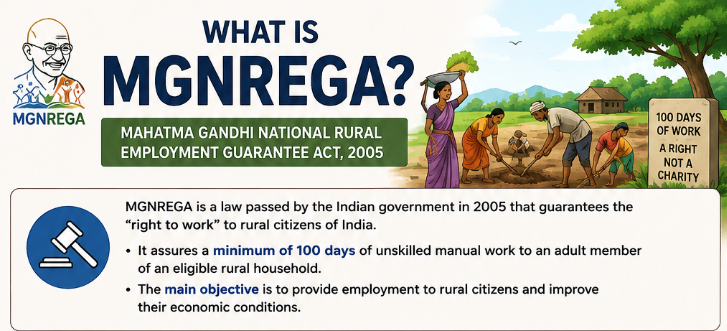
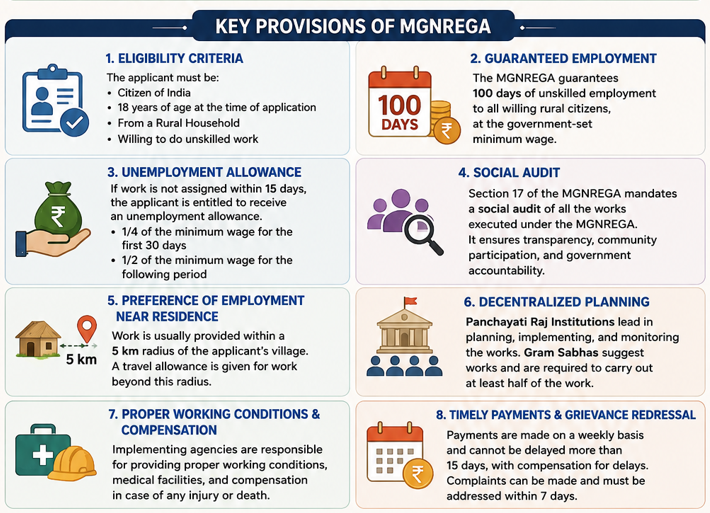
- MGNREGA was a demand-driven, rights-based rural employment guarantee providing up to 100 days of work per household annually.
- Its successor, VB-G RAM G, raises the guarantee to 125 days but has been criticised for shifting towards a more centrally controlled framework.
- According to claims placed before the Court, employment generation has reportedly fallen by around 50% despite the higher workday guarantee.
- The Centre-State funding pattern has shifted from 90:10 under the earlier framework to 60:40, increasing the financial burden on States.
Constitutional Question: Right to Work
The petition by activist Aruna Roy seeks payment and compensation for delayed MGNREGA wages and raises the possibility of treating the right to work as part of Article 21.
- Right to work is not expressly a Fundamental Right.
- Article 41 under the Directive Principles directs the State to make effective provision for the right to work, education and public assistance in certain circumstances.
- The petitioners argue that employment at minimum wages is necessary for a dignified life under Article 21.
- The Court questioned whether a Directive Principle-based aspiration can be treated on the same footing as Article 21.
Minimum Wages vs Employment Availability
The petitioners argued that wages below the applicable State minimum wage could undermine workers’ right to a dignified livelihood and potentially amount to forced labour.
The Court, however, noted that prescribing higher wage thresholds could potentially reduce the number of employment opportunities within a limited employment programme. It also observed that wage levels are linked to prevailing local conditions.
Key Concerns
The proceedings highlight three major issues:
- Livelihood security: Whether a legally guaranteed rural employment programme can ensure meaningful access to work.
- Fiscal federalism: Whether higher State contributions can constrain employment generation in fiscally weaker States.
- Rights-based welfare: Whether employment should remain an enforceable entitlement rather than primarily a government policy instrument.
Way Forward
The Court indicated that the issues need fresh examination under the VB-G RAM G framework, supported by updated data on employment, wages and funding.
The focus should be on ensuring timely wage payments, adequate employment generation, sustainable Centre-State financing and effective social protection while assessing whether the right to work can receive stronger constitutional recognition through Article 21.
