

Tariffs trumped: lower tax not all good news for India
Indian Express
I. Core Context
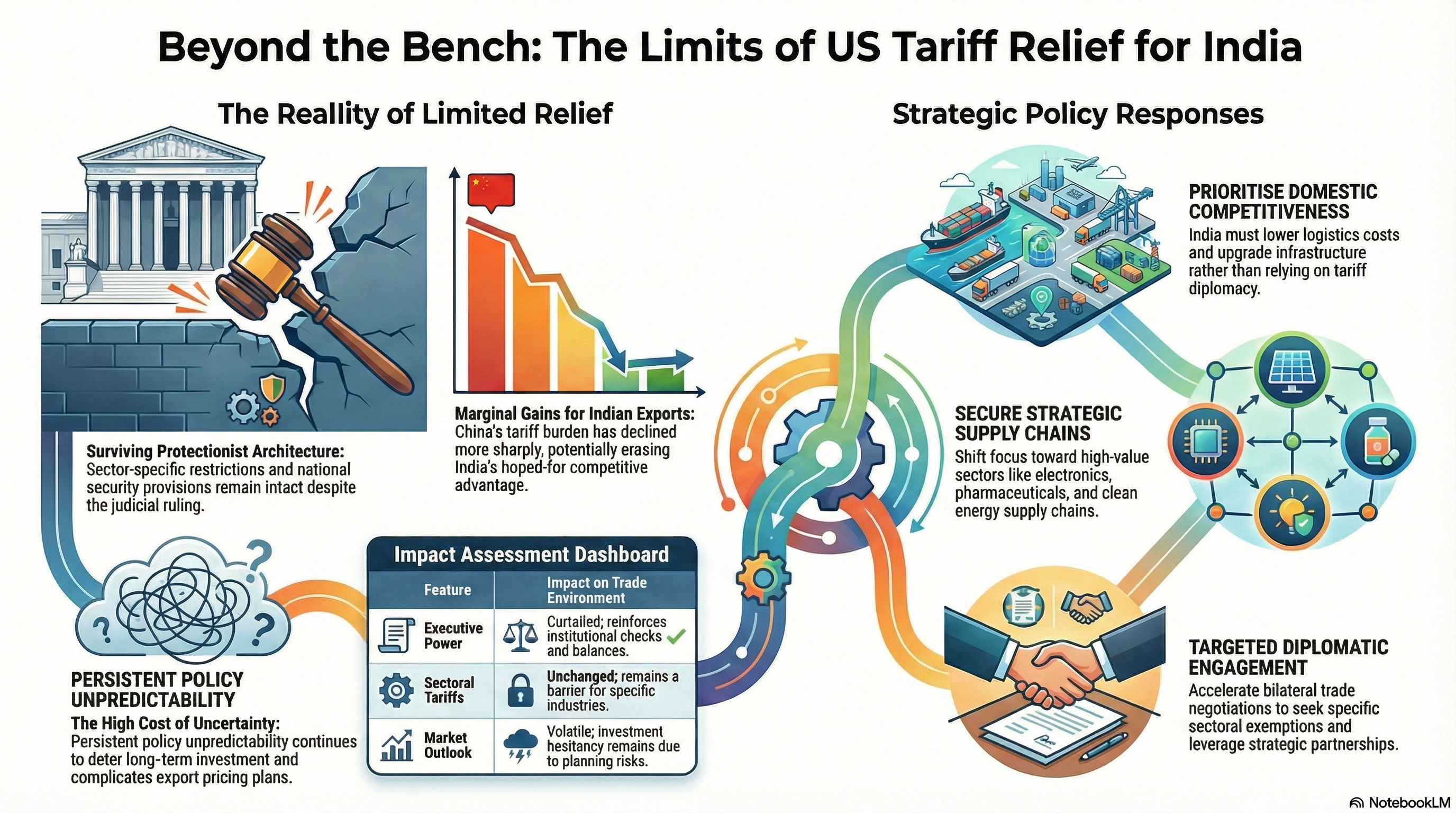
The article examines the implications of a US Supreme Court ruling that restricts executive authority to impose broad-based tariffs, while leaving intact sector-specific trade restrictions. It evaluates whether the development is beneficial for India and argues that the relief may be limited and uneven.
The piece situates the issue within:
- US protectionist trade policy
- Section 232 and Section 301 tariff frameworks
- Ongoing US–China trade tensions
- India’s export competitiveness
II. Key Arguments Presented
1. Judicial Curtailment of Blanket Tariffs
The Supreme Court decision limits the President’s ability to impose sweeping tariffs without Congressional oversight.
However:
- Existing sectoral tariffs remain
- National security provisions continue
- Policy discretion is not fully eliminated
Thus, the structural architecture of US protectionism survives.
2. India’s Gains Are Marginal
The article suggests:
- India’s exports may see limited relief
- Tariff differentials between India and competitors remain
- China’s tariff burden has reduced more sharply
The relative advantage India hoped for may not materialise fully.
3. China’s Position Strengthened
China’s tariff rates reportedly decline more significantly under the revised framework.
Implication:
- India does not automatically gain from US–China trade conflict
- Competitive pressure persists
4. Uncertainty Remains the Core Problem
The article stresses that:
- Policy unpredictability deters investment
- Exporters face pricing and planning challenges
- Trade negotiations remain fluid
Uncertainty is as damaging as tariffs themselves.
III. Author’s Stance
The tone is critical and cautious.
The author appears to argue that:
- Optimism about the US ruling is premature
- India should not overestimate benefits
- Structural trade challenges persist
There is a pragmatic realism in the analysis rather than celebratory framing.
IV. Possible Biases and Limitations
1. Competitive Framing
The article frames India’s benefit primarily relative to China. However:
- Trade outcomes depend on sector-specific dynamics
- Bilateral negotiations matter more than comparative tariff reductions
2. Limited Domestic Reform Analysis
The discussion focuses heavily on US policy but gives less weight to:
- India’s own tariff barriers
- Production-linked incentive schemes
- Logistics and cost competitiveness
3. Short-Term Lens
The piece assesses immediate tariff shifts but underexplores:
- Long-term restructuring of global supply chains
- Friend-shoring strategies
- Industrial policy realignments
V. Pros and Cons of the Development
Pros
• Curtails arbitrary executive tariff imposition
• Reinforces institutional checks and balances
• Provides limited relief to exporters
• Opens diplomatic space
Cons
• Sectoral tariffs remain intact
• Competitive advantage over China uncertain
• Policy unpredictability persists
• Exporters face planning risks
VI. Policy Implications for India
1. Strengthen Bilateral Trade Engagement
India must:
- Accelerate trade negotiations
- Seek sectoral exemptions
- Leverage strategic partnerships
2. Improve Domestic Competitiveness
Tariff diplomacy cannot substitute for:
- Lower logistics costs
- Improved infrastructure
- Technology upgrading
- Stable export policies
3. Supply Chain Strategy
India must position itself in:
- Electronics
- Pharmaceuticals
- Engineering goods
- Clean energy supply chains
Friend-shoring and diversification strategies are crucial.
4. Legal and WTO Engagement
India should:
- Monitor US legal developments
- Engage in multilateral dispute frameworks
- Strengthen trade remedy preparedness
VII. Real-World Impact
Short-term:
- Limited tariff relief
- Continued uncertainty
Medium-term:
- Recalibration of supply chains
- Investment hesitancy
Long-term:
- Shift toward strategic trade blocs
- Increased importance of bilateral FTAs
VIII. UPSC Relevance
GS Paper II
• India–US relations
• Separation of powers in US governance
• WTO and global trade disputes
GS Paper III
• Impact of tariffs on exports
• Trade wars and manufacturing
• External sector stability
Essay Themes
• Protectionism vs free trade
• Institutional checks and economic policy
• Trade policy in a multipolar world
IX. Balanced Conclusion and Future Perspective
The US Supreme Court’s ruling curtails the executive’s ability to impose sweeping tariffs, but it does not dismantle the broader protectionist framework.
For India, the relief is partial and competitive gains are uncertain. The real challenge lies not in tariff arithmetic but in structural competitiveness and policy stability.
Trade success will depend less on judicial reversals abroad and more on:
- Domestic reforms
- Strategic trade diplomacy
- Manufacturing depth
- Regulatory certainty
In an era where trade policy is intertwined with geopolitics, India must prepare for volatility rather than rely on episodic relief.
