

The Art & Culture of War
The Tribune
1. Key Arguments
A. Cultural Heritage as a Silent Casualty of War
War destroys not just infrastructure but collective memory.
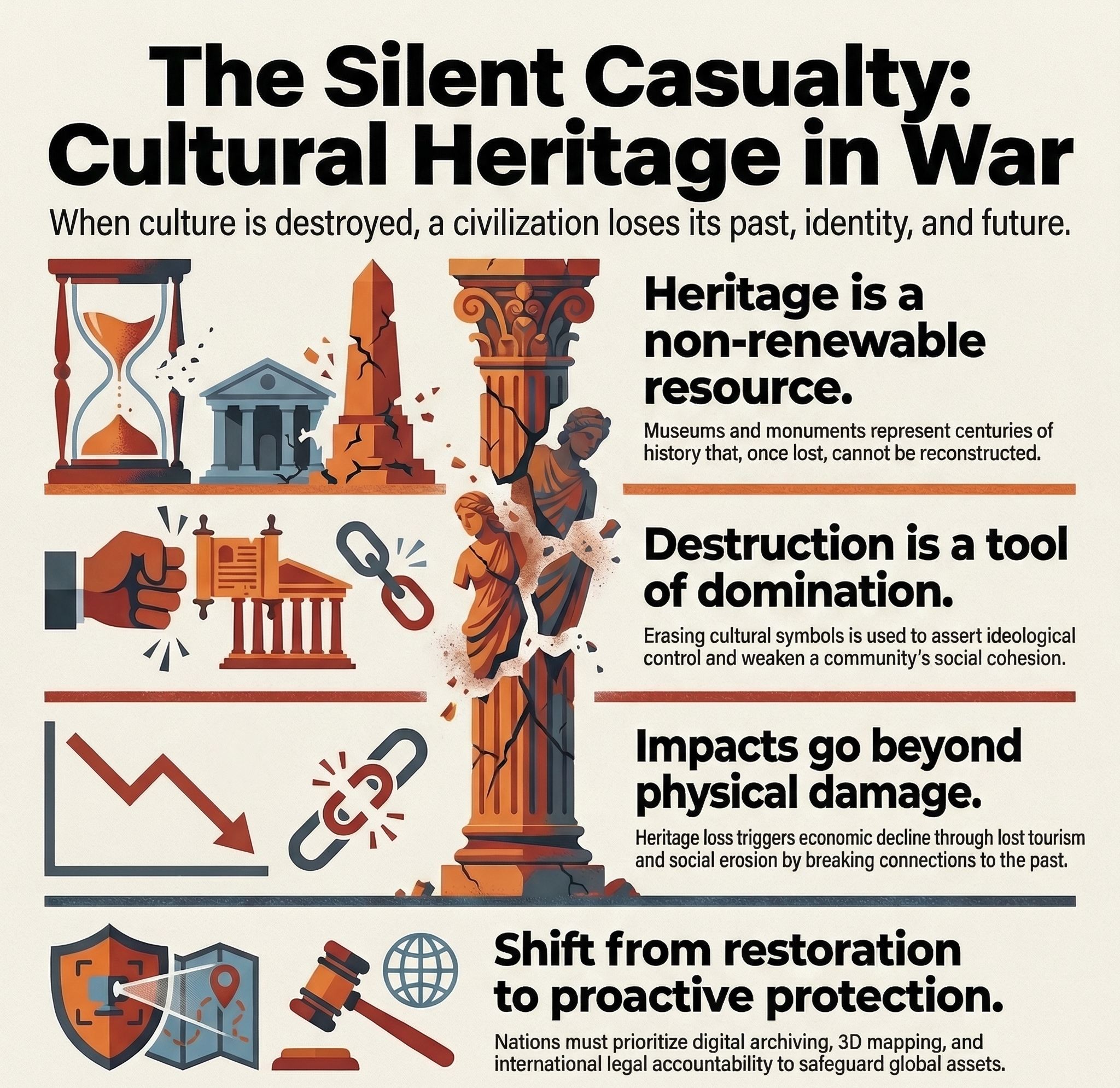
Museums, monuments, and artefacts represent centuries of history, which once lost cannot be reconstructed.
B. Deliberate Targeting and Collateral Damage
Cultural destruction is both intentional and incidental.
Looting, bombing, and neglect during conflict contribute to heritage loss.
C. Global Indifference and Selective Concern
International response to cultural destruction is inconsistent.
Some heritage losses gain global attention, while others remain ignored.
D. Role of Museums and Preservation Efforts
Institutions attempt to safeguard displaced artefacts.
Efforts to restore and conserve damaged heritage highlight resilience but are limited.
E. Cultural Identity and Power Politics
Destruction of heritage is also symbolic domination.
Erasing cultural symbols weakens identity and asserts control over narratives.
2. Author’s Stance
Strongly preservationist and critical of war-driven destruction
Moral critique of modern warfare
The author condemns the erosion of cultural heritage as a civilisational tragedy.
Implicit critique of global power structures
Suggests that geopolitical interests override cultural preservation.
3. Biases and Limitations
Normative and emotive tone
Relies heavily on moral argumentation, sometimes at the expense of analytical neutrality.
Limited geopolitical complexity
Focuses more on consequences than on underlying causes of conflicts.
Selective case emphasis
Examples are region-specific, lacking broader global comparison.
4. Strengths (Pros)
Highlights an under-discussed dimension of war
Brings cultural destruction into mainstream discourse.
Strong ethical foundation
Links heritage preservation with identity, dignity, and history.
Relevance to global heritage debates
Aligns with concerns raised by international cultural organisations.
5. Weaknesses (Cons)
Insufficient policy detailing
Does not elaborate on mechanisms for protecting heritage during conflicts.
Limited stakeholder perspective
Voices of local communities, governments, and international bodies are not fully explored.
Overgeneralisation of global response
Does not differentiate between varied international efforts.
6. Policy Implications
A. Strengthening International Legal Frameworks
Enforcement of conventions on cultural property protection
Stronger compliance with global norms during armed conflict.
B. Cultural Heritage Diplomacy
Global cooperation for preservation and restoration
Shared responsibility among nations and institutions.
C. Digital Preservation
Archiving heritage through technology
3D mapping and documentation to mitigate loss.
D. Conflict-Sensitive Planning
Integrating heritage protection in military strategies
Avoid targeting culturally significant sites.
E. Accountability Mechanisms
Penalising destruction of cultural property
International legal action against violators.
7. Real-World Impact
Cultural Loss
Irreversible erasure of history and identity
Communities lose connection to their past.
Social Impact
Weakening of cultural cohesion
Loss of shared heritage affects social unity.
Political Impact
Cultural destruction as a tool of domination
Used to assert ideological or territorial control.
Economic Impact
Loss of tourism and cultural economy
Heritage sites are key economic assets.
8. UPSC GS Paper Linkages
GS Paper I (History & Culture)
- Cultural heritage
- Impact of conflicts on heritage
GS Paper II (International Relations)
- Global governance and cultural diplomacy
- Role of international institutions
GS Paper III (Security & Environment)
- Internal security and conflict zones
- Disaster management for heritage
GS Paper IV (Ethics)
- Responsibility towards heritage
- Moral implications of war
9. Balanced Conclusion
War’s impact extends beyond immediate destruction to long-term civilisational erosion.
While the article effectively highlights the gravity of cultural loss, a comprehensive approach requires integrating preservation into conflict governance frameworks.
10. Future Perspective
From reactive restoration to proactive protection
Preventive strategies must be prioritised.
Global cooperation and shared responsibility
Cultural heritage must be treated as a universal asset.
Technological integration in preservation
Digital tools can safeguard knowledge for future generations.
Strengthening cultural consciousness
Promoting awareness about the value of heritage.
Final Insight
When culture is destroyed, a civilisation loses not just its past, but a part of its identity and future.
