

The ‘discrepancies’ in India’s new GDP data
Indian Express
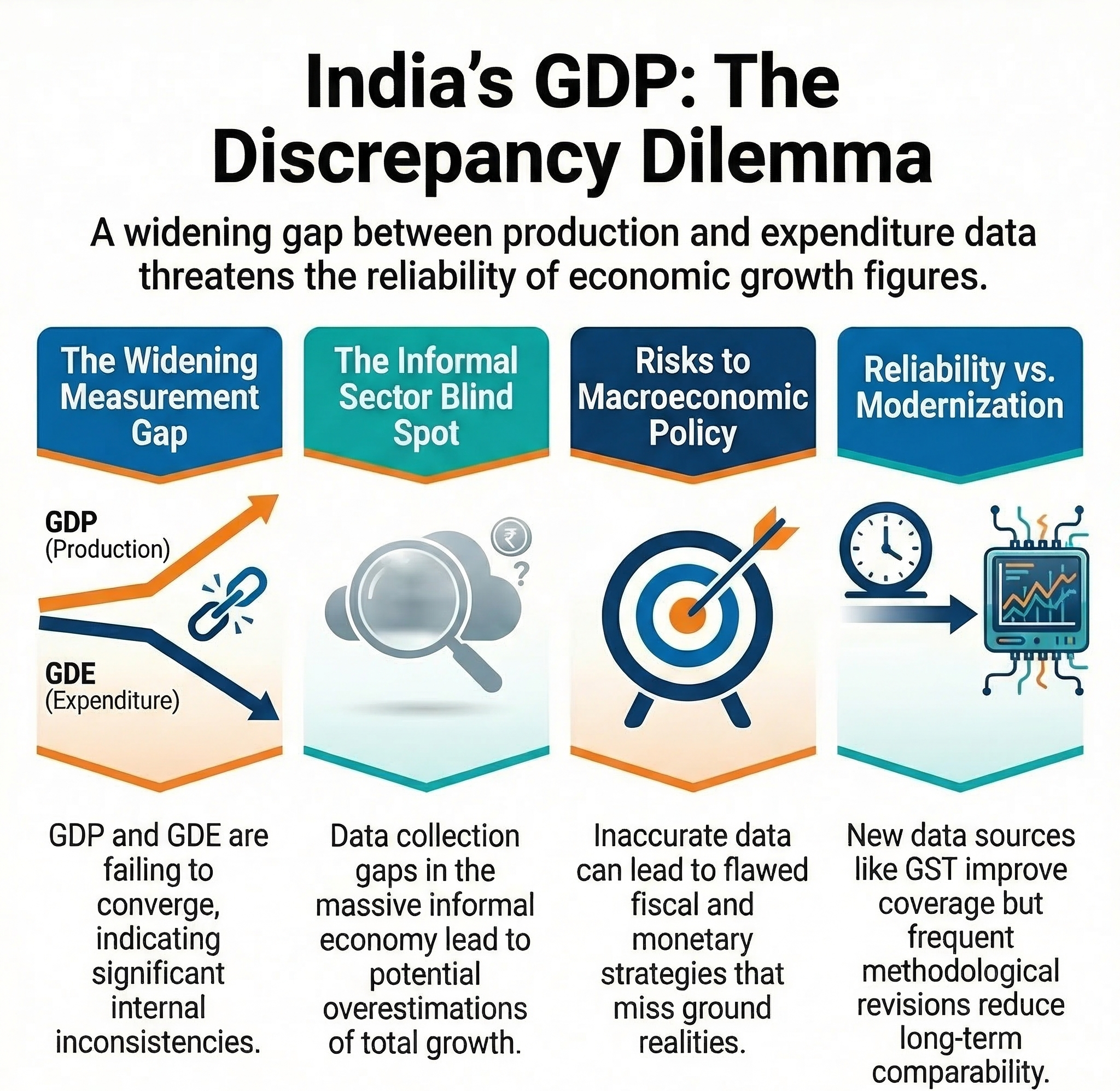
Key Arguments of the Article
Persistent GDP–GDE Discrepancies
The article highlights a widening gap between GDP (production side) and GDE (expenditure side). Ideally, both should converge, but the divergence indicates inconsistencies in measurement.
This raises concerns about data reliability.
Methodological Changes and Data Revisions
Recent revisions in base year, data sources, and estimation techniques have altered GDP calculations. While these changes aim to improve accuracy, they have also introduced complexity and confusion.
Frequent revisions reduce comparability over time.
Role of Data Quality and Coverage
The article argues that gaps in data collection—especially in informal sectors—contribute significantly to discrepancies. Surveys, administrative data, and proxies may not fully capture economic activity.
This is particularly relevant for a large informal economy like India.
Overestimation Concerns
The article suggests that GDP growth rates may appear stronger due to methodological adjustments and deflators. Some components of growth may not fully reflect ground realities.
This has implications for policy credibility.
Impact on Policy Decisions
Macroeconomic policies depend heavily on GDP data. Misinterpretation or inaccuracies can lead to inappropriate fiscal, monetary, or developmental strategies.
Author’s Stance
The author adopts a critical and cautious stance. While acknowledging improvements in methodology, the article questions the reliability and interpretation of GDP figures.
The tone emphasises the need for transparency and methodological clarity.
Possible Biases
Skepticism Towards Official Data
The article leans toward questioning official estimates, which may amplify concerns about discrepancies.
Technical Emphasis
Focus on methodological issues may overshadow broader economic trends.
Limited Acknowledgment of Improvements
While highlighting flaws, the article gives relatively less emphasis to improvements in data systems.
Advantages of the Current GDP Framework
Improved Data Integration
Inclusion of new data sources such as GST and financial databases enhances coverage.
Better Reflection of Structural Changes
Revisions capture emerging sectors such as services and digital economy.
Alignment with Global Standards
Efforts to align with international accounting standards improve comparability.
Challenges and Concerns
Data Inconsistency
Large discrepancies between GDP and GDE undermine credibility.
Informal Sector Measurement
Capturing informal economic activity remains a major challenge.
Policy Misalignment
Inaccurate data can lead to flawed macroeconomic policies.
Public Trust Deficit
Frequent revisions and inconsistencies can reduce trust in official statistics.
Policy Implications
Strengthening Statistical Systems
Investment in data collection, surveys, and statistical infrastructure is essential.
Enhancing Transparency
Clear communication of methodology and revisions can improve credibility.
Improving Informal Sector Measurement
Innovative methods are needed to better capture informal economic activity.
Institutional Reforms
Strengthening statistical institutions can ensure independence and reliability.
Real-World Impact
If discrepancies persist:
• Reduced investor confidence
• Policy miscalculations
• Misallocation of resources
If addressed effectively:
• Improved policy formulation
• Better economic planning
• Enhanced global credibility
Alignment with UPSC GS Papers
GS Paper III
Economic growth, national income accounting, data governance.
GS Paper II
Institutional frameworks and governance of statistical systems.
Balanced Assessment
The article raises legitimate concerns about discrepancies in India’s GDP estimation. While methodological improvements are necessary to reflect a changing economy, inconsistencies between different measures highlight the need for better data quality and transparency.
A balanced view recognises both the progress made and the challenges that remain.
Future Perspective
As India’s economy becomes more complex and digitised, statistical systems must evolve accordingly. Greater use of real-time data, improved survey mechanisms, and institutional autonomy will be crucial.
For policymakers and aspirants, the issue underscores the importance of reliable data in governance and economic decision-making.
