

The Fifth Estate and the Changing Nature of Democracy

The Fifth Estate and the Changing Nature of Democracy
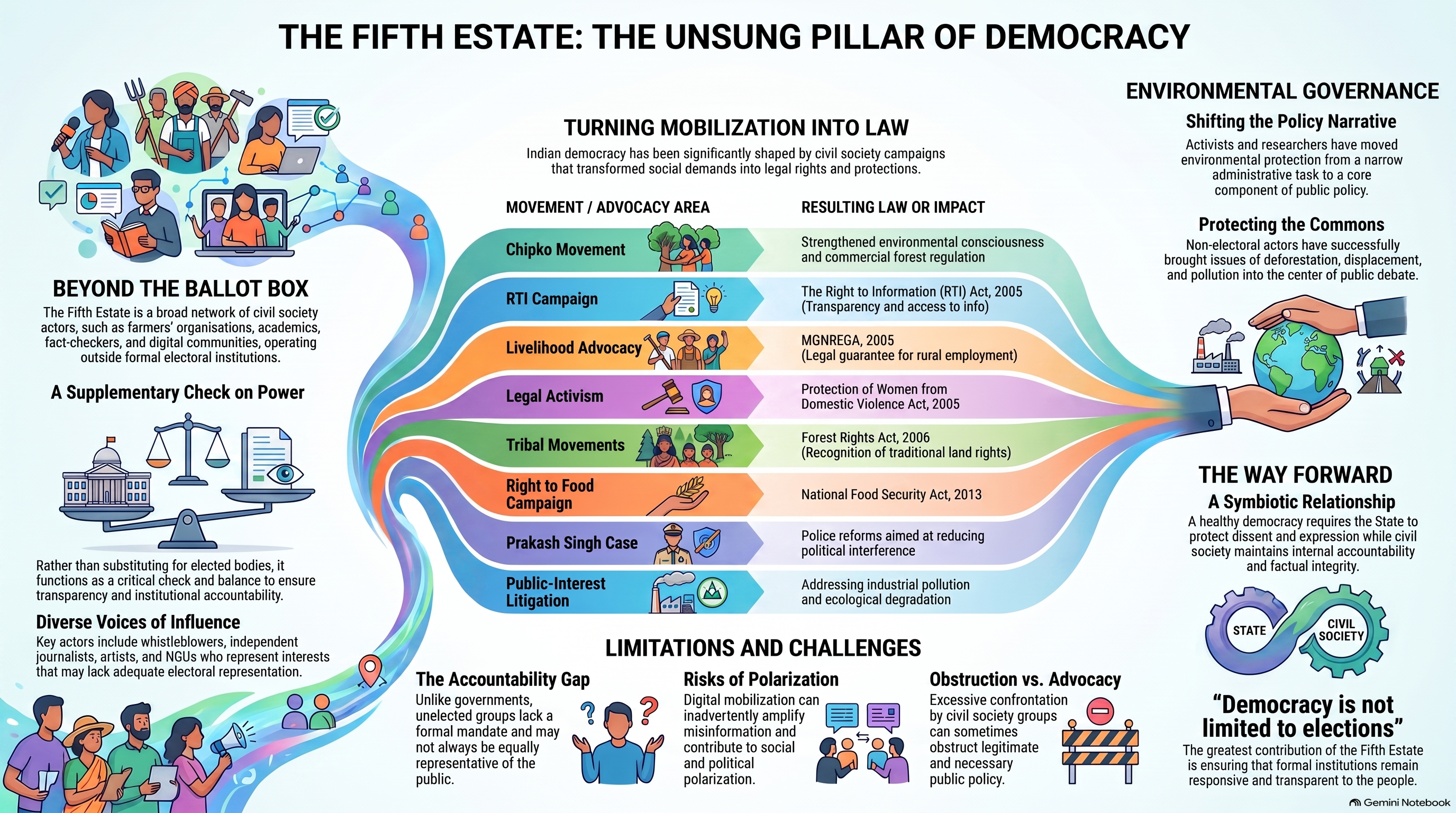
The “Fifth Estate” refers to a broad network of civil society actors that operate outside formal electoral institutions but influence public policy, accountability and social change. These include farmers’ and workers’ organisations, NGOs, academics, independent journalists, fact-checkers, whistleblowers, artists and digital communities.
Why the Fifth Estate Matters?
Conventional democratic legitimacy is often associated with electoral victory. However, democratic accountability also depends on institutions and groups that:
- Question government decisions and dominant narratives.
- Mobilise public opinion around social and environmental concerns.
- Demand transparency and institutional accountability.
- Represent interests that may not receive adequate electoral representation.
- Use courts, campaigns and public mobilisation to influence policy.
Thus, the Fifth Estate can function as a supplementary check on State power rather than as a substitute for elected institutions.
India’s Experience with Social Movements
Several important Indian laws and policy changes have emerged from sustained civil society mobilisation:
- Chipko Movement: Raised concerns over commercial deforestation and strengthened environmental consciousness.
- RTI Act, 2005: Civil society campaigns helped establish transparency and citizens’ right to access public information.
- MGNREGA, 2005: Advocacy around rural employment and livelihood rights contributed to the demand for a legal employment guarantee.
- Protection of Women from Domestic Violence Act, 2005: Long-term legal activism contributed to stronger protection against domestic violence.
- Forest Rights Act, 2006: Tribal movements and civil society advocacy supported recognition of traditional forest rights.
- Right to Food Campaign: Contributed to the policy debate that culminated in the National Food Security Act, 2013.
- Police reforms: The Prakash Singh case pushed for measures aimed at professionalising the police and reducing political interference.
- Environmental litigation: Public-interest litigation has played an important role in addressing industrial pollution and ecological degradation.
Fifth Estate and Environmental Governance
Environmental movements demonstrate how non-electoral actors can influence policy over the long term. Activists, researchers and environmental organisations have brought issues such as deforestation, displacement, pollution and protection of commons into public debate.
This has helped transform environmental protection from a narrow administrative concern into an important component of public policy and governance.
Limitations and Concerns
The Fifth Estate also faces challenges:
- Not all civil society groups are equally representative.
- Digital mobilisation can amplify misinformation and polarisation.
- Unelected groups lack the formal mandate of elected governments.
- Excessive confrontation can obstruct legitimate public policy.
- Funding, transparency and accountability of NGOs and advocacy groups can raise concerns.
Therefore, civil society activism should complement, rather than replace, constitutional institutions and representative democracy.
Way Forward
A healthy democracy requires interaction between elected institutions and an active civil society.
The State should protect legitimate peaceful dissent, freedom of expression and association while civil society organisations should maintain transparency, factual integrity and internal accountability.
Conclusion
The Fifth Estate highlights that democracy is not limited to elections. Citizen movements, independent institutions, researchers, journalists and advocacy groups can strengthen accountability by questioning power and bringing neglected issues into policymaking.
Its greatest contribution lies not in replacing the formal institutions of democracy but in ensuring that those institutions remain responsive, transparent and accountable to citizens.
