

The Freebie Trap
The Statesman
1. Key Arguments
A. Freebies vs Welfare Distinction
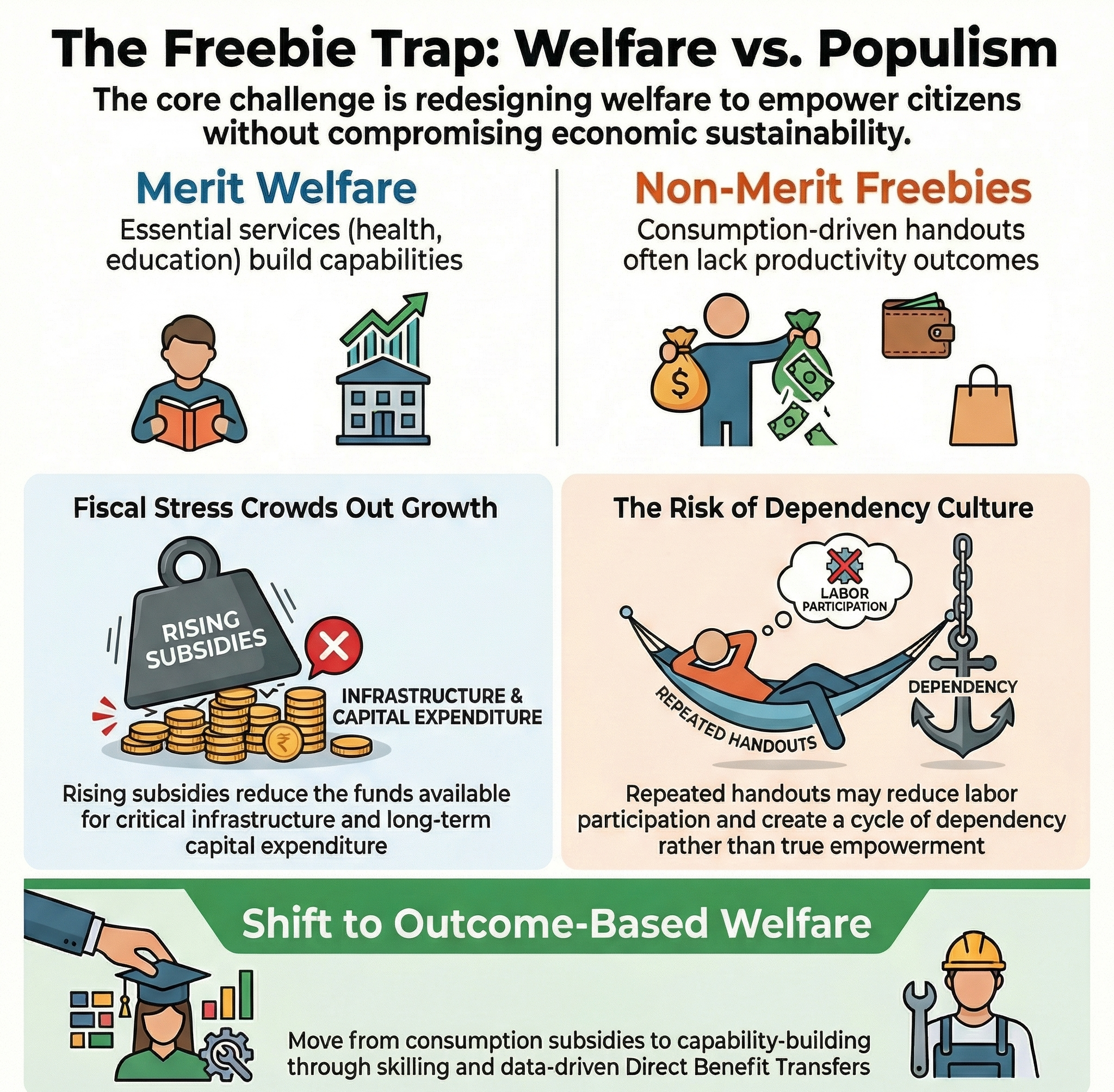
Not all state support is harmful; the issue is with non-merit freebies lacking productivity outcomes.
Essential services (health, education) differ from consumption-driven handouts.
B. Fiscal Stress and Sustainability
Freebies strain state finances and crowd out capital expenditure.
Rising subsidies reduce funds for infrastructure and long-term growth.
C. Political Economy of Populism
Competitive populism among political parties drives irrational promises.
Elections incentivise short-term gains over long-term policy planning.
D. Dependency and Work Disincentives
Repeated handouts may reduce labour participation and productivity incentives.
Creates a “dependency culture” rather than empowerment.
E. Impact on Public Services
Revenue diversion weakens core sectors like education, health, and infrastructure.
F. Judicial and Policy Concerns
Debate on whether freebies distort level playing field in elections.
Raises questions on electoral ethics and fiscal accountability.
2. Author’s Stance
Critical of indiscriminate freebies, but not anti-welfare
Supports targeted, outcome-based welfare
Argues for fiscal prudence and productive investment.
3. Biases and Limitations
Pro-market / fiscal conservatism bias
Overemphasis on efficiency and fiscal discipline
May underplay immediate socio-economic distress.
Simplification of “dependency” argument
Assumes beneficiaries reduce effort
Ignores structural inequalities (unemployment, poverty traps).
Limited differentiation across states
Different fiscal capacities and welfare needs not deeply explored
4. Strengths (Pros)
Clear conceptual distinction
Separates welfare from populist freebies effectively.
Focus on fiscal sustainability
Highlights long-term macroeconomic risks.
Policy relevance
Links issue to governance, elections, and public finance.
5. Weaknesses (Cons)
Insufficient social justice lens
Underestimates redistributive necessity in unequal societies.
Limited empirical backing
Arguments on dependency not strongly evidence-based.
Neglect of political compulsions
Does not fully engage with democratic realities.
6. Policy Implications
A. Defining “Merit vs Non-Merit” Subsidies
Institutional framework needed to classify and regulate freebies
B. Fiscal Responsibility Enforcement
Strengthen FRBM norms and transparency in state finances
C. Outcome-Based Welfare
Shift from consumption subsidies to capability-building (health, education, skilling)
D. Electoral Reforms
Disclosure of fiscal impact of promises in manifestos
E. Strengthening Social Safety Nets
Ensure targeted support without long-term dependency
7. Real-World Impact
Economic Impact
Short-term relief vs long-term fiscal stress
Social Impact
Immediate poverty alleviation but potential behavioural distortions
Political Impact
Intensifies competitive populism
Governance Impact
Weakens prioritisation of public goods
8. UPSC GS Paper Linkages
GS Paper III (Economy)
- Fiscal policy and subsidies
- Inclusive growth vs fiscal prudence
GS Paper II (Governance & Polity)
- Electoral reforms
- Welfare schemes and accountability
Essay / Ethics Paper (GS IV)
- “Populism vs Responsible Governance”
- “Means vs ends in welfare policies”
9. Balanced Conclusion
The editorial rightly cautions against the unsustainable expansion of freebies, but risks oversimplifying the welfare debate. The challenge lies not in eliminating state support, but in redesigning it to be targeted, transparent, and growth-enhancing.
10. Future Perspective
Shift to Direct Benefit Transfers (DBT)
Improve efficiency and reduce leakage.
Data-driven targeting
Use socio-economic databases for precision welfare.
Balancing equity and efficiency
Combine redistribution with productivity enhancement.
Institutional oversight
Independent fiscal councils to evaluate promises.
Final Insight
The real policy challenge is not choosing between welfare and fiscal discipline, but designing a system where welfare empowers citizens without compromising economic sustainability.
