

The judiciary’s role in complete justice
The Tribune
1. Core Arguments of the Article
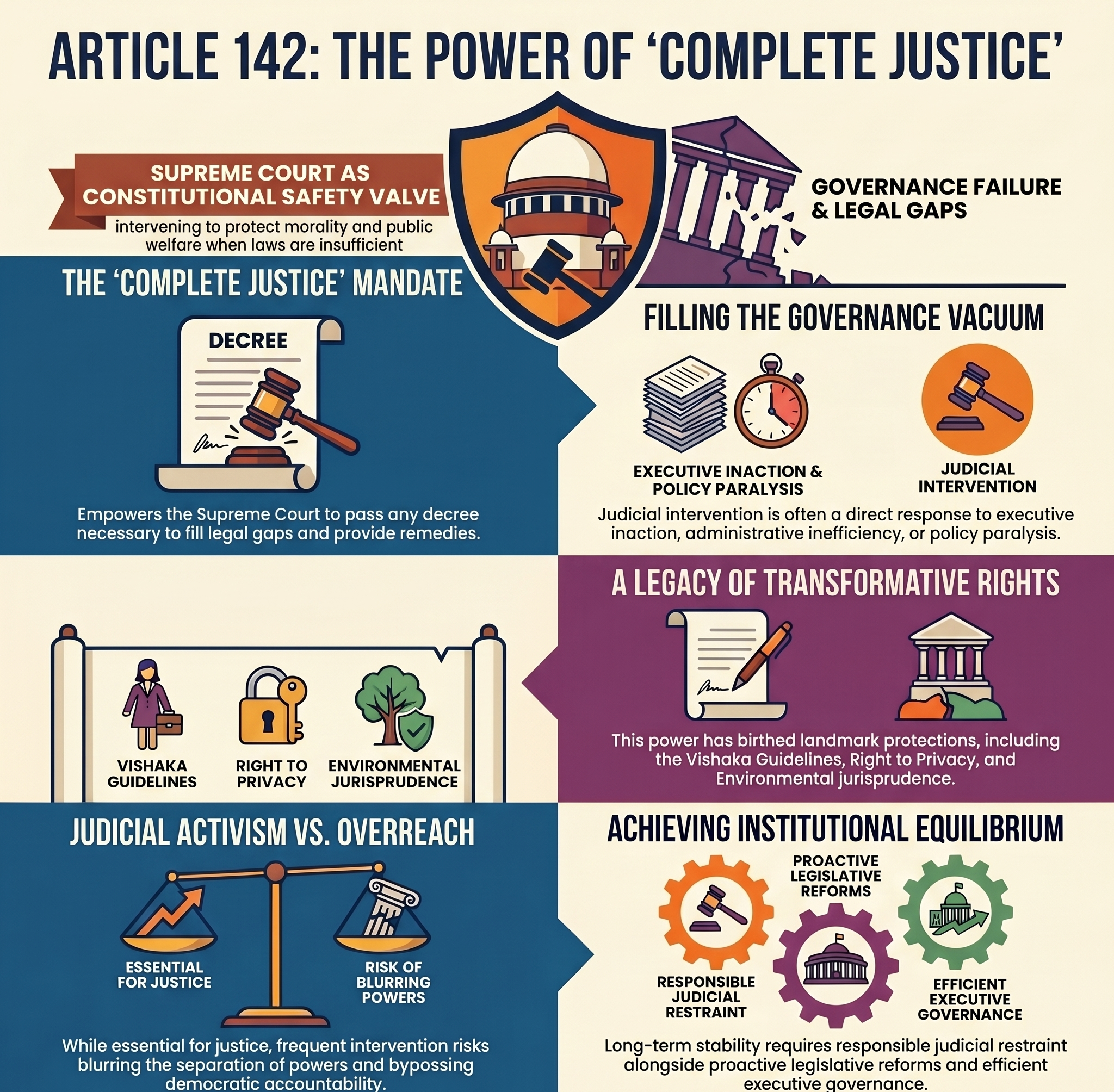
Article 142 empowers the Supreme Court to ensure “complete justice”
The article argues that:
- The Constitution intentionally grants extraordinary powers to the Supreme Court under Article 142.
This allows the Court to:
- Fill legal gaps,
- Provide remedies where statutes are insufficient,
- Protect constitutional morality and justice.
The judiciary is portrayed as:
- The “constitutional safety valve” of Indian democracy.
Constitutional justice may go beyond statutory limitations
The article emphasizes that:
- Strict legal procedures may sometimes fail to deliver substantive justice.
In such situations:
- The Supreme Court may intervene creatively to ensure fairness and public welfare.
Judicial intervention becomes necessary when governance fails
The article suggests that:
- Executive inaction,
- Policy paralysis,
- Administrative inefficiency,
often compel judicial intervention.
The road safety example is used to show:
- The judiciary stepping into a governance vacuum.
Complete justice is rooted in constitutional morality
The author argues that:
- Constitutional justice is not merely procedural,
but also: - Moral,
- Social,
- Humanistic.
This reflects a broader interpretation of:
- Article 21 (Right to Life),
- Natural justice,
- Constitutional values.
2. Author’s Stance
Strongly supportive of judicial activism
The article clearly favours:
- An expansive interpretation of judicial powers.
The author views Article 142 as:
- Essential for protecting citizens where legal systems fail.
The judiciary is presented as:
- A corrective constitutional institution.
Constitution-first approach
The article prioritizes:
- Constitutional morality over procedural rigidity.
It suggests:
- Justice must prevail even if existing laws are inadequate.
3. Ideological and Structural Biases
Pro-judiciary bias
The article strongly defends:
- Judicial intervention,
- Judicial creativity,
- Expanded constitutional interpretation.
It tends to portray:
- The judiciary as morally superior to political institutions.
Underestimation of institutional boundaries
While the article briefly mentions concerns about judicial overreach, it largely minimizes:
- Separation of powers concerns,
- Democratic accountability issues,
- Administrative complexity.
Moral idealism bias
The article assumes:
- Judicial wisdom naturally aligns with public interest.
However, courts are also:
- Unelected institutions,
and judicial decisions may have: - Policy consequences,
- Fiscal implications,
- Governance limitations.
4. Constitutional Context
A. Article 142: Meaning and Scope
Article 142 empowers the Supreme Court to:
- Pass any decree or order necessary for doing “complete justice.”
This makes the Indian Supreme Court one of the world’s most powerful constitutional courts.
B. Historical Evolution of Judicial Activism
The article fits into the broader trajectory of:
- Judicial activism in post-Emergency India.
Important examples include:
- Vishaka Guidelines,
- Environmental jurisprudence,
- Prison reforms,
- Electoral reforms,
- Right to Privacy,
- LGBTQ rights.
C. Natural Justice and Constitutional Morality
The article strongly invokes:
- Natural justice,
- Constitutional morality,
- Human dignity.
This reflects:
- The transformative constitutionalism approach.
5. Positive Dimensions of Judicial Intervention
Protection of Fundamental Rights
Article 142 enables:
- Immediate relief,
- Human rights protection,
- Constitutional enforcement.
This is particularly important when:
- State institutions fail.
Administrative accountability
Judicial monitoring often pressures:
- Governments,
- Bureaucracy,
- Regulatory bodies,
to act responsibly.
Flexibility in exceptional situations
The judiciary can:
- Adapt legal remedies to evolving realities.
This is important in:
- Environmental crises,
- Technological issues,
- Social justice cases.
Public trust in institutions
Citizens often view courts as:
- Neutral protectors of justice.
Judicial intervention can restore:
- Institutional confidence.
6. Critical Concerns and Counterarguments
A. Judicial Overreach
Encroachment into executive domain
A major criticism is that:
- Courts increasingly enter policymaking territory.
This can weaken:
- Democratic accountability,
- Executive autonomy,
- Legislative supremacy.
Governance by judiciary
Critics argue that:
- Unelected judges should not routinely frame policy.
Examples include:
- Environmental bans,
- Administrative monitoring,
- Appointment mechanisms,
- Welfare implementation supervision.
B. Separation of Powers Concerns
The Constitution envisages:
- Institutional balance among Legislature, Executive, and Judiciary.
Excessive judicial activism may:
- Disturb constitutional equilibrium.
C. Institutional Capacity Issues
Courts may lack:
- Technical expertise,
- Administrative experience,
- Financial understanding,
required for governance decisions.
Judicial solutions may therefore become:
- Idealistic but impractical.
D. Accountability Deficit
Unlike elected governments:
- Judges are not directly accountable to citizens.
This creates concerns regarding:
- Democratic legitimacy.
7. Road Safety Example: A Governance Perspective
The article uses:
- Highway accident deaths,
as an example of judicial intervention.
Positive interpretation
The Court’s intervention:
- Highlights state failure in protecting life,
- Expands Article 21 meaningfully.
Critical interpretation
However:
- Road safety requires long-term institutional reforms,
not merely judicial directives.
Sustainable solutions need:
- Engineering improvements,
- Policing reforms,
- Better transport planning,
- Public awareness,
- Administrative coordination.
8. Policy Implications
Need for stronger executive governance
Frequent judicial intervention indicates:
- Administrative weakness.
The real solution lies in:
- Better governance capacity.
Legislative reforms are essential
Parliament must:
- Address legal gaps proactively,
instead of leaving courts to create ad hoc remedies.
Institutional coordination
India needs:
- Cooperative constitutionalism,
where institutions complement rather than compete with one another.
Clear judicial guidelines
There may be a need to:
- Define limits and principles governing Article 142 usage.
9. Real-World Impact
Positive effects
Judicial activism has historically contributed to:
- Expansion of civil liberties,
- Environmental protection,
- Social justice,
- Gender rights,
- Governance accountability.
Negative effects
Over-judicialisation can:
- Slow governance,
- Create policy uncertainty,
- Politicize the judiciary,
- Increase institutional friction.
10. UPSC GS Paper Linkages
GS Paper II
Major themes:
- Separation of powers
- Judicial activism
- Constitutional morality
- Supreme Court powers
- Governance accountability
- Fundamental Rights
GS Paper IV (Ethics)
Relevant ethical themes:
- Justice,
- Constitutional values,
- Institutional responsibility,
- Public accountability,
- Rule of law.
Essay Relevance
Potential essay themes:
- “Judicial activism vs judicial overreach”
- “Constitutional morality and democratic governance”
- “Can courts deliver social transformation?”
11. Pros of the Article
Strong constitutional grounding
The article correctly explains:
- The significance of Article 142.
Focus on substantive justice
It highlights:
- Justice beyond technical legality.
Recognition of governance failures
The article identifies:
- Administrative incapacity as a major cause of judicial intervention.
Human rights orientation
The emphasis on:
- Life,
- Dignity,
- Public welfare,
is constitutionally significant.
12. Weaknesses of the Article
Insufficient critique of judicial overreach
The article underplays:
- Institutional risks of excessive judicial power.
Over-romanticisation of judiciary
Courts are portrayed almost exclusively as:
- Protectors of justice,
while ignoring: - Delays,
- Pendency,
- Inconsistency,
- Capacity constraints.
Limited democratic perspective
The article insufficiently addresses:
- The importance of elected institutions in policymaking.
13. Broader Constitutional Debate
The article reflects a larger constitutional question:
Should courts merely interpret law, or actively shape governance?
India’s constitutional evolution increasingly shows:
- A powerful judiciary stepping into governance gaps.
However, long-term democratic health requires:
- Strong legislatures,
- Efficient executives,
- Independent judiciary,
all functioning within constitutional boundaries.
14. Balanced Conclusion
The article presents a persuasive defence of the Supreme Court’s extraordinary power under Article 142 to ensure “complete justice.” It rightly argues that constitutional courts cannot remain passive when:
- Fundamental rights are threatened,
- Governance failures endanger public welfare,
- Existing laws prove inadequate.
The judiciary’s role in expanding constitutional protections has undeniably strengthened Indian democracy in many areas, including:
- Civil liberties,
- Environmental justice,
- Social rights.
However, the article tends to understate serious concerns relating to:
- Judicial overreach,
- Separation of powers,
- Democratic accountability.
A judiciary that frequently substitutes executive or legislative functions risks:
- Institutional imbalance,
- Policy uncertainty,
- Democratic distortion.
The challenge therefore lies not in weakening judicial powers, but in ensuring:
- Responsible judicial restraint,
- Stronger governance institutions,
- Better legislative responsiveness.
15. Future Perspective
India’s constitutional future will depend upon maintaining:
- A delicate balance between judicial activism and democratic accountability.
Courts must remain:
- Guardians of constitutional morality,
but should avoid becoming: - Permanent substitutes for governance.
The ideal constitutional order is one where:
- The Executive governs efficiently,
- The Legislature legislates responsibly,
- The Judiciary intervenes only when constitutional justice genuinely demands it.
In that balance lies the true meaning of:
- “Complete justice.”
