

The Long Arm of El Niño That Suppresses Monsoon Rains
Hindustan Times
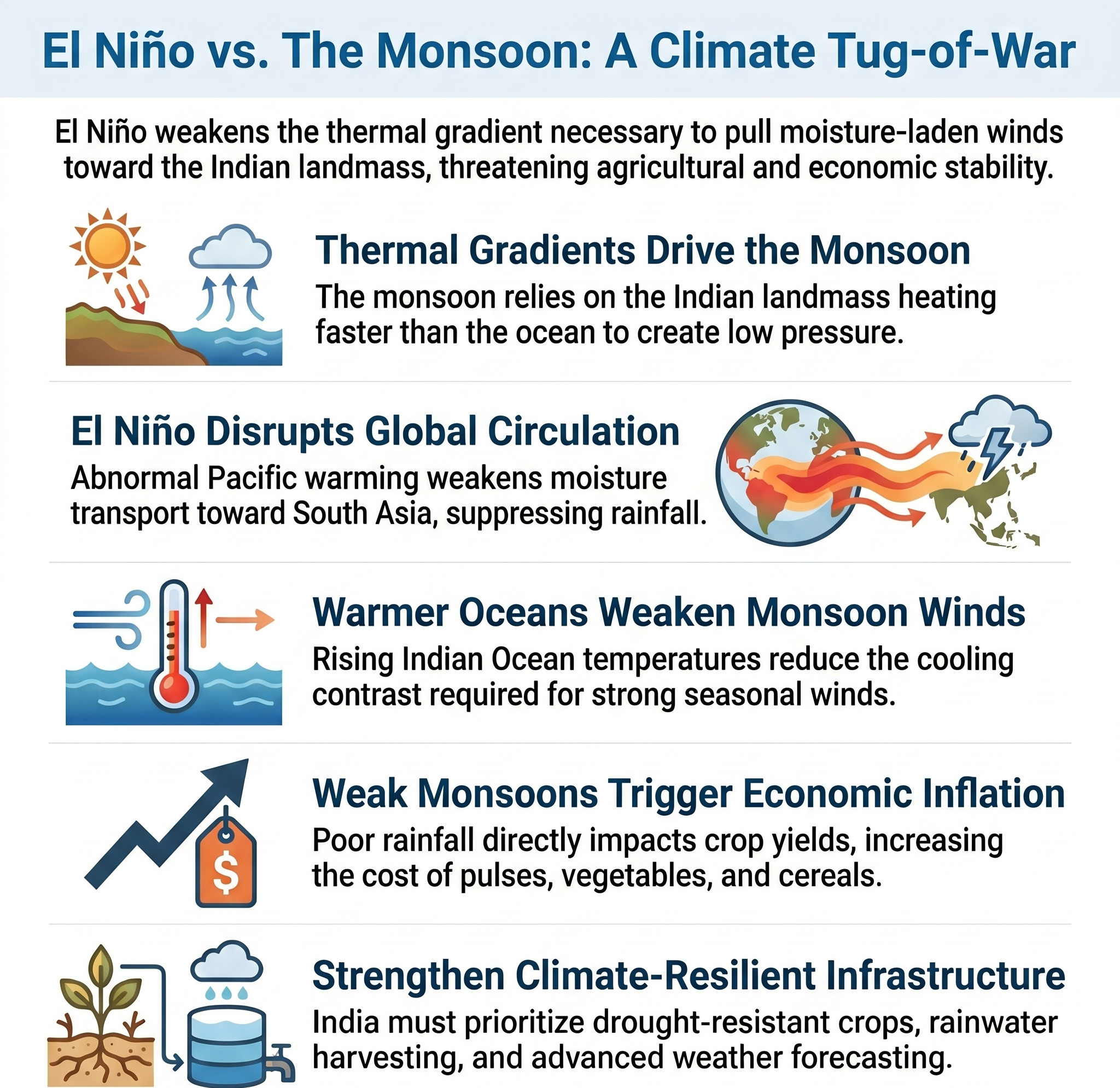
1. Core Arguments of the Article
Monsoon depends on land-ocean temperature difference
The article explains that:
- The Indian monsoon is driven by thermal contrast between:
- The Indian landmass,
- The surrounding ocean.
Normally:
- Land heats faster than oceans during summer,
creating: - Low pressure over land,
- Moisture-laden winds from oceans toward India.
El Niño weakens this thermal gradient
The article argues that:
- El Niño alters global oceanic and atmospheric conditions.
During El Niño years:
- Ocean warming changes atmospheric circulation patterns,
- The land-sea temperature gradient weakens,
- Moisture transport toward India reduces.
This suppresses monsoon rainfall.
Indian Ocean warming is a major factor
An important scientific insight in the article is:
- Indian Ocean temperatures are also rising significantly.
This reduces the normal cooling contrast required for:
- Strong monsoon winds.
Upper atmospheric temperatures matter more
The article notes that:
- Monsoon strength depends not only on surface temperatures,
but also on: - Temperature differences in the upper atmosphere.
This is a sophisticated meteorological explanation often ignored in simplified discussions.
Climate variability is becoming more complex
The article indirectly suggests:
- Climate systems are becoming increasingly unpredictable due to:
- Ocean warming,
- Climate change,
- Changing atmospheric dynamics.
2. Author’s Stance
Scientific and explanatory
The author adopts:
- A data-driven meteorological approach.
The tone is:
- Analytical,
- Educational,
- Scientific.
The article aims to:
- Explain complex climate dynamics in accessible language.
3. Underlying Biases
Climate-science-centric perspective
The article strongly relies on:
- Meteorological models,
- Scientific datasets,
- Oceanic indices.
This reflects confidence in:
- Scientific climate analysis.
Natural-climate-process emphasis
The article focuses heavily on:
- El Niño and atmospheric mechanisms.
It gives comparatively less attention to:
- Human-driven ecological degradation,
- Land-use change,
- Deforestation,
which also affect local rainfall systems.
Technical orientation
The article assumes readers can understand:
- Scientific graphs,
- Atmospheric circulation concepts,
which may limit accessibility for general audiences.
4. Scientific Explanation of El Niño
What is El Niño?
El Niño refers to:
- Abnormal warming of the central and eastern Pacific Ocean.
It affects:
- Global atmospheric circulation,
- Rainfall patterns,
- Temperature distribution.
Impact on Indian Monsoon
El Niño weakens:
- Walker Circulation,
which affects: - Moisture transport toward South Asia.
As a result:
- Monsoon rainfall often declines.
Role of temperature gradient
The article’s major scientific contribution is explaining:
- Why temperature differences—not just temperature itself—drive monsoon circulation.
5. Importance for India
Agriculture dependence
India’s agriculture remains highly dependent on:
- Monsoon rainfall.
Weak monsoons affect:
- Crop yields,
- Farmer incomes,
- Rural employment.
Water security
Poor monsoon impacts:
- Reservoirs,
- Groundwater,
- Drinking water availability,
- Hydropower generation.
Inflation risks
Weak rainfall increases:
- Food inflation,
especially in: - Pulses,
- Vegetables,
- Cereals.
Economic growth
Monsoon performance still influences:
- Rural demand,
- Consumption,
- GDP growth.
6. Pros of the Article
Excellent scientific simplification
The article successfully explains a complex phenomenon in:
- Relatively understandable language.
Use of visual evidence
Graphs and maps improve:
- Conceptual clarity,
- Scientific credibility.
Connects climate science with Indian realities
The article effectively links:
- Oceanic changes,
to: - Monsoon behaviour in India.
Useful for informed policymaking
Understanding monsoon science helps improve:
- Disaster preparedness,
- Agricultural planning.
7. Limitations and Weaknesses
Limited discussion on climate change
The article could have more explicitly discussed:
- Anthropogenic climate change,
- Global warming trends.
Underplays local ecological factors
Deforestation,
urbanisation,
and land degradation also influence:
- Rainfall variability.
These aspects receive limited attention.
Monsoon variability is more complex
Indian monsoon depends on multiple interacting factors:
- Indian Ocean Dipole (IOD),
- Madden-Julian Oscillation,
- Snow cover,
- Jet streams.
The article focuses mainly on El Niño.
Risk of deterministic interpretation
Not every El Niño year leads to drought. The relationship is:
- Strong but not absolute.
8. Policy Implications
Need for climate-resilient agriculture
India must strengthen:
- Drought-resistant crops,
- Efficient irrigation,
- Crop diversification.
Water conservation becomes critical
Weak monsoons require:
- Rainwater harvesting,
- Reservoir management,
- Groundwater recharge.
Improved climate forecasting
Investment in:
- Weather forecasting,
- Climate modelling,
- Early warning systems,
is essential.
Reducing monsoon dependence
India’s economy must reduce excessive dependence on:
- Rain-fed agriculture.
9. Real-World Impact
Impact on farmers
Monsoon failure directly affects:
- Rural livelihoods,
- Agricultural productivity,
- Indebtedness.
Impact on food prices
Weak rainfall often triggers:
- Inflationary pressure,
especially in food commodities.
Impact on migration
Drought-prone regions may witness:
- Distress migration,
- Rural unemployment.
Impact on energy
Hydropower generation may decline during poor monsoon years.
10. UPSC GS Paper Linkages
GS Paper I
Relevant themes:
- Climatology
- Monsoon mechanism
- El Niño and La Niña
- Indian geography
GS Paper III
Relevant themes:
- Disaster management
- Climate change
- Agriculture
- Food security
- Water resources
Essay Topics
Possible themes:
- “Climate change and India’s monsoon”
- “Water security in a warming world”
- “Science and disaster preparedness”
11. Critical Examination from UPSC Perspective
India remains monsoon-dependent
Despite industrialisation:
- Monsoon still shapes India’s economy and society.
Climate uncertainty is increasing
Global warming is intensifying:
- Weather variability,
- Heat extremes,
- Rainfall unpredictability.
Science-based governance is essential
Climate-sensitive sectors require:
- Data-driven policymaking,
- Long-term forecasting.
Water and food security are interconnected
Weak monsoons affect:
- Agriculture,
- Rural economy,
- Inflation,
- Public welfare.
12. Balanced Conclusion
The article provides a scientifically rich and accessible explanation of how El Niño suppresses Indian monsoon rainfall by weakening the critical land-ocean temperature gradient. Its major strength lies in simplifying complex meteorological processes while connecting them directly to India’s economic and agricultural realities.
The article correctly demonstrates that:
- Monsoon dynamics are not merely seasonal events,
but part of larger global climate interactions.
However, a broader discussion on:
- Climate change,
- Ecological degradation,
- Long-term adaptation strategies,
would have strengthened the analysis further.
Ultimately, the article highlights India’s continued vulnerability to climate variability and the urgent need for:
- Climate-resilient development,
- Scientific forecasting,
- Sustainable water management.
13. Future Perspective
The future of India’s monsoon system may become increasingly uncertain due to:
- Global warming,
- Ocean temperature rise,
- Extreme climate events.
India must therefore focus on:
- Climate-adaptive agriculture,
- Integrated water management,
- Strong forecasting systems,
- Urban heat mitigation,
- Sustainable ecological planning.
The larger lesson is clear:
- Climate science is no longer merely academic;
it is central to: - Economic planning,
- Food security,
- Disaster governance,
- National resilience.
