

The Macro-Micro Nobel in Economics: Relevance for India

The Macro-Micro Nobel in Economics: Relevance for India
Source: Business Standard
Syllabus: GS III: Indian economy, inflation, monetary policy, fiscal policy
Why in news?
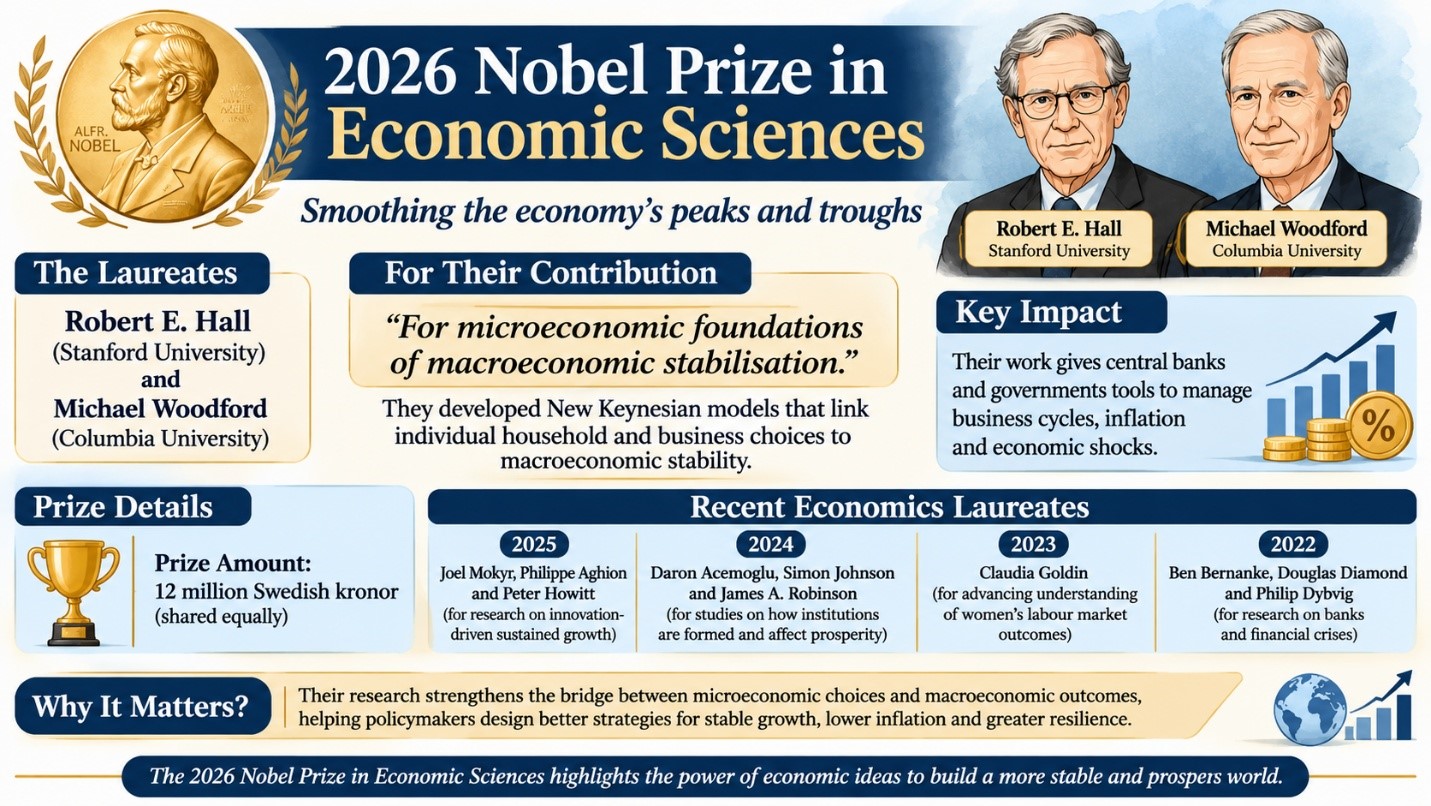
This year's Nobel Prize in Economics went to Robert Hall and Michael Woodford for their work on the micro foundations of macroeconomic stabilisation. The article explains why the award matters for economic policy and how far the framework suits a developing country like India.
The idea behind the award
- Robert Hall (1978): His paper on the Life-Cycle Permanent Income Hypothesis showed that consumption depends on expected permanent income, so only unexpected and permanent policy changes can alter consumption and employment. This became central to the New Keynesian models.
- Context: The 1973-74 oil shock produced stagflation (high inflation with high unemployment), which existing models could not explain, as they assumed prices and wages adjust to clear markets.
- New Keynesian response: Economists including Calvo, Fischer, Bruno, Blanchard, Bernanke, Stiglitz and Akerlof built models with wage and price rigidities, information asymmetries and credit market imperfections. These restored a role for fiscal policy, which monetarists like Friedman and Prescott had dismissed as ineffective for smoothing consumption.
- Michael Woodford: In Interest and Prices he synthesised this work into a macro model built on micro insights into how consumers and firms form price expectations, how prices and wages are set, and how central banks and tax policy shape behaviour. John Taylor's work, including the Taylor rule, is also central.
Spillovers and limits for developing countries
|
1. Spillovers
2. Why the framework fits India poorly?
3. India's inflation
|
Conclusion
The prize recognises that macroeconomics is applied microeconomics, in Hall's words, and that theory backed by empirical work improves policy. For India, tools should be adapted to informality and limited financial depth, while the framework gains relevance as the economy formalises.