

The rational ape: study says chimpanzees reason through their beliefs
Indian Express
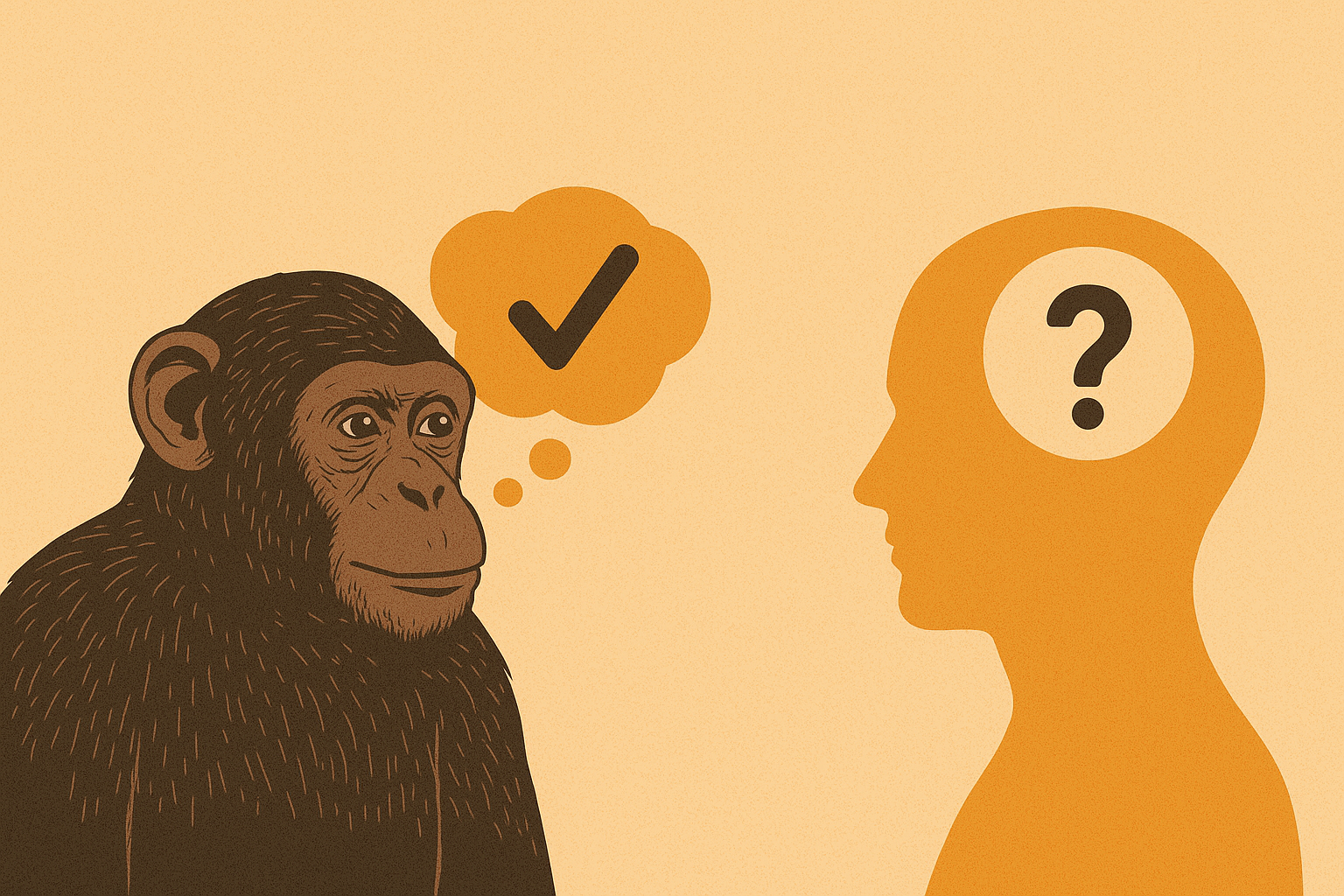
Key arguments
- Experimental evidence: A set of controlled behavioural tests showed chimpanzees did not just respond to the most recent or loudest cues; instead they evaluated which information was relevant and updated choices accordingly.
- Cognitive interpretation: Authors and quoted experts interpret this behaviour as indicative of reasoning about beliefs — a rudimentary form of meta-cognition or theory of mind.
- Comparative significance: The findings suggest continuity between human and great ape cognition, challenging assumptions about uniquely human belief-like reasoning.
- Limitations acknowledged: The article signals caveats — experimental constraints, sample size, and the necessity for replication under varied conditions before generalising.
3. Author’s stance and tone
- Curious, cautiously enthusiastic. The author presents the study’s claims with interest, highlights their potential significance for understanding animal minds, but also includes sceptical voices and methodological caveats. The tone is science-journalistic: explanatory, accessible, and balanced.
4. Biases, omissions and assumptions
Biases
- Anthropocentric framing: Interpreting chimp actions through human concepts like “belief” risks anthropomorphism; the article flirts with framing animal behaviour as directly comparable to human cognitive categories.
- Publication bias emphasis: The text focuses on the novelty and positive result; less space is devoted to null results, replication difficulties, or alternative mechanistic accounts (e.g., associative learning models).
Omissions
- Methodological detail: The article does not give granular detail on sample size, exact controls, statistical significance, or potential experimenter effects — information crucial to evaluate strength of inference.
- Alternative explanations: Limited discussion of lower-level explanations (reinforcement histories, cue salience, stimulus–response chaining) that could account for the observed behaviours without invoking theory-of-mind-like constructs.
- Wider literature: There is sparse contextualisation with conflicting or supporting studies (e.g., debate over whether primates possess full-fledged theory of mind).
Assumptions
- That the experimental controls were sufficient to rule out simpler learning explanations; that chimpanzee performance reflects general cognitive capacities rather than task-specific training or ecological contingencies.
5. Pros and cons — structured analysis
Pros
- Public understanding: The article brings an important scientific topic to a general readership, parsing complex experimental claims into accessible language.
- Balanced reporting: It includes expert caution, avoiding sensationalist claims that chimpanzees have identical mental states to humans.
- Stimulates debate: By reporting provocative results, the piece encourages discussion on animal cognition, ethics, and the evolutionary roots of cognition.
Cons
- Risk of over-interpretation: Readers may accept “chimpanzees reason through beliefs” at face value without appreciating epistemic limits; nuance about operational definitions of “belief” is thin.
- Lacks methodological depth: Without numeric detail on effect sizes, controls, sample composition, or replication status, the reader cannot judge robustness.
- Missed policy/ethical implications: The piece does not explore broader implications (e.g., for animal welfare, research ethics) that logically follow from attributing belief-like cognition to apes.
6. Policy implications & real-world impact
While this is basic research, the societal and policy implications can be meaningful if findings are robust and replicated:
A. Animal welfare & legal status
- Stronger ethical case for protection: Evidence that great apes possess belief-like reasoning could strengthen arguments for heightened welfare protections, restrictions on invasive research, and stricter conditions for captivity.
- Policy calibration: Governments and research regulators might re-evaluate laws governing use of non-human primates in research, tourism, or entertainment.
B. Research governance
- Replication & transparency mandates: Funding bodies and journals should emphasise replication, preregistration, open sharing of methods and data for such consequential cognitive claims.
- Interdisciplinary standards: Encourage collaboration between ethologists, neuroscientists, philosophers of mind and statisticians to craft rigorous tests that distinguish associative learning from higher-order cognition.
C. Education and public discourse
- Science literacy: Media and science communicators should stress limitations and avoid anthropomorphic simplifications when reporting on cognitive-behavioural studies.
7. Real-world impact scenarios
If replicated and robust
- Ethics shift: Regulatory frameworks governing primate research and captive management could become more stringent; public sentiment towards primate conservation and captivity may intensify.
- Scientific advance: New research lines on the evolutionary continuity of cognition, neural correlates of meta-reasoning, and cross-species comparisons.
If not replicated / alternative explanations prevail
- Caution reinstated: The study will be seen as an interesting but task-specific result, reinforcing the need for conservative interpretation of single-study claims. Policy changes would be deprioritised.
8. Alignment with UPSC GS syllabus (how to use in answers)
- GS Paper 3 (Science & Technology / Biodiversity): Use for questions on animal cognition, ethics of animal research, biodiversity conservation and wildlife management policy.
- GS Paper 2 (Governance / Ethics): Relevant to debates on regulation of animal research, bioethics committees, and legal protection for sentient species.
- GS Paper 4 (Ethics, Integrity & Aptitude): Ethical treatment of animals, moral considerations about non-human minds, and responsibilities of researchers and policymakers.
9. Balanced conclusion & future perspectives
The article is a good public-facing account of a thought-provoking scientific claim: chimpanzees may show behaviour consistent with evaluating the reliability of information and updating choices — a capacity some interpret as precursory belief reasoning. The report wisely includes caution, but readers and policymakers should treat the result as tentative pending replication and rigorous exclusion of simpler learning-based explanations.
Future perspectives: Robust progress requires (a) larger, preregistered, cross-site replication studies, (b) experimental designs explicitly pitting associative-learning models against metarepresentational explanations, and (c) interdisciplinary synthesis (neurobiology + behaviour + philosophy of mind) to refine operational definitions of “belief” across species. If convergent evidence accumulates, the consequences extend beyond academic theory — reshaping ethical norms, conservation priorities, and our philosophical understanding of minds across species.
