

The smartphone can wait, childhood can’t
Hindustan Times
I. Core Context
The article argues for limiting smartphone usage among children and adolescents, particularly in educational spaces. It advocates a “smartphone-free campus” model to preserve attention span, emotional well-being, social interaction, and authentic childhood experiences.
The piece is reflective and experiential, drawing from institutional practice and broader psychological research.
II. Key Arguments Presented
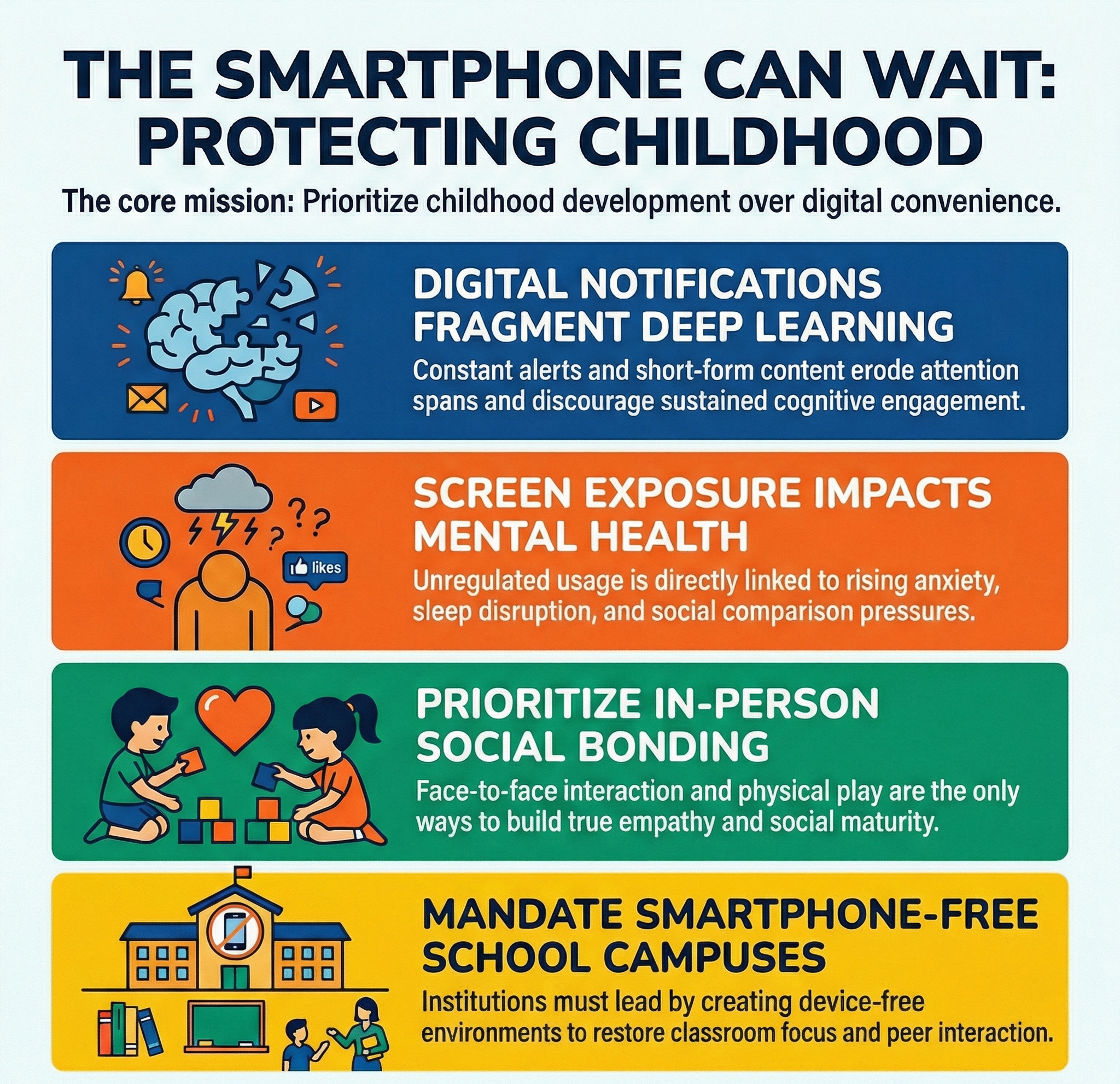
1. Smartphones Erode Attention and Deep Learning
The author claims:
- Constant notifications fragment attention.
- Social media encourages short-form thinking.
- Deep reading and sustained cognitive engagement decline.
The argument connects smartphone overuse to reduced academic concentration and shallow information processing.
2. Social Media Impacts Mental Health
The article references:
- Rising anxiety and social comparison pressures.
- Sleep disruption due to device usage.
- Links between screen exposure and emotional instability.
The concern is not technology per se, but early and unregulated exposure.
3. Childhood Needs Presence, Not Screens
A central philosophical point:
- Childhood should prioritise play, physical activity, and in-person bonding.
- Face-to-face interaction builds empathy and social maturity.
- Digital immersion prematurely compresses experiential growth.
The tone here is normative and value-driven.
4. Institutional Responsibility
The author advocates:
- School-level restrictions on smartphones.
- Structured digital discipline.
- A balanced approach rather than total technological rejection.
The argument suggests education systems must intervene proactively.
III. Author’s Stance
The article adopts a protective, reformist stance:
- Pro-childhood
- Skeptical of early smartphone exposure
- Supportive of structured digital boundaries
It is not anti-technology but anti-premature immersion.
IV. Possible Biases and Limitations
1. Generational Bias
The article may reflect:
- Adult anxiety about digital change.
- Nostalgia for pre-digital childhood.
It risks underestimating digital literacy as a necessary 21st-century skill.
2. Limited Recognition of Benefits
The piece underplays:
- Educational access via smartphones.
- Online learning platforms.
- Digital inclusion for rural and marginalised students.
It frames smartphones primarily as risk vectors.
3. Urban-Centric Perspective
Assumes:
- Institutional control over device access.
- Availability of alternative educational resources.
In many areas, smartphones are the only gateway to digital opportunity.
V. Strengths of the Argument
• Recognises attention economy dynamics
• Aligns with emerging research on adolescent mental health
• Advocates preventive rather than reactive regulation
• Emphasises social and emotional development
VI. Weaknesses
• Lacks nuanced digital pedagogy solutions
• Does not differentiate between productive and addictive use
• Underestimates inevitability of digital integration
VII. Policy Implications
1. Digital Governance in Schools
Possible measures:
- Age-based smartphone access guidelines
- Device-free classroom hours
- Structured digital literacy curriculum
2. Mental Health Framework
Schools must:
- Integrate emotional resilience training
- Address cyberbullying awareness
- Encourage balanced digital habits
3. Parental Awareness
Policy outreach should promote:
- Screen-time discipline
- Device-free family time
- Monitoring without surveillance culture
4. Regulatory Approach
Government may:
- Strengthen online safety frameworks for minors
- Mandate child-safe digital design
- Encourage ethical algorithmic standards
VIII. Real-World Impact
If adopted carefully:
Short-term:
- Improved classroom focus
- Better peer interaction
Medium-term:
- Healthier adolescent development
- Reduced digital addiction patterns
Long-term:
- Balanced digital citizens
However, extreme restriction may:
- Create digital skill gaps
- Exacerbate inequalities
- Push usage underground rather than regulate it
IX. UPSC Alignment
GS Paper I
• Role of family and educational institutions in socialisation
• Adolescence and social change
GS Paper II
• Education policy
• Child protection frameworks
• Digital governance
GS Paper III
• Technology and society
• Social impact of digital platforms
GS Paper IV
• Ethics of algorithm design
• Responsibility in technology use
Essay Themes
• Technology and human values
• Childhood in the digital age
• Balance between innovation and well-being
X. Balanced Conclusion and Future Perspective
The article makes a compelling case that childhood is developmentally sensitive and cannot be subordinated entirely to digital convenience. Attention, empathy, and social bonding are foundational capacities that require physical presence and sustained engagement.
However, the solution lies not in technological rejection but calibrated integration. Digital literacy must accompany digital restraint. Institutions, families, and policymakers must collaborate to design environments where technology serves childhood—not replaces it.
In a digital century, the challenge is not to choose between screens and childhood, but to ensure that childhood shapes how screens are used.
