

The Strength of Trust
Morning Standard
1. Key Arguments
A. Trust as the Basis of Leadership
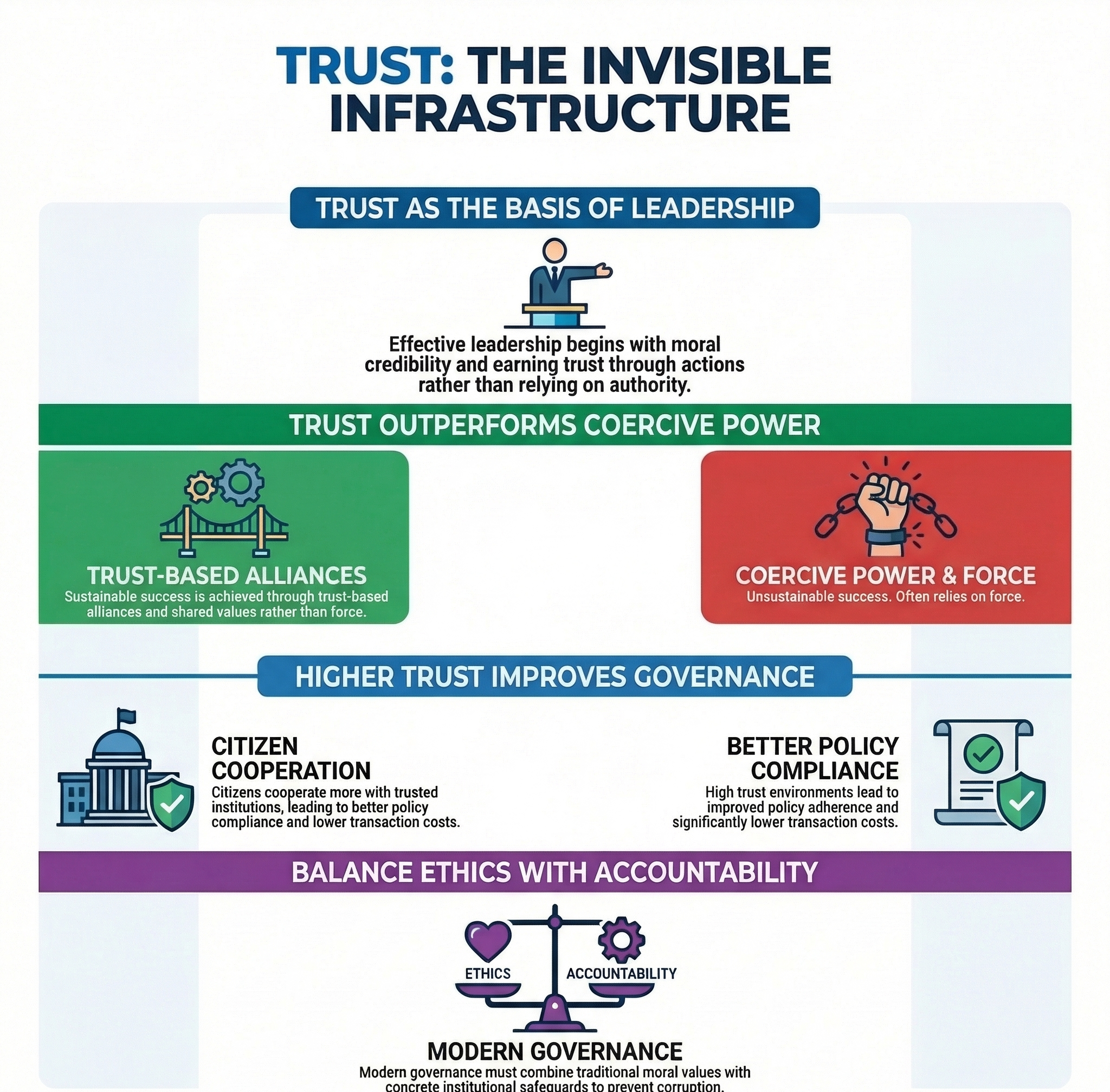
Effective leadership begins with moral credibility and trust-building.
Examples from the Ramayana show leaders earning trust through actions, not authority.
B. Trust Over Power and Force
Sustainable success comes from trust, not coercion.
Contrasts Ravana’s power-centric approach with Rama’s trust-based alliances.
C. Trust in Relationships and Alliances
Alliances are strengthened through mutual respect and shared values.
Relationships such as Rama–Sugriva and Rama–Vibhishana illustrate trust as a binding force.
D. Trust as Moral and Social Glue
Trust sustains societal morality and order.
It enables cooperation, reduces conflict, and fosters collective well-being.
E. Relevance in Contemporary Society
Modern institutions and governance depend on trust.
Decline in trust leads to institutional inefficiency and social fragmentation.
2. Author’s Stance
Normative and ethics-driven
Strong emphasis on moral philosophy
The author uses the Ramayana as a framework to derive universal ethical principles.
Advocacy for value-based leadership
Promotes integrity, humility, and empathy as essential leadership traits.
3. Biases and Limitations
Mythological framing bias
Relies heavily on epic narratives, which may not fully capture modern institutional complexities.
Idealistic tone
Assumes trust can be universally applied despite structural inequalities and power asymmetries.
Limited critical perspective
Does not question or reinterpret the examples from alternative viewpoints.
4. Strengths (Pros)
Strong ethical grounding
Connects leadership with values like integrity and empathy.
Cultural resonance
Uses familiar narratives to communicate complex ideas effectively.
Contemporary relevance
Applies ancient lessons to modern governance and society.
5. Weaknesses (Cons)
Lack of empirical evidence
Arguments are largely illustrative rather than data-driven.
Limited policy articulation
Does not translate ethical insights into concrete governance mechanisms.
Overgeneralisation
May oversimplify complex socio-political realities.
6. Policy Implications
A. Ethical Governance
Promoting transparency and accountability
Building trust in public institutions.
B. Leadership Development
Value-based training for public officials
Integrity and empathy as core competencies.
C. Social Cohesion Policies
Encouraging community trust and participation
Reducing social fragmentation.
D. Institutional Trust-Building
Strengthening credibility of institutions
Consistent and fair policy implementation.
E. Conflict Resolution
Using trust-based approaches
Dialogue and mutual respect over coercion.
7. Real-World Impact
Governance
Higher trust improves policy compliance and effectiveness
Citizens cooperate more with trusted institutions.
Social Stability
Trust reduces conflict and enhances cohesion
Communities function more harmoniously.
Economic Impact
Trust lowers transaction costs
Facilitates business and investment.
Challenges
Erosion of trust leads to institutional crises
Corruption and inefficiency increase.
8. UPSC GS Paper Linkages
GS Paper IV (Ethics)
- Trust, integrity, and leadership
- Moral values in governance
GS Paper II (Governance)
- Transparency and accountability
- Public trust in institutions
GS Paper I (Culture)
- Role of epics in shaping values
9. Balanced Conclusion
Trust is a timeless principle, but its application requires contextual adaptation.
While the article effectively highlights the ethical importance of trust, modern governance demands combining moral values with institutional safeguards.
10. Future Perspective
Integrating ethics with institutions
Balancing moral leadership with systemic accountability.
Rebuilding trust in public life
Addressing corruption and inefficiency.
Cultural narratives as tools for governance ethics
Using traditional wisdom to inform modern policymaking.
Sustaining trust in a complex society
Adapting trust-based principles to diverse and dynamic contexts.
Final Insight
Trust is not merely a virtue—it is the invisible infrastructure that holds societies, institutions, and leadership together.
