

To lower China dependence, India signs rare earths deal with Brazil
Times Of India
I. Core Context
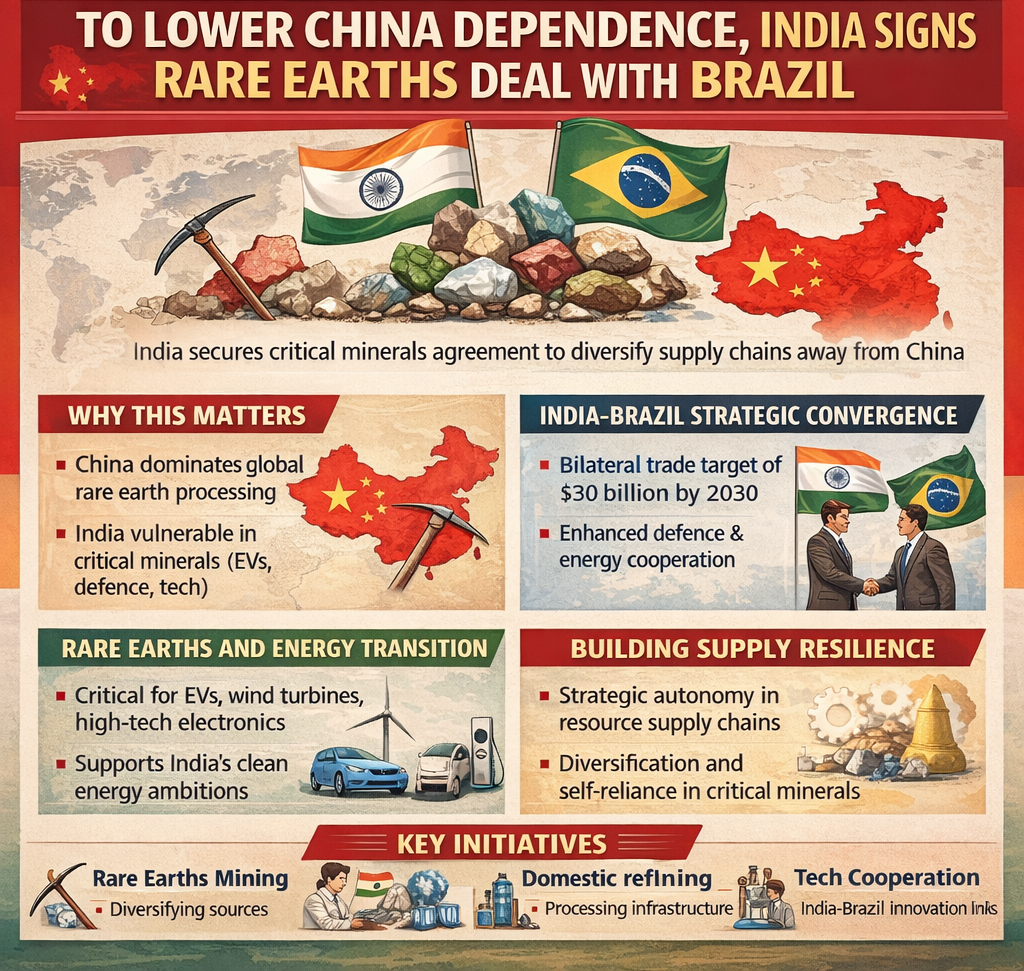
The article reports India’s strategic move to diversify rare earth mineral supply chains by signing an agreement with Brazil.
The development must be seen against:
- China’s dominance in global rare earth processing
- Rising geopolitical tensions
- India’s push for supply chain resilience
- Strategic partnerships within the Global South
The rare earths agreement is framed as part of a broader bilateral expansion in trade, defence and energy cooperation.
II. Key Arguments Presented
1. Reducing China Dependence
The article highlights that:
- China controls a significant share of rare earth mining and processing
- India remains vulnerable in critical minerals required for EVs, defence, electronics and renewables
- Diversifying supply sources is a strategic necessity
The deal with Brazil is presented as a geopolitical and economic hedge.
2. Strategic Convergence with Brazil
Beyond minerals, the article notes:
- Bilateral trade target of $30 billion by 2030
- Cooperation in defence and energy
- Alignment in Global South platforms
- Shared positions in multilateral institutions
The partnership is positioned within broader South-South cooperation.
3. Rare Earths as Critical for Energy Transition
Rare earth minerals are essential for:
- Electric vehicles
- Wind turbines
- Advanced electronics
- Defence technologies
The agreement is linked to India’s clean energy ambitions and industrial strategy.
4. Economic and Diplomatic Signalling
The article suggests:
- India is proactively reconfiguring supply chains
- Emerging economies are building alternative networks
- Strategic autonomy requires resource diversification
III. Author’s Stance
The article adopts a strategic diversification narrative.
Tone:
- Forward-looking
- Geopolitically aware
- Pragmatic
It views the agreement as a rational response to global supply concentration risks.
The stance reflects support for India’s multipolar diplomacy.
IV. Possible Biases and Limitations
1. Overemphasis on Immediate Impact
The article implies significant reduction in dependence, but:
- Brazil’s processing capacity remains limited
- China dominates refining and downstream value chains
- Rare earth supply chains are technologically complex
Diversification is long-term, not immediate.
2. Limited Discussion on Domestic Mining
The piece does not sufficiently explore:
- India’s own rare earth reserves
- Environmental concerns in mining
- Regulatory hurdles
- Processing capacity deficits
Supply security depends on domestic capability too.
3. Processing vs Extraction
Rare earth value lies in refining, not merely extraction.
The article underplays:
- China’s 80–90% control over global refining
- Need for Indian processing infrastructure
V. Pros and Cons of the Argument
Pros
• Highlights strategic mineral diplomacy
• Connects energy transition with geopolitics
• Recognises supply chain vulnerability
• Aligns with Atmanirbhar Bharat goals
Cons
• Overstates short-term independence
• Limited cost and feasibility analysis
• Underplays environmental risks
• Minimal exploration of refining bottlenecks
VI. Policy Implications
1. Supply Chain Resilience Strategy
India must:
- Secure diversified mining sources
- Invest in domestic refining
- Develop recycling ecosystems
2. Strategic Minerals Policy
- Critical minerals mission acceleration
- Public-private partnerships
- Incentives for downstream manufacturing
3. Environmental Governance
Rare earth mining is environmentally sensitive.
India must ensure:
- Sustainable extraction
- Strict regulatory oversight
- Community consent
4. Global South Diplomacy
The agreement strengthens:
- BRICS coordination
- G20 cooperation
- South-South trade architecture
VII. Real-World Impact
If implemented effectively:
- Reduced geopolitical vulnerability
- Strengthened EV and renewable manufacturing
- Greater defence supply security
- Increased bilateral trade
If poorly executed:
- Continued refining dependence
- Environmental backlash
- High capital costs
VIII. UPSC Relevance
GS Paper II
• India–Brazil relations
• BRICS and Global South diplomacy
• Strategic autonomy
GS Paper III
• Critical minerals
• Energy transition
• Supply chain resilience
• Industrial policy
Essay Themes
• Resource security in a multipolar world
• Energy transition and geopolitics
IX. Balanced Conclusion and Future Perspective
The rare earths agreement with Brazil is strategically sound but structurally incomplete.
Diversification of mining sources is only the first step.
True independence lies in:
- Domestic refining capacity
- Technological advancement
- Recycling ecosystems
- Strategic stockpiling
India’s challenge is not merely reducing China dependence, but building a resilient, vertically integrated critical minerals ecosystem.
Strategic autonomy in the 21st century will depend as much on mineral diplomacy as on military diplomacy.
