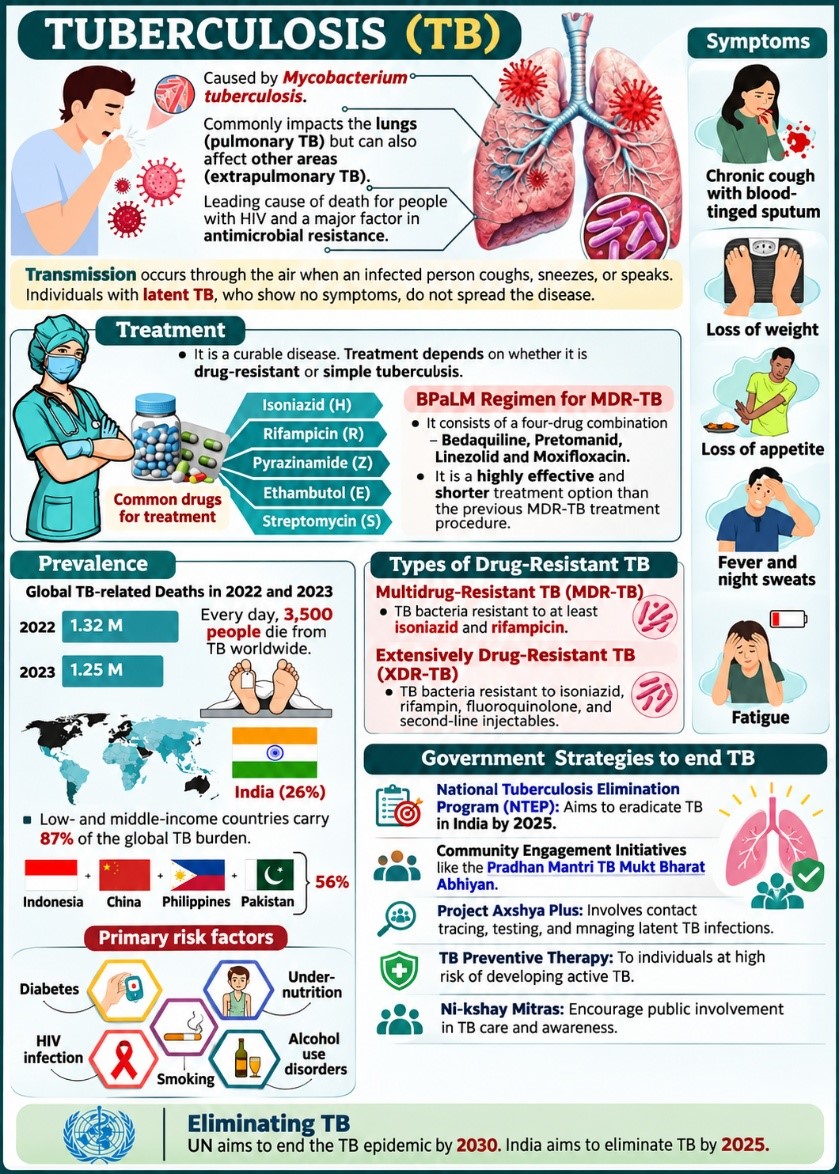

Tuberculosis (TB): Global Burden, India's Progress and Elimination Strategy

Tuberculosis (TB): Global Burden, India's Progress and Elimination Strategy
Context
According to the WHO Global Tuberculosis (TB) Report 2026, India has achieved a 38% reduction in TB-related mortality between 2015 and 2025, compared with a global reduction of 35%.
Despite this improvement, India continues to have the highest TB burden globally, accounting for 25% of all TB cases in 2025.
The report recognises India's progress in reducing mortality, improving treatment outcomes and strengthening domestic financing. However, the high incidence of the disease remains a major challenge.
Global and India's TB Burden
- An estimated 10.6 million people developed TB globally in 2025, approximately 75,000 fewer than in 2024.
- The global TB incidence rate declined from 131 cases per lakh population in 2024 to 129 cases per lakh in 2025.
- Since 2015, global TB incidence has declined by only 14%, considerably below the End TB Strategy milestone of 50% reduction by 2025 and the target of 80% by 2030.
- TB remains the leading cause of death from a single infectious agent and ranks 13th among all causes of death worldwide.
Top Eight Countries Contributing to Global TB Cases (2025)
|
Country |
Share of Global TB Cases |
|
India |
25% |
|
Indonesia |
10% |
|
Philippines |
6.8% |
|
China |
6.5% |
|
Pakistan |
6.4% |
|
Nigeria |
4.9% |
|
Democratic Republic of Congo (DR Congo) |
3.9% |
|
Bangladesh |
3.7% |
- These eight countries together account for approximately 67% of global TB cases.
- The 30 high-burden countries collectively contribute around 88% of the global TB burden.
Demographic Distribution of TB (2025)
- Men: 54%
- Women: 35%
- Children: 11%
India's Progress in TB Control
1. Reduction in TB-related mortality
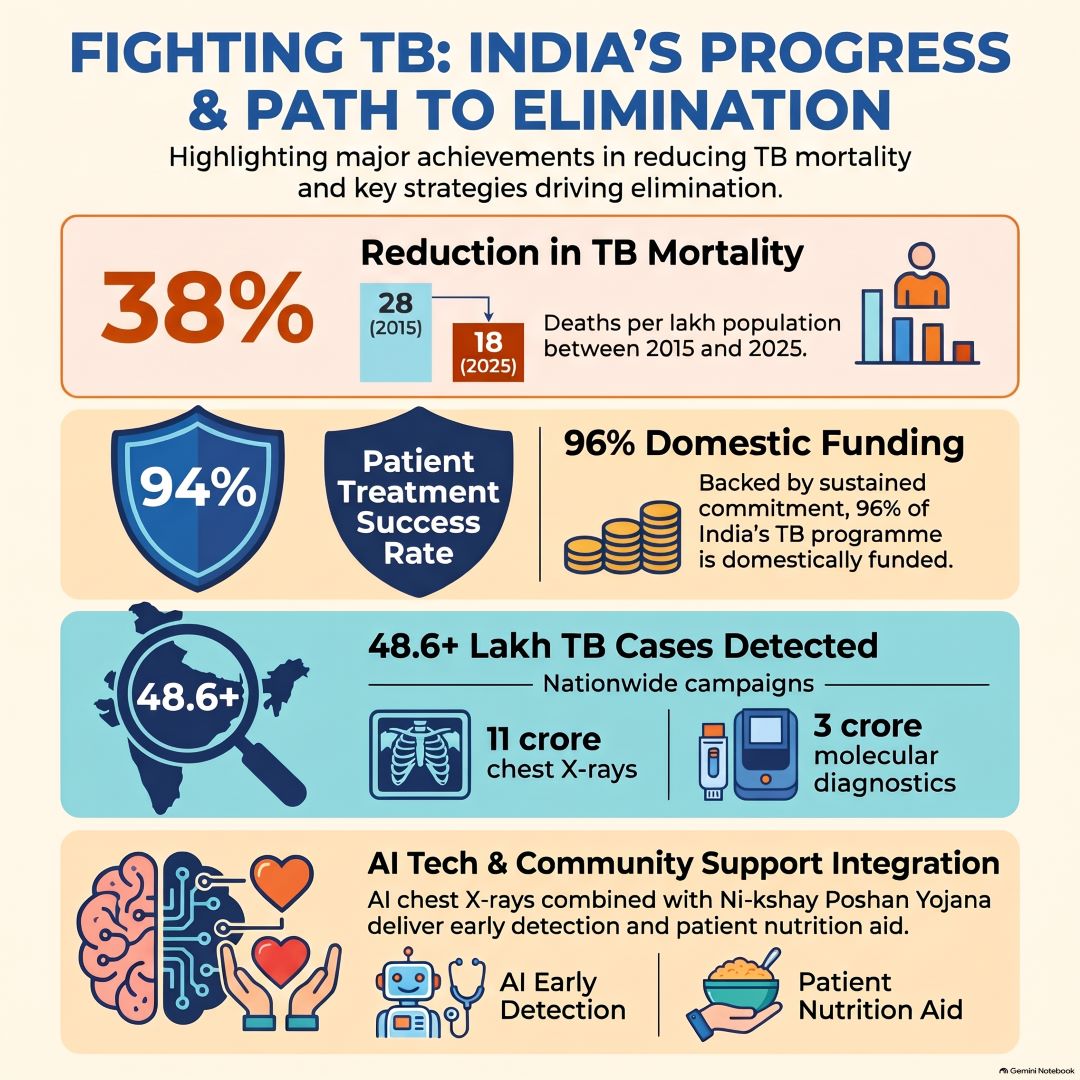
- Estimated TB deaths declined from 28 per lakh population in 2015 to 18 per lakh in 2025.
- This represents a 38% reduction in TB-related mortality.
2. Improved treatment success rate
- India recorded a treatment success rate of 94%, indicating improvements in treatment delivery and patient support mechanisms.
3. Increased domestic financing
- Approximately 96% of the funding requirements for India's TB programme are being met through domestic resources.
- This reflects sustained national investment in TB control and elimination efforts.
4. Declining MDR-TB incidence
- India remains among the four countries accounting for more than 50% of global multidrug-resistant tuberculosis (MDR-TB) cases.
- However, the incidence of MDR-TB in India has been gradually declining.
5. Revision of disease-burden estimates
- WHO, India's Central TB Division and the Indian Council of Medical Research (ICMR) are examining district-level sentinel surveillance data.
- The assessment also includes findings from the nationally representative TB prevalence survey conducted by ICMR-National Institute for Research in Tuberculosis (NIRT) in 2025.
Government Initiatives for TB Elimination
India's progress has been supported by interventions under the National TB Elimination Programme (NTEP), focusing on early diagnosis, improved treatment, technological interventions and community participation.
1. TB Mukt Bharat Abhiyaan
- Launched as an intensified campaign on December 7, 2024.
- Initially covered 347 high-priority districts across 33 States and Union Territories before being expanded nationwide.
Achievements (2024 – November 2026)
|
Indicator |
Achievement |
|
Chest X-rays conducted |
More than 11 crore |
|
Nucleic Acid Amplification Tests (NAAT) conducted |
Over 3 crore |
|
TB cases detected |
Approximately 48.64 lakh |
|
Asymptomatic TB cases detected |
14.97 lakh |
- Identification of asymptomatic TB cases enables early treatment, reduces disease transmission and prevents progression to severe illness.
2. Technology-enabled TB Management
Technology is being increasingly integrated into TB screening, diagnosis and patient management.
- AI-enabled chest X-rays: Improve screening and facilitate early identification of suspected TB cases.
- AI-based hotspot identification: Helps identify geographical areas with a high vulnerability to TB.
- Predictive AI tools: Identify patients at higher risk of adverse treatment outcomes.
- Digital interventions: Khushi AI Chatbot and Avatar Videobot support public awareness, information dissemination and patient engagement.
- Rapid molecular diagnostics: Facilitate faster and more accurate detection of TB.
3. Nutritional and Community Support
- Ni-kshay Poshan Yojana: Provides nutritional assistance to TB patients to support their recovery and treatment.
- Ni-kshay Mitra Initiative: Encourages community participation by facilitating nutritional support through individual and institutional donors.
- Integrated healthcare: TB screening is linked with diabetes, undernutrition and other comorbidities to ensure comprehensive and differentiated patient care.
Challenges in Achieving TB Elimination
- High disease burden: India continues to contribute one-fourth of the world's TB cases.
- Detection gaps: Asymptomatic and undiagnosed cases contribute to continued disease transmission.
- Drug resistance: Multidrug-resistant TB (MDR-TB) remains a major public health concern.
- Socio-economic determinants: Undernutrition, poverty, overcrowding and poor living conditions increase vulnerability to TB.
- Slow global progress: The reduction in worldwide TB incidence remains significantly below the targets established under the End TB Strategy.
- Data uncertainties: The ongoing revision of India's TB incidence estimates highlights the need for stronger surveillance systems and reliable disease-burden assessments.
Conclusion
India's substantial contribution to the global TB burden highlights the need to move beyond reducing mortality towards accelerating prevention, early diagnosis and interruption of disease transmission.
A technology-driven, adequately financed and community-centred approach, supported by stronger healthcare infrastructure and nutritional interventions, will be essential to achieving the goal of a TB-Mukt Bharat.