

Voter ID for Welfare Delivery

Voter ID for Welfare Delivery
Source: The Hindu
Why in news?
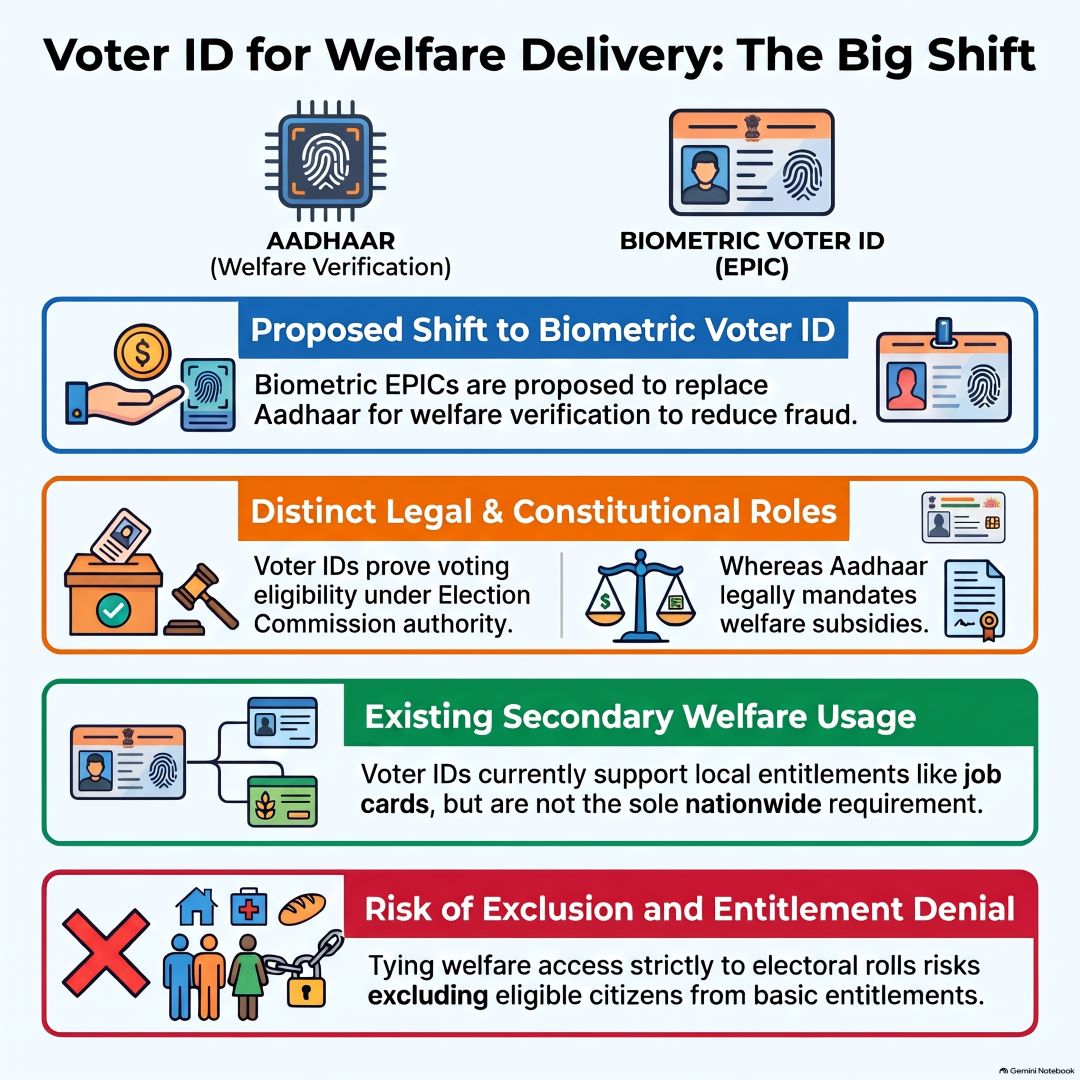
Union Panchayati Raj Minister Rajiv Ranjan Singh (Lalan Singh) announced that voter ID cards (EPICs) with biometric authentication would replace Aadhaar for identifying welfare beneficiaries and processing payments. He argued Aadhaar cards "can be made at every street corner in five minutes", enabling fraud. Experts and the Opposition contested this. The timing, during the Special Intensive Revision (SIR) of electoral rolls, made it controversial.
|
Constitutional & Legal Framework The Voter ID is issued by the Election Commission of India (ECI), an autonomous body under Article 324. While the card acts as identity and address proof, your eligibility to vote depends strictly on your name being in the Electoral Roll.
Recent Reforms (2024-2026) As of November 2026, several key reforms have been integrated into the electoral process following the Election Laws (Amendment) Act, 2021:
|
Static background
- Voter ID (EPIC): Issued by the Election Commission, which has superintendence over elections under Article 324. Rolls are prepared under the Representation of the People Act, 1950, and Article 326 gives the right to vote to every citizen aged 18 and above.
- Citizenship is governed by Articles 5 to 11 and the Citizenship Act, 1955, and decided by the Centre. The electoral roll records eligibility to vote, not citizenship.
- Aadhaar Act, 2016: Section 7 allows Aadhaar to be required for subsidies and benefits paid from the Consolidated Fund. In Puttaswamy (2018) the Supreme Court upheld Aadhaar for welfare benefits but struck down mandatory linking with bank accounts and mobile numbers. Puttaswamy (2017) made privacy a fundamental right.
- The Election Laws (Amendment) Act, 2021 allows voluntary linking of Aadhaar with electoral rolls.
- Panchayati Raj: The 73rd Amendment (1992) added Part IX. Article 243A provides for the gram sabha, and the Eleventh Schedule lists 29 subjects for panchayats. Article 280 sets up the Finance Commission, which recommends grants to local bodies.
- Welfare delivery: Ration cards under the National Food Security Act, 2013 and direct benefit transfer (DBT) depend on identifying the right beneficiary. Article 21 includes the right to food.
Are voter IDs already used for welfare?
- The voter ID, called pehchaan patra in Hindi, has often been an entry document for other entitlements, like the ration card. It was among documents accepted for MGNREGA job cards.
- In Delhi it is compulsory for certain pension schemes, with endorsement from a local councillor or legislator.
- It has never been the exclusive nationwide identifier for welfare delivery.
- Ten States, starting with Madhya Pradesh and Rajasthan, have introduced family cards, since many schemes target households, not individuals.
Digital Evolution: e-EPIC
The e-EPIC is a secure, non-editable PDF version of the Voter ID that can be downloaded on mobile or printed.
- Feature: It contains a secured QR code with images and demographics to prevent duplicates.
- Utility: It is as valid as the physical card for all identification purposes.
Conclusion
The proposal sits between administrative reform and electoral politics, and raises legal questions given the Supreme Court's distinction between electoral and welfare uses of the EPIC. With SIR already facing credibility concerns over mass exclusions, linking welfare to the rolls risks adding denial of entitlements to disenfranchisement. Until safeguards are clear, it remains a test of balancing fraud prevention against the right to welfare access.