

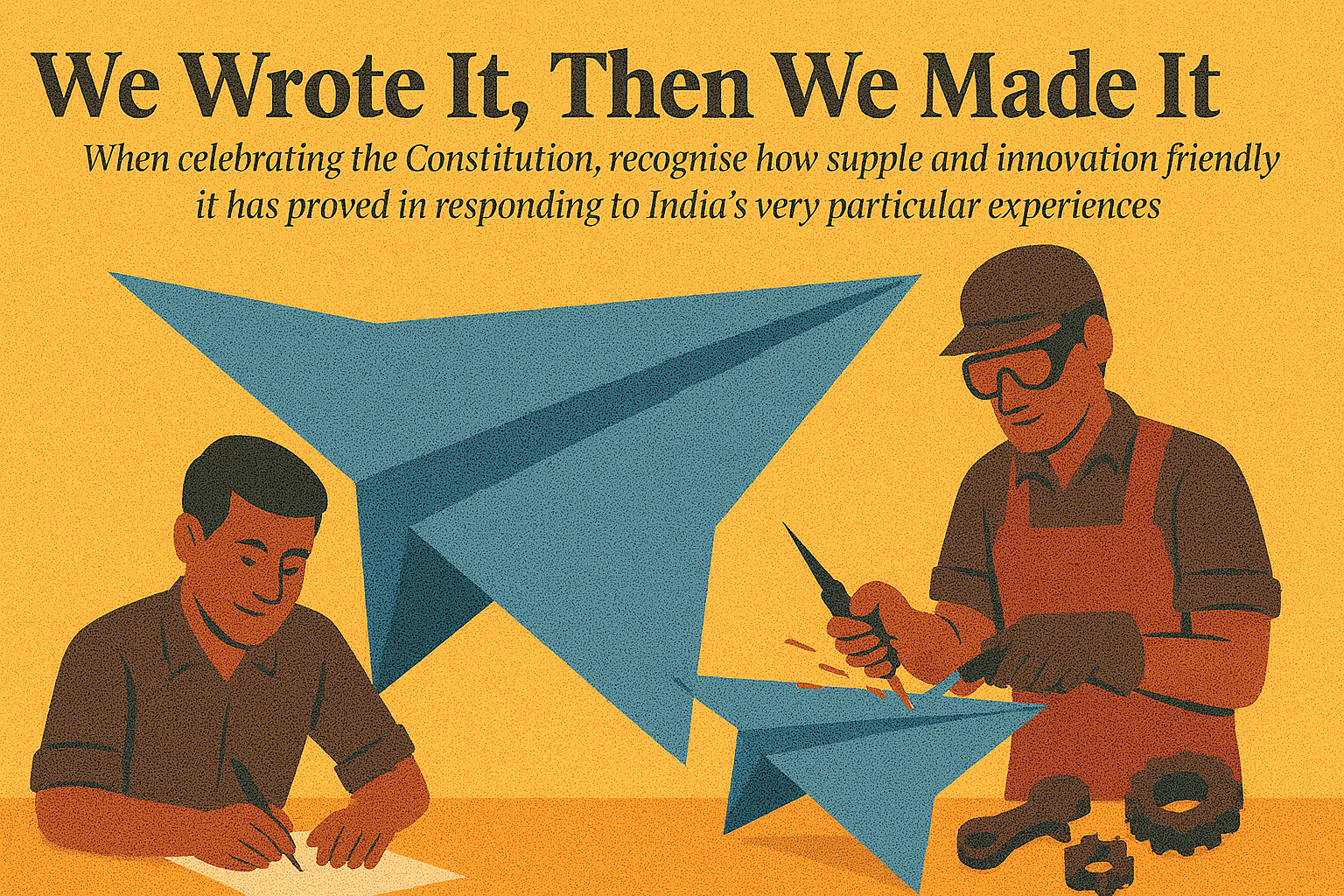
We Wrote It, Then We Made It
Times Of India
Key Arguments Presented
A. Indian constitutionalism is innovative and improvisational
- Courts, Parliament, and civil society have constantly reimagined constitutional values.
- India’s federal structure, rights jurisprudence, and institutional design have evolved through practice, not just text.
B. Creativity over rigid textualism
- Authors argue that strict textual interpretation is unsuitable for India’s socio-political context.
- The framers intended flexibility, not doctrinal rigidity.
C. PIL as India’s indigenous innovation
- Public Interest Litigation transformed court access, enabling marginalised voices.
- Western jurisprudence has no equivalent to India’s wide PIL jurisdiction.
D. Directive Principles as interpretive tools
- Unlike Western constitutions, India elevates Directive Principles in interpretation to balance rights with social justice.
- Courts utilised DPSPs to justify:
- Right to livelihood
- Right to education
- Environmental protections
E. Principles of swa-deshi interpretation
The authors identify four indigenous doctrines:
- Harmonious construction – balancing conflicting parts of the Constitution
- Cooperative federalism – federal flexibility suited to India’s diversity
- Transformative constitutionalism – interpreting the Constitution progressively
- Creative judicial review – evolving fundamental rights jurisprudence
F. India’s judiciary responded to real-world pressures
- Emergency-era excesses led to expansion of judicial review and basic structure doctrine.
- Social inequality led to rights expansion.
- Bureaucratic constraints led to PIL.
Thus, Indian constitutionalism is shaped by lived realities, not political theory alone.
3. Authors’ Stance
The authors take a celebratory and affirmative stance toward India’s constitutional evolution.
They argue that:
- India’s judiciary has acted as a democratic innovator
- Constitutional practices must remain flexible
- Indigenous jurisprudence is superior to borrowed Western models
The tone is optimistic, framing India’s constitutional journey as a success story of adaptation and resilience.
4. Potential Biases or Limitations
A. High praise for judiciary, limited critique
The editorial does not engage deeply with:
- Judicial overreach
- Delays and pendency
- Concerns about PIL misuse
- Executive-judiciary tensions
B. Underplays challenges in implementation
While jurisprudence has expanded rights, on-ground enforcement often lags.
C. Somewhat romanticises India’s “improvisational” model
Improvisation may also lead to:
- Legal unpredictability
- Excessive judicial discretion
- Policy uncertainty
D. Limited engagement with constitutional setbacks
Such as:
- Erosion of civil liberties in certain periods
- Weakening institutions
- Uneven federal balance
Thus, the analysis is more celebratory than critical.
5. Pros and Cons of Argumentation
Pros
- Highlights India’s unique constitutional journey
- Strong historical grounding
- Shows how constitutional interpretation shaped governance
- Explains indigenous doctrines clearly
- Useful for understanding judicial innovation
Cons
- Insufficient criticism of judicial activism
- Overlooks political capture of institutions
- Minimal discussion on social exclusion despite rights expansion
- Does not address modern concerns such as privacy, technology, or digital rights deeply
6. Policy Implications
A. Constitutional Interpretation
- Supports maintaining judiciary’s flexibility in rights expansion
- Encourages contextual interpretation instead of rigid doctrinalism
B. Democratic Governance
- Suggests institutional reforms should accommodate India’s diversity and evolving needs
- Reinforces cooperative federalism as a governance norm
C. Social Justice
- Reaffirms Directive Principles as necessary tools for inclusive development
- Encourages continuation of welfare-focused jurisprudence
D. Judicial Reform
- Acknowledges need to preserve judicial independence
- Suggests courts should retain capacity for creative interventions, but with caution
7. Real-World Impact
Positive Impact
- Rights expansion (education, environment, livelihood)
- Greater access to justice through PIL
- Improved accountability of the state
- Strengthening of democracy through judicial review
Negative/Complex Impacts
- Judicial activism sometimes results in policy overreach
- Increased pendency from expansive jurisdiction
- Ambiguity in constitutional interpretation may challenge governance
- Federal tensions when courts override state autonomy
8. UPSC Relevance
GS Paper 2
- Constitutional amendments
- Separation of powers
- Judicial review
- PIL
- Directive Principles
- Federalism
GS Paper 4
- Ethical foundations of constitutionalism
- Justice, liberty, equality
Essay Paper
- Indian democracy
- Judicial role
- Transformative constitutionalism
Prelims
- Constitutional doctrines
- Articles 32, 136, 142, 226
- Directive Principles
9. Balanced Summary
The article persuasively argues that India’s Constitution is a dynamic, living document that has grown through innovative judicial interpretation, indigenous doctrines, and adaptation to social realities. It highlights the flexibility and resilience of India’s constitutional order, celebrating innovations like PIL, transformative constitutionalism, and harmonious construction.
However, the piece underplays the tensions created by judicial activism, challenges in implementation, and concerns around institutional overreach. While innovativeness is a strength, unpredictability and excessive judicial discretion may also undermine democratic balance.
10. Future Perspectives
- Strengthen constitutional literacy so citizens understand evolving jurisprudence.
- Reform judicial processes to address pendency while preserving judicial creativity.
- Modernise constitutional interpretation to address digital-era challenges such as AI, privacy, and data rights.
- Protect federalism while maintaining cooperative frameworks.
- Institutional transparency to prevent misuse of PIL and judicial overreach.
Ultimately, India’s constitutional journey is not just about the text drafted in 1950 but the continuous effort of adapting it to the nation’s socio-political realities. The challenge ahead is balancing innovation with institutional stability.
