

Wealth of India, hits and misses
Hindustan Times
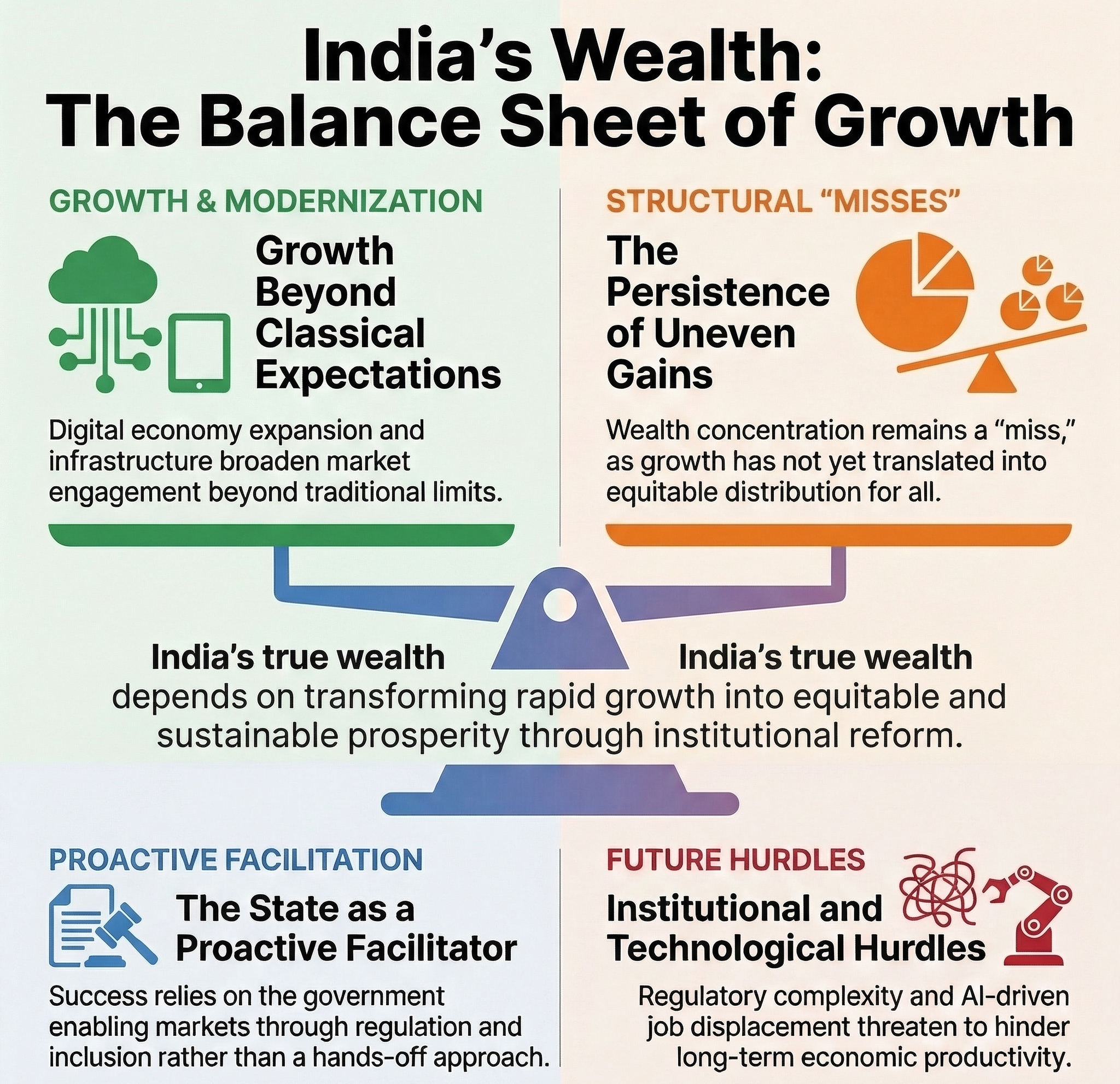
1. Key Arguments
A. Growth Beyond Classical Expectations
India has expanded markets, infrastructure, and participation beyond what classical economists envisaged.
Digital economy, financial inclusion, and public infrastructure have broadened economic engagement.
B. Role of the State as Facilitator
The State has played a proactive role in enabling markets.
Contrary to pure laissez-faire ideas, government intervention has supported infrastructure, regulation, and inclusion.
C. Persistent Inequality and Uneven Gains
Economic growth has not translated into equitable distribution.
Wealth concentration and disparities limit inclusive prosperity.
D. Institutional Challenges
Regulatory complexity, policy unpredictability, and governance gaps hinder efficiency.
These issues affect investment climate and economic productivity.
E. Emerging Technological Disruptions
AI and automation may reshape labour markets.
Risk of job displacement and concentration of wealth among capital owners.
2. Author’s Stance
Balanced and analytical
Recognition of achievements with critical caution
Acknowledges India’s progress while highlighting structural weaknesses.
Institution-centric perspective
Emphasises governance quality as key to sustainable growth.
3. Biases and Limitations
Theoretical framing bias
Heavy reliance on Adam Smith’s framework may not fully capture modern economic complexities.
Limited sectoral depth
Does not deeply analyse agriculture, MSMEs, or informal economy.
Moderate pessimism on inequality
May understate recent welfare and redistribution efforts.
4. Strengths (Pros)
Integrates classical and contemporary analysis
Provides intellectual depth by linking past theories with present realities.
Balanced narrative
Neither overly celebratory nor overly critical.
Focus on institutions
Highlights governance as central to economic success.
5. Weaknesses (Cons)
Limited empirical backing
Lacks detailed data to support claims.
Insufficient policy specificity
Broad observations without detailed reform pathways.
Underexplored global context
India’s position relative to other emerging economies is not deeply analysed.
6. Policy Implications
A. Strengthening Institutions
Improving regulatory clarity and policy stability
Enhancing ease of doing business.
B. Inclusive Growth Strategies
Reducing inequality through targeted interventions
Social welfare, education, and health investments.
C. Market Reforms
Balancing regulation with competition
Prevent monopolies and encourage innovation.
D. Managing Technological Transition
Skill development and labour market reforms
Preparing workforce for AI and automation.
E. State-Market Synergy
Collaborative approach to development
State as facilitator, not controller.
7. Real-World Impact
Economic Growth
Sustained but uneven expansion
Growth benefits concentrated in certain sectors and regions.
Social Impact
Inequality affects social cohesion
Limits broad-based prosperity.
Labour Market
Jobless growth concerns
Automation and informalisation challenges.
Governance
Institutional efficiency determines outcomes
Policy consistency impacts investor confidence.
8. UPSC GS Paper Linkages
GS Paper III (Economy)
- Economic growth vs development
- Inequality and inclusive growth
- Role of state in economy
GS Paper II (Governance)
- Institutional effectiveness
- Policy implementation
GS Paper I (Society)
- Socio-economic disparities
GS Paper IV (Ethics)
- Equity and fairness in development
9. Balanced Conclusion
India’s economic trajectory is a mix of significant achievements and unresolved structural challenges.
While growth has expanded opportunities, institutional weaknesses and inequality remain key constraints.
10. Future Perspective
Towards inclusive and sustainable growth
Balancing efficiency with equity.
Institutional reforms as priority
Ensuring transparency and predictability.
Adapting to technological change
Leveraging AI while protecting livelihoods.
Strengthening state-market balance
Collaborative governance for long-term development.
Final Insight
India’s true wealth will be measured not just by growth, but by how equitably and sustainably that growth is shared.
