

What are the key takeaways from AI summit?
The Hindu
I. Core Context
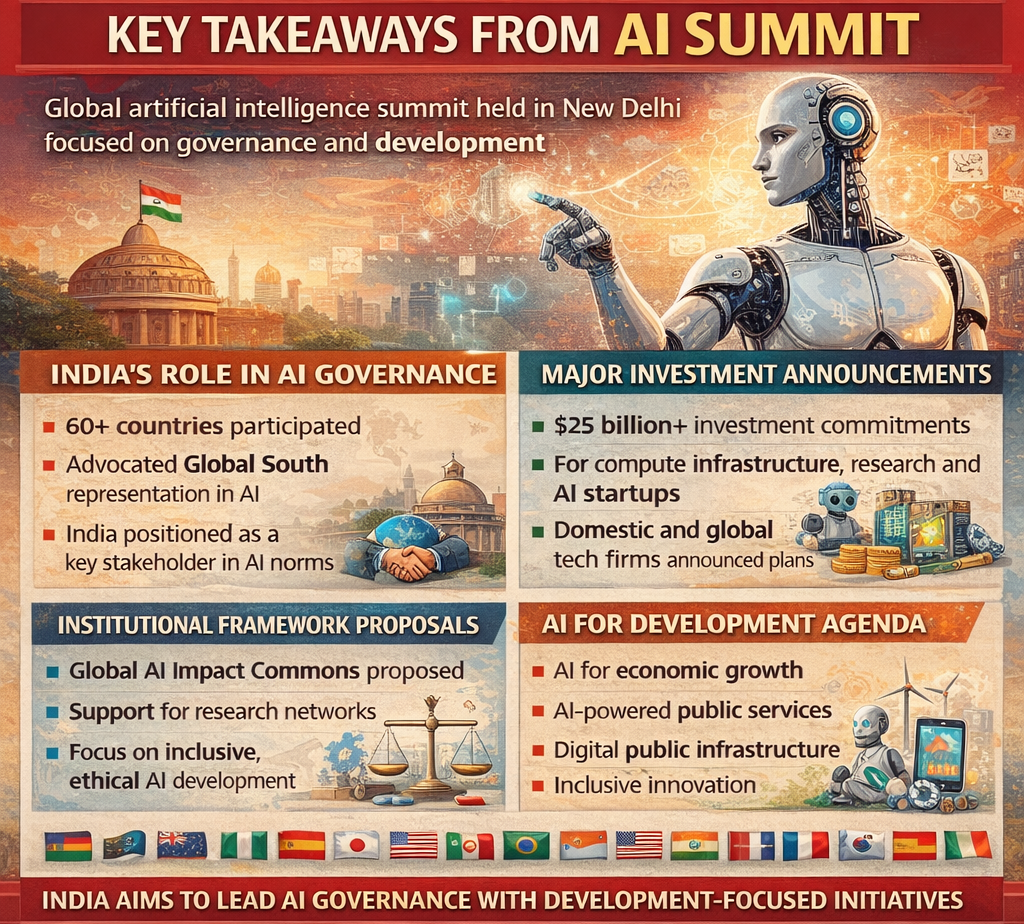
The article reviews the outcomes of a major AI summit hosted in New Delhi, highlighting India’s positioning in the global artificial intelligence ecosystem. It examines participation, investment announcements, institutional proposals, and the broader geopolitical and economic implications.
The summit is presented as:
- A platform for Global South representation in AI governance
- A venue for investment commitments
- A step toward shaping democratic AI norms
II. Key Arguments Presented
1. India’s Emerging Leadership in AI Governance
The article emphasises that:
- Over 60 countries participated
- The summit sought to represent the Global South’s interests
- India aims to shape AI governance frameworks
The messaging suggests India is positioning itself as a normative and technological leader.
2. Investment Announcements
The piece highlights:
- Commitments from technology firms and domestic conglomerates
- Proposed investments in compute infrastructure, research, and AI ecosystems
- Emphasis on long-term capacity building
These are framed as signals of investor confidence in India’s AI ambitions.
3. Institutional Architecture for AI
The article notes proposals such as:
- Global AI Impact Commons
- AI research networks
- Skill development initiatives
The summit’s outcome includes calls for collaborative frameworks rather than fragmented regulation.
4. Strategic Framing: AI for Development
The narrative links AI to:
- Economic growth
- Social inclusion
- Digital public infrastructure expansion
- Public service delivery
This aligns AI development with India’s broader digital governance model.
III. Author’s Stance
The tone is cautiously optimistic.
The article appears supportive of India’s ambition to:
- Lead AI discourse in the Global South
- Attract large-scale investments
- Promote inclusive AI development
There is a subtle celebratory undertone regarding India’s convening power.
IV. Possible Biases and Limitations
1. Overemphasis on Announcements
Investment pledges may not always translate into:
- Timely execution
- Sustainable infrastructure
- Deep technological breakthroughs
Summits often generate headlines without guaranteed follow-through.
2. Limited Discussion on Regulatory Challenges
The article does not deeply engage with:
- Data privacy concerns
- Algorithmic bias
- AI ethics enforcement
- Labour displacement
The governance complexity is understated.
3. Compute and Hardware Constraints
India’s AI ecosystem still faces:
- Limited semiconductor manufacturing
- Heavy reliance on imported GPUs
- Infrastructure bottlenecks
These structural challenges receive limited attention.
V. Pros and Cons of the Developments
Pros
• Elevates India’s role in AI diplomacy
• Encourages Global South representation
• Signals private sector participation
• Links AI with development goals
Cons
• Risk of policy overpromising
• Infrastructure readiness gaps
• Talent concentration in private sector
• Regulatory ambiguity
VI. Policy Implications
1. AI Governance Framework
India must balance:
- Innovation promotion
- Ethical safeguards
- Data protection
- Competition policy
2. Investment in Compute Infrastructure
Strategic priorities include:
- Indigenous chip ecosystem
- Data centre expansion
- Public–private research labs
3. Human Capital Development
AI leadership depends on:
- Advanced STEM education
- Interdisciplinary AI research
- Skill reorientation for workforce transition
4. Digital Public Infrastructure Integration
AI can strengthen:
- Health systems
- Agriculture advisories
- Financial inclusion
- Urban governance
But requires strong accountability frameworks.
VII. Real-World Impact
Short-term:
- Increased global visibility
- Private investment momentum
- Policy signalling
Medium-term:
- Expansion of AI startups
- Strengthened research collaboration
- Possible regulatory debates
Long-term:
- Positioning India as AI rule-shaper
- Increased economic productivity
- New geopolitical leverage
VIII. UPSC Relevance
GS Paper II
• Global governance and emerging technologies
• India’s foreign policy and Global South leadership
• Regulatory frameworks for digital technologies
GS Paper III
• Artificial Intelligence and economic growth
• Science and technology policy
• Digital infrastructure and innovation
Essay Themes
• Technology and democracy
• AI and inclusive development
• Ethics in emerging technologies
IX. Balanced Conclusion and Future Perspective
The AI summit marks an important diplomatic and technological milestone for India. It signals ambition, convening power, and intent to shape AI governance narratives.
However, leadership in AI is not declared through summits—it is earned through:
- Sustained investment
- Indigenous innovation
- Regulatory clarity
- Ethical robustness
India’s opportunity lies in combining its digital public infrastructure model with responsible AI innovation.
If execution matches ambition, the summit may be remembered as a turning point. If not, it risks being another high-visibility event with limited structural transformation.
