

When the Chief Justice steps away
The Hindu
1. Key Arguments
A. Recusal as a Tool of Judicial Integrity
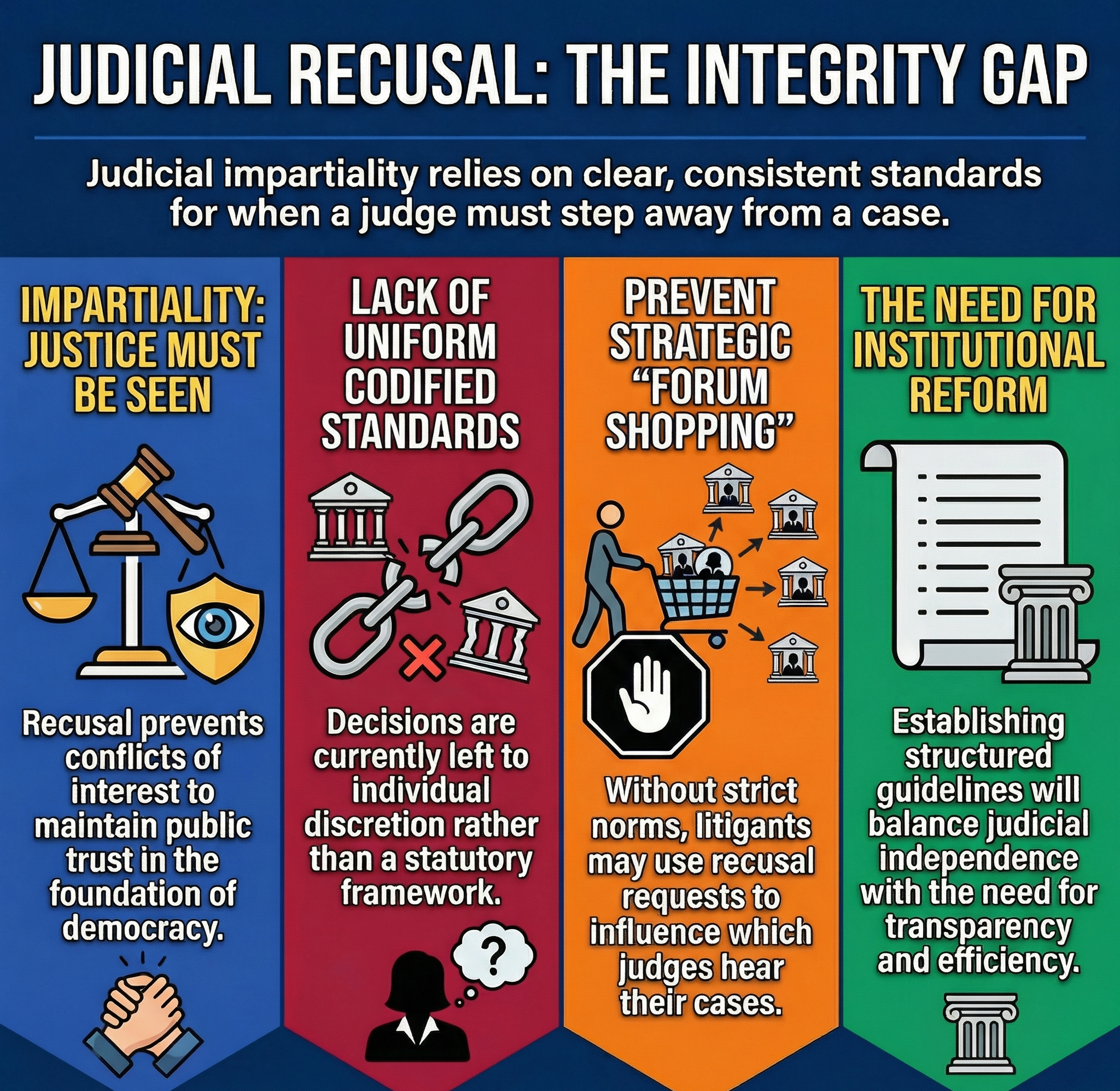
Recusal ensures fairness by preventing conflict of interest.
It upholds the principle that justice must not only be done but must be seen to be done.
B. Lack of Codified Standards
India lacks a uniform statutory framework on recusal.
Decisions are often left to individual judges’ discretion, leading to variability.
C. Supreme Court’s Recent Observations
Judiciary acknowledges the need for structured guidelines.
Recent cases highlight ambiguity in applying doctrines like “necessity” and “reasonable apprehension of bias.”
D. Risks of Strategic or Excessive Recusal
Frequent recusals can delay justice and enable forum shopping.
Litigants may attempt to influence bench composition.
E. Transparency vs Judicial Independence
Disclosure of reasons for recusal is debated.
Too much transparency may expose judges to undue pressure; too little may erode trust.
2. Author’s Stance
Balanced but reform-oriented
Advocates institutional clarity
Supports creation of structured guidelines.
Recognises practical constraints
Acknowledges risks of over-regulation and misuse.
3. Biases and Limitations
Judicial-centric perspective
Focuses on higher judiciary; lower judiciary challenges are not explored.
Limited comparative analysis
Global best practices are not deeply examined.
Normative emphasis
Relies on principles more than empirical evidence.
4. Strengths (Pros)
Addresses a critical institutional issue
Recusal directly impacts judicial credibility.
Balanced treatment of competing concerns
Transparency vs independence, fairness vs efficiency.
Timely relevance
Important amid increasing public scrutiny of judiciary.
5. Weaknesses (Cons)
Limited policy detailing
Does not outline specific framework or criteria.
Underexplored systemic implications
Impact on case backlog and judicial efficiency needs more depth.
Lack of stakeholder perspective
Views of litigants, bar, and civil society are limited.
6. Policy Implications
A. Codification of Recusal Guidelines
Establish clear criteria for recusal
Balancing objectivity with judicial discretion.
B. Transparency Mechanisms
Reasoned disclosure of recusal decisions
Enhancing accountability while protecting independence.
C. Safeguards Against Misuse
Prevent forum shopping and strategic litigation
Strict norms for recusal requests.
D. Institutional Strengthening
Bench allocation reforms and case management systems
Reducing dependency on individual discretion.
E. Judicial Ethics Framework
Strengthening codes of conduct
Regular training and ethical guidelines.
7. Real-World Impact
Judicial Credibility
Clear guidelines enhance public trust
Consistency improves perception of fairness.
Efficiency of Justice Delivery
Reduced delays and ambiguity
Better case management.
Litigation Behaviour
Limits misuse of recusal requests
Discourages strategic manipulation.
Governance
Strengthens rule of law
Predictable judicial processes.
8. UPSC GS Paper Linkages
GS Paper II (Polity & Governance)
- Judiciary and judicial reforms
- Transparency and accountability
GS Paper IV (Ethics)
- Judicial ethics
- Integrity and impartiality
9. Balanced Conclusion
Judicial recusal is essential for maintaining integrity, but its effectiveness depends on clarity and consistency.
The absence of codified norms creates uncertainty, while excessive regulation may compromise judicial independence.
10. Future Perspective
Towards structured judicial ethics
Balancing discretion with clear guidelines.
Enhancing transparency without compromising independence
Careful calibration of disclosure norms.
Strengthening institutional mechanisms
Reducing reliance on individual judgment.
Building public trust in judiciary
Consistency and accountability as key pillars.
Final Insight
In a democracy, judicial impartiality is not just a principle—it is the foundation of public trust, and recusal is one of its most delicate instruments.
