

Why bulldozers threaten due process
The Hindu
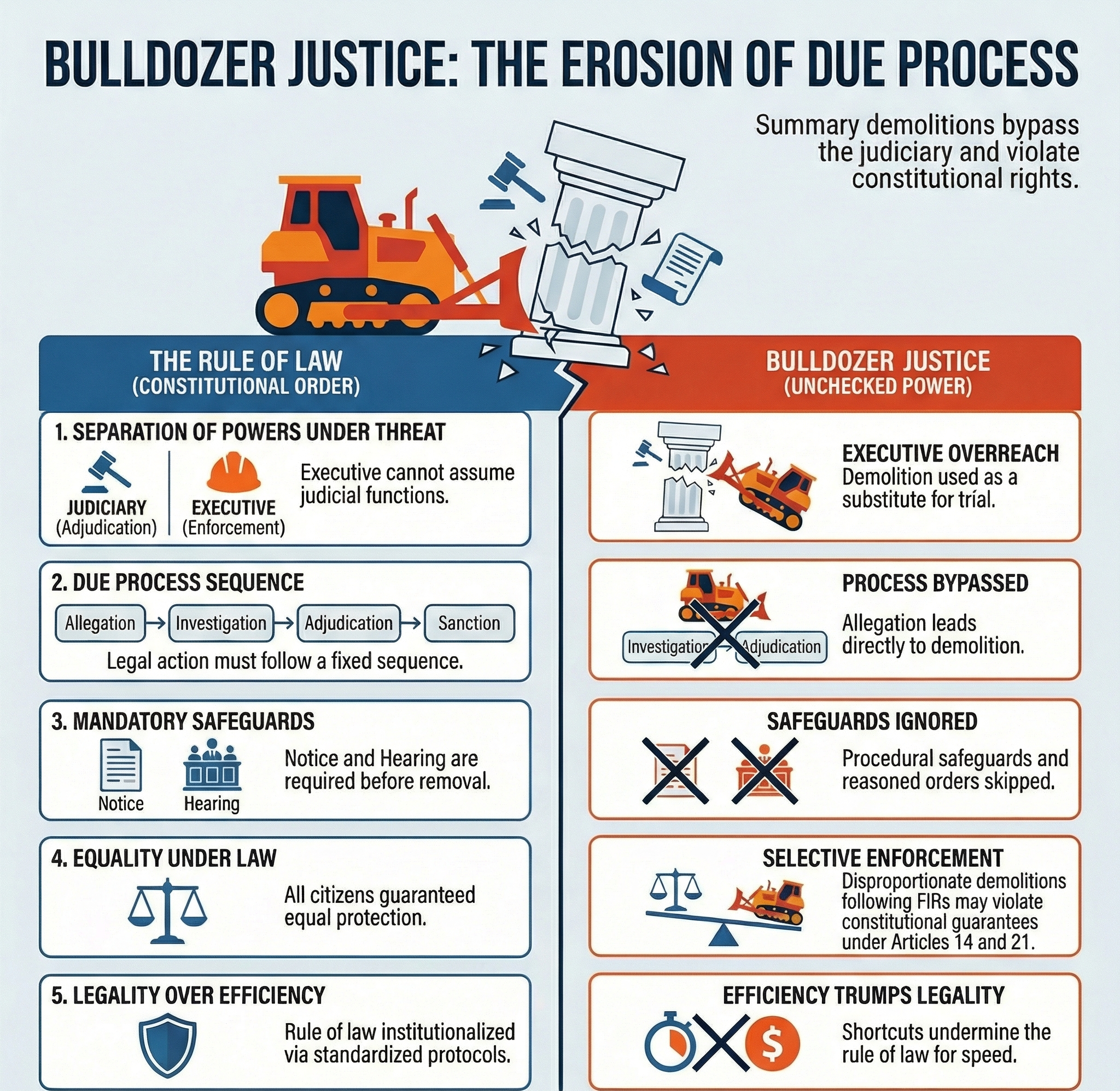
Core Theme of the Article
The article critically examines the growing practice of immediate demolitions—popularly termed “bulldozer justice”—especially after the filing of FIRs. It focuses on the Allahabad High Court’s scrutiny of whether such demolitions violate constitutional guarantees of due process, separation of powers, and equality before law.
The central claim is that punitive demolitions, carried out without notice or hearing, undermine the rule of law and blur the line between executive enforcement and judicial punishment.
Key Arguments Presented
1. Due Process is Non-Negotiable
In a constitutional democracy, coercive state power must follow a defined sequence: allegation, investigation, adjudication, and then sanction. Immediate demolitions invert this order.
2. Punishment Lies with the Judiciary
The article stresses that demolition cannot become a substitute for criminal adjudication. Executive authorities cannot assume judicial functions.
3. Municipal Laws Have Limited Scope
Urban planning statutes permit removal of illegal structures—but only through procedural safeguards such as notice, hearing, and reasoned orders.
4. Selective Demolitions Raise Equality Concerns
If demolitions follow FIRs selectively and disproportionately, they may violate Articles 14 and 21 of the Constitution.
5. Separation of Powers at Risk
Using administrative power as punitive action risks eroding the distinction between executive enforcement and judicial punishment.
Author’s Stance
The stance is clearly constitutionalist and rights-centric.
• Strongly critical of punitive demolitions
• Emphasises procedural fairness over executive expediency
• Anchors the argument in constitutional morality
The tone is analytical rather than polemical but clearly leans against executive overreach.
Possible Biases and Framing
Rights-First Bias
The article prioritises civil liberties and due process, potentially underplaying concerns about illegal encroachments or urban regulation challenges.
Executive Skepticism Bias
Administrative motivations are framed as possibly punitive, though not all enforcement actions may be arbitrary.
However, these biases align with constitutional safeguards rather than partisan ideology.
Strengths of the Article
• Strong grounding in Articles 14 and 21
• Highlights separation of powers
• Connects municipal law with constitutional law
• Emphasises institutional accountability
Limitations
• Limited engagement with law-and-order complexities
• Does not deeply examine procedural timelines in emergency situations
• Could have included comparative jurisprudence
Policy Implications
1. Standardised Demolition Protocols
Clear guidelines ensuring prior notice, hearing, and appeal mechanisms.
2. Judicial Oversight
Mandatory review mechanisms before irreversible actions.
3. Administrative Training
Sensitisation of municipal authorities to constitutional limits.
4. Legal Reform
Clarification of distinction between regulatory demolition and punitive action.
Real-World Impact
Short Term
• Increased judicial scrutiny of demolition drives
• Administrative caution in enforcement
Medium Term
• Institutionalised procedural safeguards
• Possible slowdown in summary enforcement
Long Term
• Strengthening of rule of law
• Greater public confidence in neutral governance
UPSC GS Paper Alignment
GS Paper II – Polity and Governance
• Separation of powers
• Rule of law
• Judicial review
• Articles 14 and 21
GS Paper IV – Ethics
• Constitutional morality
• Accountability in public administration
• Abuse of discretion
Essay Relevance
• “Rule of law vs rule by law”
• “Balancing state authority and civil liberties”
Balanced Editorial Assessment
The article makes a compelling constitutional argument: even when dealing with illegality, the State must operate within procedural fairness. Efficiency cannot replace legality.
However, governance also requires effective urban regulation. The solution lies not in abandoning enforcement but in ensuring it is non-selective, transparent, and procedurally sound.
Future Perspective
Going forward, the judiciary is likely to:
• Clarify constitutional limits on executive demolition
• Strengthen procedural compliance requirements
• Reinforce separation of powers
The executive, in turn, must institutionalise due process safeguards while maintaining urban governance standards.
Final Editorial Judgment:
Bulldozers may enforce urban law, but they cannot enforce criminal guilt. In a constitutional democracy, punishment must follow adjudication—not precede it.
