

Why India must step on the gas with ethanol
Indian Express
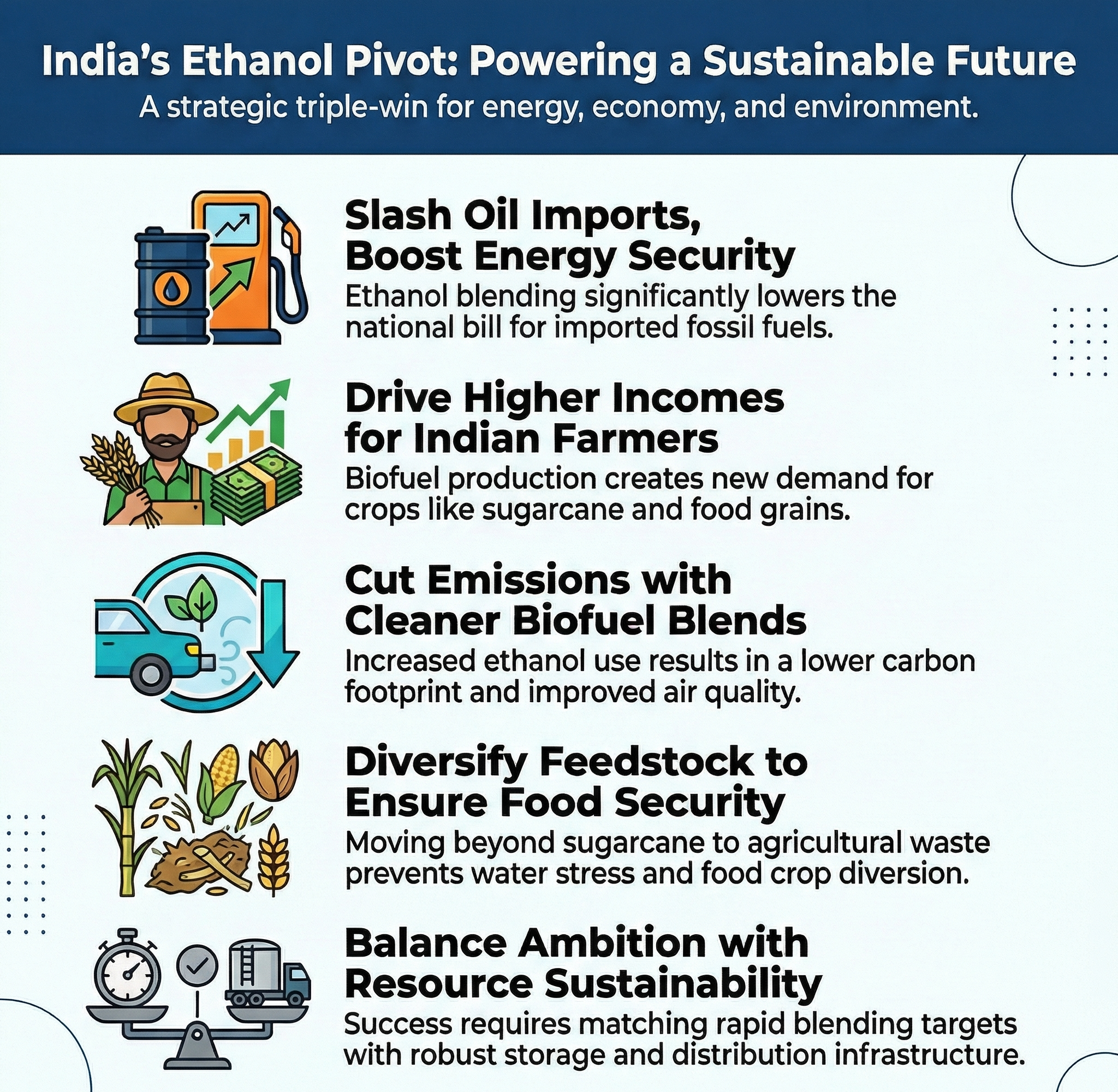
1. Key Arguments
A. Reducing Crude Oil Import Dependence
Ethanol blending lowers reliance on imported fossil fuels.
India’s high oil import bill can be mitigated through domestic biofuel production.
B. Supporting Agricultural Economy
Ethanol production creates demand for crops like sugarcane and grains.
Provides additional income streams for farmers and stabilises agricultural markets.
C. Environmental Benefits
Cleaner fuel reduces emissions.
Ethanol blending contributes to lower carbon footprint and improved air quality.
D. Progress in Ethanol Blending Targets
India has achieved significant milestones in blending percentages.
Policy push has led to rapid increase in ethanol supply.
E. Need for Diversification of Feedstock
Reliance on sugarcane poses sustainability risks.
Encourages use of grains, agricultural residues, and second-generation biofuels.
2. Author’s Stance
Strongly supportive with cautious realism
Pro-policy expansion
Advocates accelerating ethanol blending efforts.
Acknowledges structural constraints
Highlights risks of overdependence on certain crops.
3. Biases and Limitations
Policy optimism bias
Assumes scalability without major implementation challenges.
Limited environmental trade-off analysis
Water usage and land diversion issues need deeper exploration.
Underrepresentation of food security concerns
Diversion of food crops for fuel is not fully examined.
4. Strengths (Pros)
Multi-dimensional benefits highlighted
Energy, agriculture, and environment interconnected.
Data-driven narrative
Uses trends in blending and supply.
Global comparison (Brazil model)
Provides contextual understanding.
5. Weaknesses (Cons)
Insufficient focus on sustainability limits
Water-intensive crops like sugarcane raise ecological concerns.
Limited infrastructure discussion
Storage, transport, and blending capacity challenges are underexplored.
Overemphasis on ethanol as a solution
May overlook alternatives like EVs and hydrogen.
6. Policy Implications
A. Diversified Feedstock Strategy
Promoting second-generation ethanol
Using agricultural waste and non-food biomass.
B. Water and Resource Management
Regulating crop patterns
Avoid excessive sugarcane cultivation in water-stressed regions.
C. Infrastructure Development
Expanding storage, blending, and distribution networks
Ensuring efficient supply chains.
D. Balancing Food and Fuel
Safeguarding food security
Monitoring diversion of food crops.
E. Integrated Energy Policy
Combining ethanol with other clean energy sources
Holistic energy transition strategy.
7. Real-World Impact
Energy Security
Reduced import dependence
Improves trade balance.
Rural Economy
Higher farmer incomes
Diversified revenue sources.
Environmental Impact
Lower emissions but potential ecological stress
Water and land use concerns.
Economic Impact
Investment in biofuel sector
Job creation and industrial growth.
]
8. UPSC GS Paper Linkages
GS Paper III (Economy & Environment)
- Energy security
- Biofuels policy
- Sustainable agriculture
GS Paper II (Governance)
- Policy implementation
- Agricultural and energy policies
GS Paper I (Geography)
- Resource distribution
- Agriculture patterns
9. Balanced Conclusion
Ethanol blending is a promising but not standalone solution to India’s energy challenges.
While it offers economic and environmental benefits, sustainability and resource constraints must be carefully managed.
10. Future Perspective
Towards diversified biofuel ecosystem
Expanding beyond sugarcane-based ethanol.
Sustainable resource use
Balancing water, land, and energy needs.
Technological innovation
Advancing second-generation biofuels.
Integrated energy transition
Combining ethanol with renewables and EVs.
Final Insight
India’s ethanol push must balance ambition with sustainability—turning a strategic opportunity into a long-term solution.
