

Women in the Job Market: District-Level PLFS Data

Women in the Job Market: District-Level PLFS Data
GS Paper: GS-I (Role of Women, Women's Issues) | GS-II (Welfare Schemes) | GS-III (Employment) |
Source: TOI
Why in News?
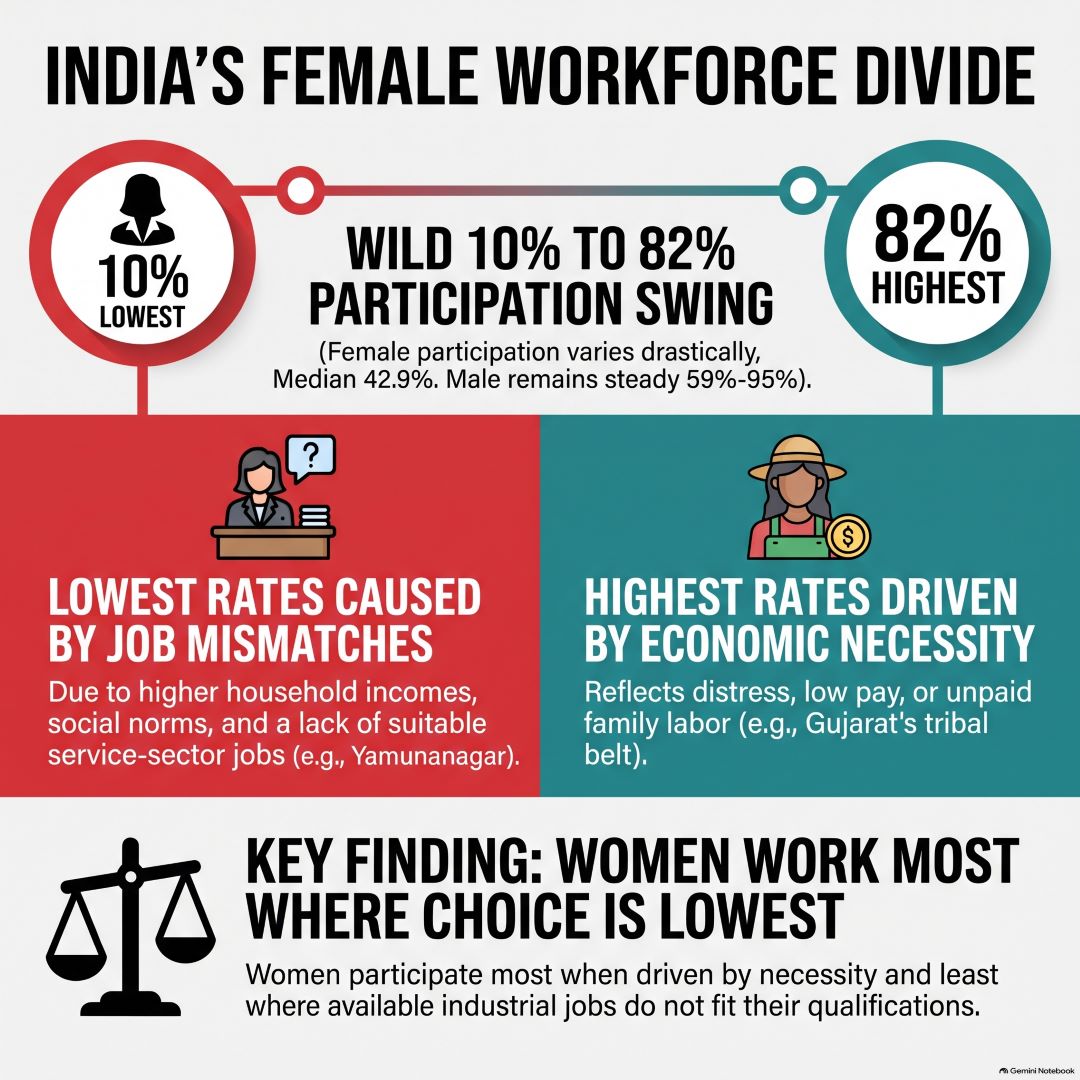
The first district-level Periodic Labour Force Survey (PLFS), released in September, reveals a huge gap in the Female Labour Force Participation Rate (LFPR) across districts: from about 82% in Gujarat's tribal belt to 10% in Yamunanagar, Haryana.
Key Findings
• Highest female LFPR (15+): Dahod-Narmada-Dang-Tapi-Chhota Udepur-Mahisagar (Gujarat) at 82.1%; Hamirpur (Himachal) 80.9%; Nabarangapur (Odisha) 80.4%.
• Lowest: Yamunanagar (Haryana) 10.0%; Darbhanga (Bihar) 12.6%; Ghaziabad (UP) 13.9%.
• Men: participation stays between 59% and 95% in every district (median 79.2%). Women: swings from 10% to 82% (median 42.9%).
Why Do Women Work More in Some Places?
• Gujarat's tribal belt (82.1%; rural 86.5%): distress and necessity. Households need two earners; men migrate; farms and livestock need family labour; self-help groups (SHGs) produce soaps and bamboo goods; tourism around the Statue of Unity created jobs such as e-rickshaw drivers. But participation does not equal secure work, and much of it is unpaid or low paid.
• Unpaid work on a family farm or business counts as work in PLFS; housework does not.
Why Do Women Stay Out in Some Places?
• Yamunanagar (10%): factories (plywood, paper, sugar) need physically demanding or skilled work, which local women are not prepared for. Educated women (two-thirds of college students) prefer government, education and service jobs, which are scarce. Higher household income ("my husband earns well") and social norms discourage women from working.
• Migrants fill factory jobs (e.g., brick kilns).
Analysis and Way Forward
• The data shows women work most where they have the least choice and least where available jobs do not fit their lives (the TOI headline). Quality of employment matters as much as quantity.
• Measures: skill development linked to local industry, safe transport, childcare, flexible and service-sector jobs, SHG linkages, and women-friendly workplaces.