

Women's Labour Force Participation and the Data on Unpaid Care Work

Women's Labour Force Participation and the Data on Unpaid Care Work
Source: The Indian Express
Why in news?
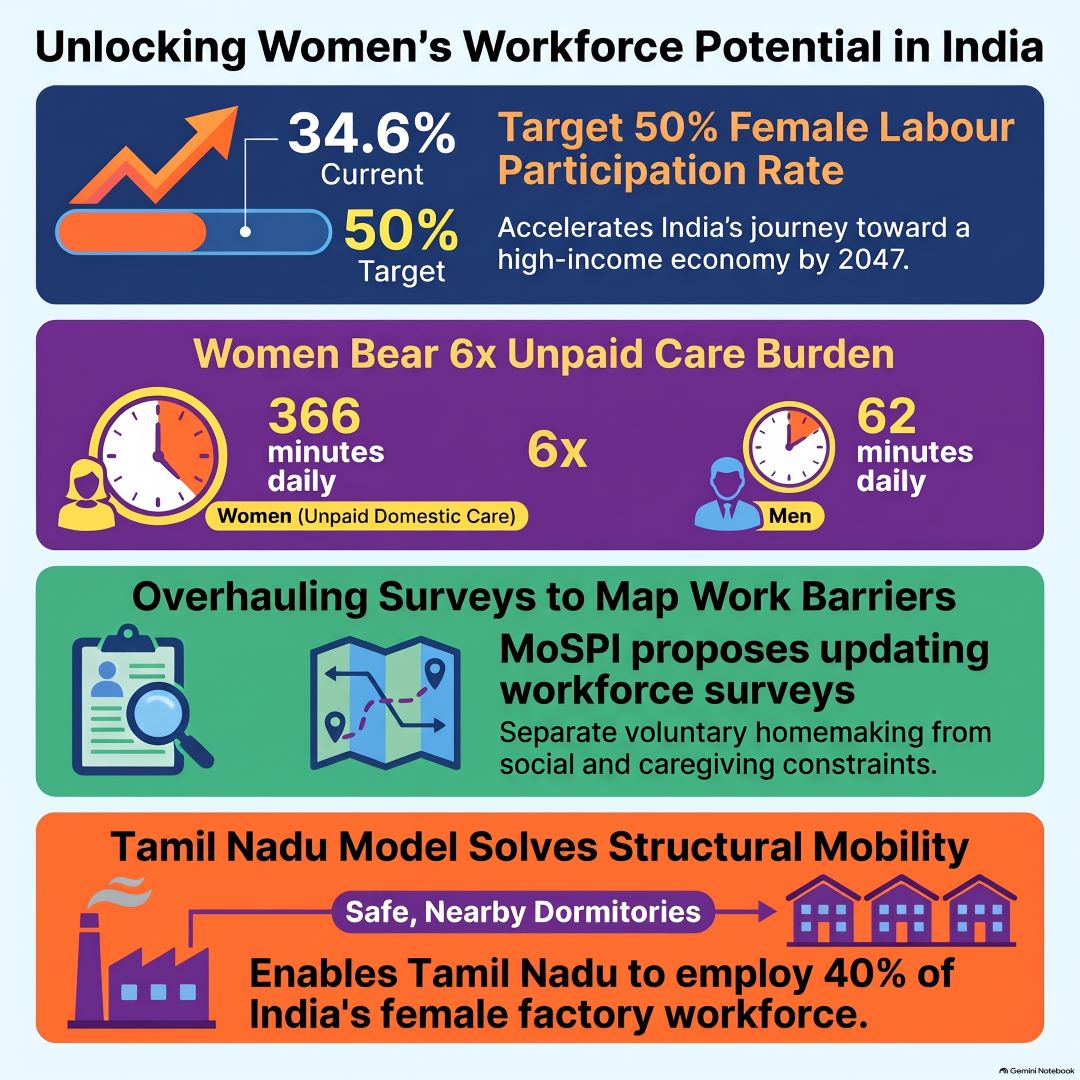
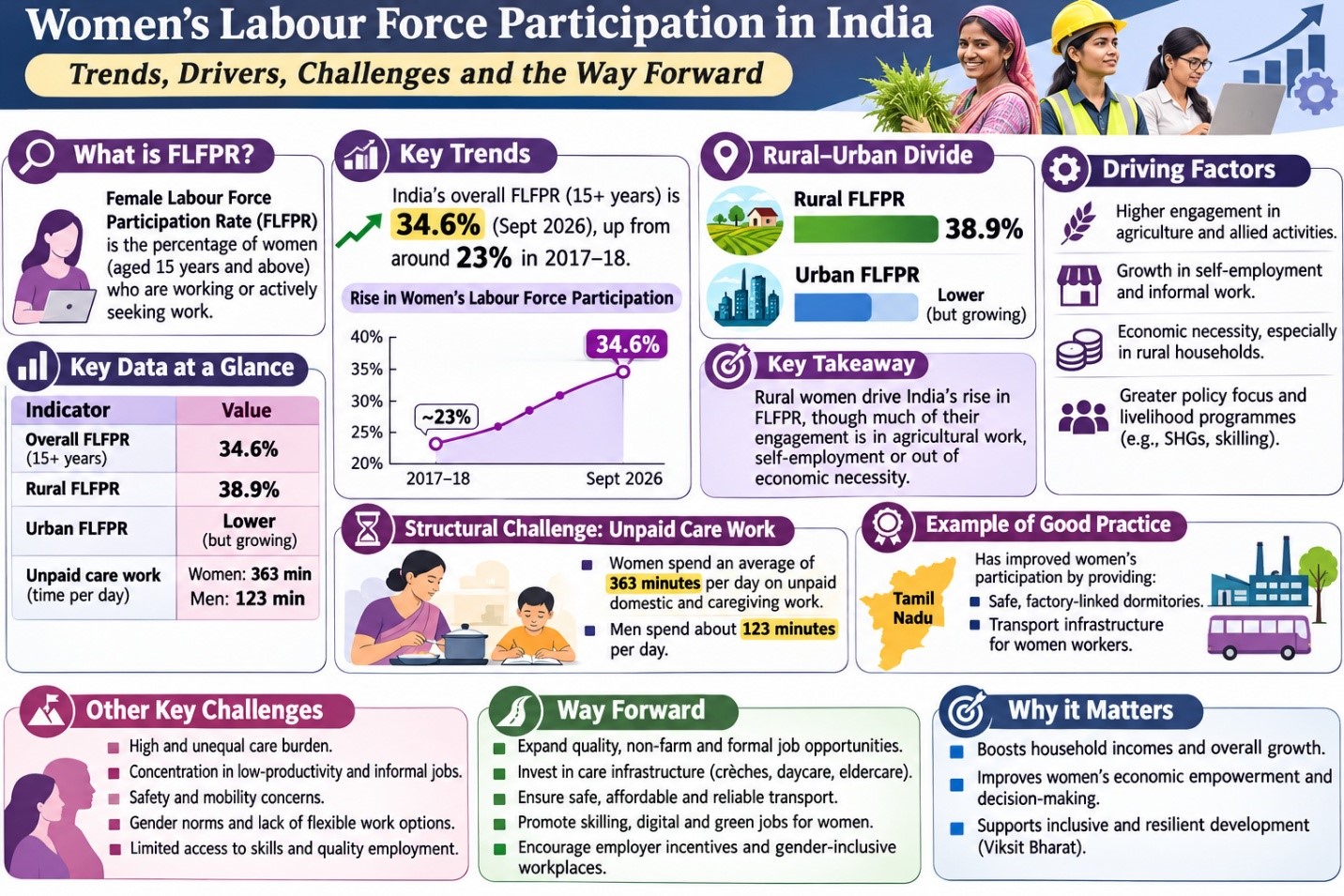
Achieving Viksit Bharat by 2047 needs growth closer to 8% and more women in the workforce. The World Bank says raising the Female Labour Force Participation Rate (FLFPR) to 50%, from 34.6% in September 2026, could speed India's progress to a high-income economy. But poor data on unpaid domestic and care work makes it hard to know why women stay out of paid work, so MoSPI has proposed changes to two major surveys.
Static background
- Labour force participation rate (LFPR): The share of the population in the labour force, that is, either working or seeking work.
- Periodic Labour Force Survey (PLFS): India's main employment survey, run by the National Statistical Office (NSO) under MoSPI since 2017.
- Time Use Survey: Measures how people spend their time, including unpaid work. The first national one was in 2019 and the second in 2024.
- Annual Survey of Unincorporated Sector Enterprises (ASUSE): Covers small, non-corporate and informal businesses.
- Unpaid care work is part of SDG 5.4, which seeks to recognise and value it.
- Maternity Benefit (Amendment) Act, 2017: Paid maternity leave of 26 weeks, and a crèche facility in establishments with 50 or more employees.
Gender gap in workforce participation
- Women's paid work depends on unpaid domestic work, childcare, eldercare, mobility restrictions and workplace accessibility.
- Experts caution against assuming care duties directly cause women to leave work without empirical evidence. The government is therefore trying to improve its statistics on the link between unpaid care and employment choices.
Proposed change to PLFS
The changes aim to capture the nature and extent of unpaid household work. They would:
- Identify whether household-produced goods and services, such as cooking, feeding children and caring for the elderly, are for self-consumption or commercial purposes.
- Ask whether people actively sought paid work in the previous 30 days, and whether they currently wish to do paid work.
- Record the main reasons for not seeking work, including family and household responsibilities.
The existing gap: PLFS already asks why people outside the workforce are not seeking jobs, but its categories, such as childcare and personal commitments in homemaking, are too generic. In 2025, 44.4% of women gave childcare or personal commitments in homemaking as their main reason. The data cannot separate women who do unpaid work by choice from those who do it because of social expectation or a sense of duty.
Proposed change to ASUSE
MoSPI proposes asking women business owners about barriers to entrepreneurship, especially limited time, restrictions on mobility outside the home, and household and caregiving duties. This could identify gender-specific barriers in the informal and entrepreneurial sectors.
Unpaid care work: the gendered burden
- Time Use Surveys (2019 and 2024): Working-age men (15-59) spent 62 minutes a day on unpaid activities in 2024, down from 74 in 2019. Women in the same age group spent 366 minutes in 2024, up slightly from 364 in 2019.
- Women spend nearly six times as much time as men on unpaid activities, and men's unpaid work fell while women's stayed almost the same.
- Even so, female LFPR rose from about 26.5% to 43.6% over the same period. The figures are on different bases from the World Bank's 34.6%, so check the basis before quoting.
- This suggests the need to study how women balance paid work with unpaid duties, rather than assuming care work automatically prevents participation.
Why better data matters?
- Better measurement: The size and distribution of unpaid domestic and care work.
- Regional analysis: Differences between rural and urban areas and across States.
- Demographic insights: Differences between younger and older women.
- Preferences: Whether women outside the workforce actually want paid work.
- Policy targeting: Telling apart lack of jobs, social restrictions and caregiving duties.
- A caution: Reliability depends on honest answers. MoSPI officials think people generally report their work accurately, though expectations of government benefits may sometimes affect answers.
Structural barriers: the Tamil Nadu model
- Care duties are only part of the problem. Women's work also depends on suitable wages, nearby workplaces, safe transport and suitable housing.
- Tamil Nadu employs four of every ten directly employed female factory workers in India. It has adopted parts of the Chinese manufacturing model by providing dormitories for women workers near factories or inside industrial campuses.
- The model cuts commuting distances and mobility constraints, offers safer accommodation, helps employ migrant women and supports manufacturing growth as several southern States age.
- Returning to work needs several conditions together: adequate pay, accessible workplaces, safe transport, and childcare and eldercare support.
Conclusion
Viksit Bharat needs more than higher participation numbers; it needs removal of the structural barriers that limit women's economic choices. Better data on unpaid care work can turn women's participation into a major driver of inclusive and sustainable growth.