

Women’s Leadership Gap: A Barrier to Inclusive Development

Source: The Hindu
Global Gender Representation Gap
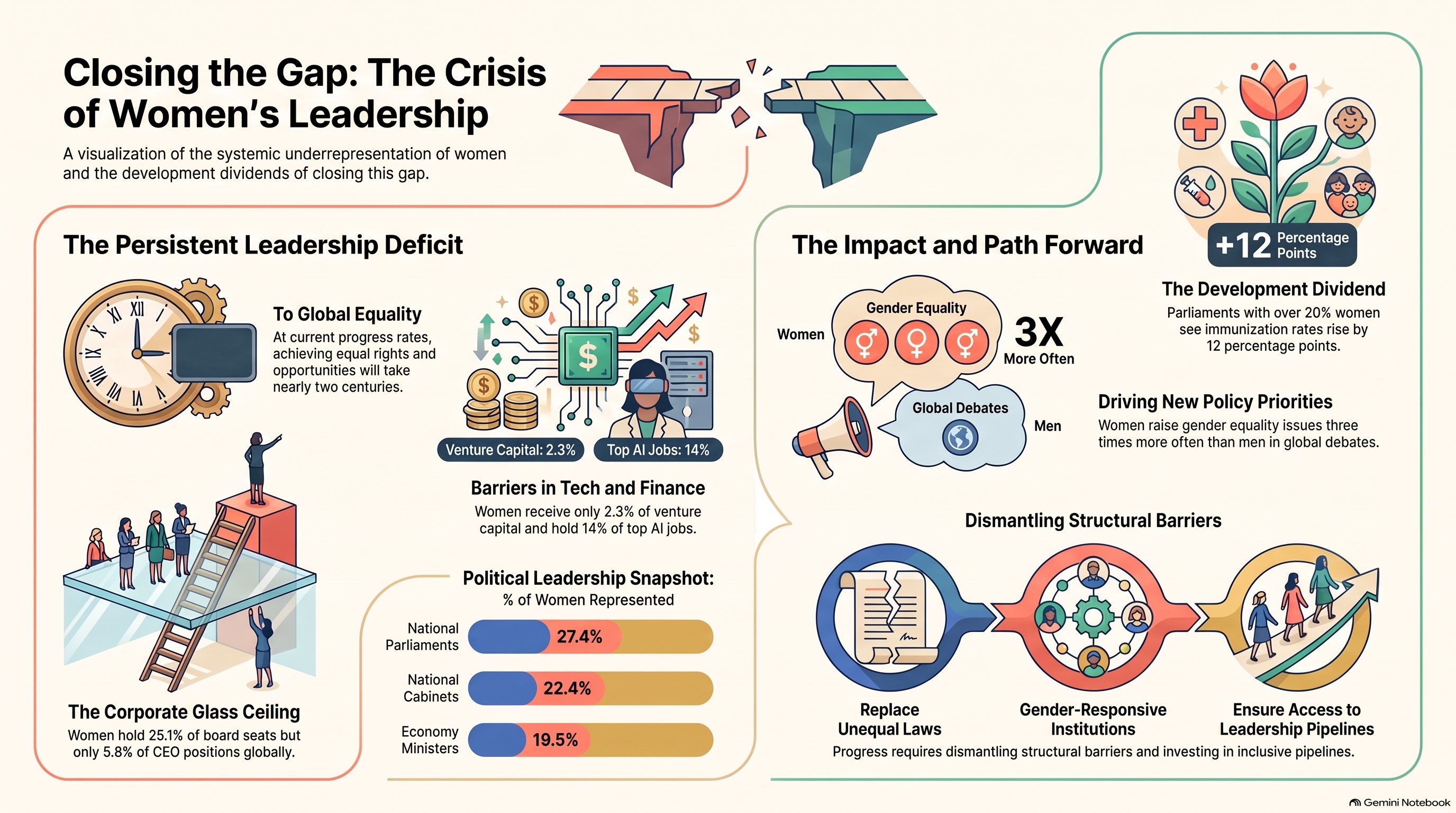
- UN Women’s Gender Snapshot 2026 highlights a persistent global deficit in women’s representation across political, judicial, corporate and technological institutions.
- At the current pace, gender parity in national parliaments could take another 63 years.
- Equal rights and opportunities for women may take around 171 years at the present rate of progress.
- Women currently occupy only 27.4% of parliamentary seats globally.
- Women’s representation in national Cabinets declined to 22.4% in 2026 from a peak of 23.3% in 2024, highlighting the fragile nature of progress.
- Women remain underrepresented in key decision-making portfolios:
- Economy ministers: 19.5%.
- Health ministers: 26.3%.
- Among 175 chief justices globally, only 31 are women.
Leadership Gap Across Economy and Technology
- The representation deficit extends beyond political institutions to corporate leadership and access to capital.
- Women occupy 25.1% of corporate board seats, but only 5.8% of CEOs in publicly traded companies are women.
- Female-only founding teams received only 2.3% of global venture-capital funding in 2024.
- Between 2020 and 2025, companies in 80% of countries paid female managers less per hour than male managers.
- Technology represents another major gap:
- Women constitute only 22% of AI professionals globally.
- Their representation in leading AI jobs falls to around 14%.
- These disparities indicate that women’s underrepresentation persists across the entire leadership pipeline, from access to finance and employment to senior decision-making positions.
Women’s Leadership and Development Outcomes
- The report links greater political representation of women with improved development outcomes in some contexts.
- Countries where women occupy more than 20% of parliamentary seats have recorded:
- Immunisation rates up to 12 percentage points higher.
- Higher survival rates among children beyond early childhood.
- Women raised gender equality issues nearly three times as often as men during the 2025 UN General Assembly General Debate.
- Greater representation can bring issues such as:
- Healthcare and reproductive health.
- Parental leave.
- Care work.
- Unpaid domestic work.
- Social protection.
into greater policy attention. - Thus, women’s leadership is not only a question of representation but also concerns whose priorities and experiences are reflected in public policy.
Structural Barriers to Women’s Leadership
- UN Women attributes the persistent gap to structural factors rather than merely individual choices.
- Key barriers include:
- Unequal laws and institutional structures.
- Gender stereotypes and social norms.
- Unequal access to economic resources and finance.
- Limited opportunities to enter leadership pipelines.
- Gender-based disparities in professional advancement.
- Underrepresentation in key portfolios such as finance, defence, technology and justice can limit women’s influence over areas that shape long-term development and national priorities.
- The persistence of gaps across politics, corporate leadership, justice and technology indicates that achieving numerical representation alone is insufficient without institutional and social change.
Way Forward
- Strengthen gender-responsive laws and institutions to remove structural barriers to leadership.
- Improve women’s access to political participation, education, professional opportunities and leadership positions.
- Increase access to finance and venture capital for women entrepreneurs and founders.
- Promote women’s participation in STEM, AI and other emerging technology sectors.
- Strengthen measures addressing workplace discrimination and gender-based pay gaps.
- Create institutional mechanisms that support women’s progression from entry-level participation to senior decision-making roles.
- Greater representation should be accompanied by meaningful participation in important portfolios and decision-making processes.
- Closing the leadership gap is therefore closely linked with achieving the Sustainable Development Goals and ensuring more inclusive development.
